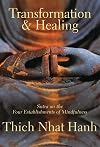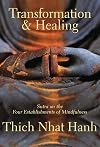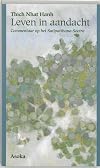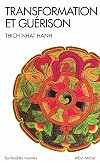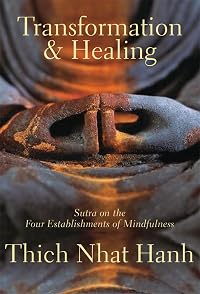
Transformation and Healing : The Sutra on the Four Establishments of Mindfulness
by Thich Nhat Hanh
On This Page
Description
The Sutra has been studied, practiced, and handed down with special care from generation to generation for 2,500 years. In these commentaries, Thich Nhat Hanh guides the reader to an understanding of the fundamental basis of the Buddhist practice and encourages application in daily life. The book describes the four methods of mindfulness: mindfulness of the body, the feelings, the mind, and the object of mind. It teaches how to deal with anger and jealousy; to nurture the best qualities in show more our children, spouse, and friends; and to greet death with compassion and equanimity. Three versions show lessTags
Recommendations







Member Reviews
I read this faster than I really should have. This is more a book about spiritual practice and I read through much of it today. Obviously, I should have approached it with a greater patience--and oh, there's some irony there--but I needed to get it back to the library before heading out of town.
One part that struck me, though, was when Hanh talked about how neutral feelings and sensations can become pleasurable sensations when given the proper consideration. I'll quote:
"If we don't know how to deal with or manage our neutral feeling, it will turn into an unpleasant feeling. . . . Every neutral feeling, when held in mindfulness, will become a pleasant feeling."
He gives the example of having the unpleasant feeling of a toothache, and that show more the absence of that unpleasant feeling, when following soon after the presence of it, becomes a pleasant sensation. But that absence of feeling, far removed from your last toothache, will simply be a neutral feeling.
This isn't an earth shattering concept, but it is one that's often hard to remember. Neutral can be positive or it can be negative, depending on how you approach it. Good to keep in mind. show less
One part that struck me, though, was when Hanh talked about how neutral feelings and sensations can become pleasurable sensations when given the proper consideration. I'll quote:
"If we don't know how to deal with or manage our neutral feeling, it will turn into an unpleasant feeling. . . . Every neutral feeling, when held in mindfulness, will become a pleasant feeling."
He gives the example of having the unpleasant feeling of a toothache, and that show more the absence of that unpleasant feeling, when following soon after the presence of it, becomes a pleasant sensation. But that absence of feeling, far removed from your last toothache, will simply be a neutral feeling.
This isn't an earth shattering concept, but it is one that's often hard to remember. Neutral can be positive or it can be negative, depending on how you approach it. Good to keep in mind. show less
I read this faster than I really should have. This is more a book about spiritual practice and I read through much of it today. Obviously, I should have approached it with a greater patience--and oh, there's some irony there--but I needed to get it back to the library before heading out of town.One part that struck me, though, was when Hanh talked about how neutral feelings and sensations can become pleasurable sensations when given the proper consideration. I'll quote:"If we don't know how to deal with or manage our neutral feeling, it will turn into an unpleasant feeling. . . . Every neutral feeling, when held in mindfulness, will become a pleasant feeling."He gives the example of having the unpleasant feeling of a toothache, and that show more the absence of that unpleasant feeling, when following soon after the presence of it, becomes a pleasant sensation. But that absence of feeling, far removed from your last toothache, will simply be a neutral feeling.This isn't an earth shattering concept, but it is one that's often hard to remember. Neutral can be positive or it can be negative, depending on how you approach it. Good to keep in mind. show less
A very important sutra which teaches the practitioner to be firmly grounded in and mindful of her body, feelings, mind, and objects of mind. (Read more to find out what the heck THOSE are!) Thay is a clear and gentle and insightful teacher. Wonderful book.
> TRANSFORMATION ET GUÉRISON, de Thich Nhat Hanh (Albin Michel, 1999). — A travers trois versions commentées du Sutra des Quatre Établissements de l’attention, et avec la simplicité et la profondeur qui caractérisent son enseignement, le maître zen nous invite à considérer concrètement les exigences d’une transformation intérieure, chemin vers une véritable guérison spirituelle. (Spiritualités Vivantes)
> Babelio : https://www.babelio.com/livres/Hanh-Transformation-et-guerison--Le-Sutra-des-qua...
> Bibliographie : https://www.librarything.fr/catalog.php?view=Joop-le-philosophe&author=hanht...
> Voir un extrait : https://books.google.fr/books?id=DUF_BAAAQBAJ&hl=fr&printsec=frontcover&...
> Le livre nous présente show more transformation et guérison. il nous explique comment analyser la vie, comprendre l'origine de nos souffrances et nous donne les clés pour s'en libérer. Les recettes sont simples et remplies de profondeur. Des exercices pratiques sont donnés au fil du livre et de l'explication du sutra. Il n'est pas nécessaire d'être bouddhiste pour comprendre et mettre en pratique. Bonne lecture à tous.
—(Danieljean) show less
> Babelio : https://www.babelio.com/livres/Hanh-Transformation-et-guerison--Le-Sutra-des-qua...
> Bibliographie : https://www.librarything.fr/catalog.php?view=Joop-le-philosophe&author=hanht...
> Voir un extrait : https://books.google.fr/books?id=DUF_BAAAQBAJ&hl=fr&printsec=frontcover&...
> Le livre nous présente show more transformation et guérison. il nous explique comment analyser la vie, comprendre l'origine de nos souffrances et nous donne les clés pour s'en libérer. Les recettes sont simples et remplies de profondeur. Des exercices pratiques sont donnés au fil du livre et de l'explication du sutra. Il n'est pas nécessaire d'être bouddhiste pour comprendre et mettre en pratique. Bonne lecture à tous.
—(Danieljean) show less
Feb 16, 2021 (Edited)French
TRANSFORMACIÓN Y SANACIÓN
El Sutra de los cuatro fundamentos
de la conciencia
(Primera versión)
Satipatthana-sutta (Theravada) del Majhima-nikaya,
número 10
SECCION UNO
Una vez escuché estas palabras del Buddha cuando estaba
viviendo en Kammassadharma, una ciudad mercado del pueblo
kuru. El Buddha se dirigió a los bhikkhus: '¡Oh, bhikkhush.
Y los bhikkhus respondieron: Venerable Señor".
El Buddha dijo:
El Sutra de los cuatro fundamentos
de la conciencia
(Primera versión)
Satipatthana-sutta (Theravada) del Majhima-nikaya,
número 10
SECCION UNO
Una vez escuché estas palabras del Buddha cuando estaba
viviendo en Kammassadharma, una ciudad mercado del pueblo
kuru. El Buddha se dirigió a los bhikkhus: '¡Oh, bhikkhush.
Y los bhikkhus respondieron: Venerable Señor".
El Buddha dijo:
Jun 21, 2018Spanish
Ratings
Members
- Recently Added By
Lists

Books About Non-Abrahamic Religions
98 works; 2 members
Author Information

499+ Works 42,993 Members
Thich Nhat Hanh was born in central Vietnam on October 11, 1926. He entered Tu Hieu Temple as a novice monk at the age of sixteen. During the Vietnam War, he was part of a movement called "engaged Buddhism", which combines traditional practices with nonviolent civil disobedience. For this, he was exiled by both the Communist and non-Communist show more governments and was nominated by Martin Luther King, Jr. for the Nobel Peace Prize in 1967 for his efforts to reconcile North and South Vietnam. He is a teacher, author, poet, and peace activist. He has written over 100 titles on meditation, mindfulness and Engaged Buddhism, as well as poems, children's stories, and commentaries on ancient Buddhist texts. His books include The Heart of the Buddha's Teaching: An Introduction to Buddhism, Peace Is Every Step, The Miracle of Mindfulness, The Art of Power, True Love and Anger, Vietnam: Lotus in a Sea of Fire, and Living Buddha, Living Christ. He founded a retreat in France called Plum Village. (Bowker Author Biography) show less
Series
Belongs to Publisher Series
Common Knowledge
- Canonical title
- Transformation and Healing : The Sutra on the Four Establishments of Mindfulness
- Original publication date
- 1990
Classifications
Statistics
- Members
- 372
- Popularity
- 84,359
- Reviews
- 5
- Rating
- (4.17)
- Languages
- 8 — Dutch, English, French, German, Italian, Japanese, Portuguese, Spanish
- Media
- Paper, Ebook
- ISBNs
- 21
- ASINs
- 4