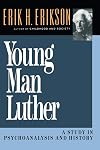
Young Man Luther
by Erik H. Erikson
On This Page
Description
In this classic psychobiography, Erik H. Erikson brings his renowned insights on human development and the identity crisis to bear on the mighty figure of the Protestant Reformation, Martin Luther.Tags
Recommendations

























Member Reviews
Among the most intriguing material in this book is when the author references his insights gathered from anthorpological assessment of Native Americans, such as:
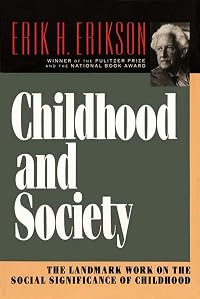
"It is well to remember that the majority of men have never invented the device of beating children into submission. Some of the American Plains Indian tribes were (as I had an opportunity to relate and to discuss twenty years ago Childhood and Society) deeply shocked when they first saw white people beat their children. In their bewilderment they could only explain such behavior as part of an over-all missionary scheme an explanation also supported by the white people's method of letting their babies cry themselves blue in the face. It all must mean, so they thought, a show more well-calculated wish to impress white children with the idea that this world is not a good place to linger in, and that it is better to look to the other world where perfect happiness is to be had at the price of having sacrificed this world. This is an ideological interpretation, and a shrewd one: it interprets a single typical act not on the basis of its being a possible cause of a limited effect, but as part of a world view. And indeed, we now beat our children less, but we are still harrying them through this imperfect world, not so much to get them to the next one as to make them hurry from one good moment to better ones, to climb, improve, advance, progress."
Along with that, I have been avoiding psychoanalytical biographies considering such things as Moses and Monotheism as bordering on hubris. Getting into this work, I had no idea we could know so much in detail about an early 16th Century personage. Luther's annotated writings, early biographies, financial records, first person accounts and other primary sources complete a picture of the life of this important figure largely from his abruptly redirected university career to leading an out of control reactionary reform movement with a fully violent insurgency.
Admittedly, when I came across a phrase like "transfer neurosis" I let my eyes drop down to the next paragraph seeking more details on Luther's life and times. However, with Luther's confessed and documented obsession with diabolical derrieres, his own disordered bowel movements, and a mind or times given to anal metaphors it does appear subjecting his life to Freudian interpretation was bound to happen and I commend the author in his restraint in this direction. show less
"It is well to remember that the majority of men have never invented the device of beating children into submission. Some of the American Plains Indian tribes were (as I had an opportunity to relate and to discuss twenty years ago Childhood and Society) deeply shocked when they first saw white people beat their children. In their bewilderment they could only explain such behavior as part of an over-all missionary scheme an explanation also supported by the white people's method of letting their babies cry themselves blue in the face. It all must mean, so they thought, a show more well-calculated wish to impress white children with the idea that this world is not a good place to linger in, and that it is better to look to the other world where perfect happiness is to be had at the price of having sacrificed this world. This is an ideological interpretation, and a shrewd one: it interprets a single typical act not on the basis of its being a possible cause of a limited effect, but as part of a world view. And indeed, we now beat our children less, but we are still harrying them through this imperfect world, not so much to get them to the next one as to make them hurry from one good moment to better ones, to climb, improve, advance, progress."
Along with that, I have been avoiding psychoanalytical biographies considering such things as Moses and Monotheism as bordering on hubris. Getting into this work, I had no idea we could know so much in detail about an early 16th Century personage. Luther's annotated writings, early biographies, financial records, first person accounts and other primary sources complete a picture of the life of this important figure largely from his abruptly redirected university career to leading an out of control reactionary reform movement with a fully violent insurgency.
Admittedly, when I came across a phrase like "transfer neurosis" I let my eyes drop down to the next paragraph seeking more details on Luther's life and times. However, with Luther's confessed and documented obsession with diabolical derrieres, his own disordered bowel movements, and a mind or times given to anal metaphors it does appear subjecting his life to Freudian interpretation was bound to happen and I commend the author in his restraint in this direction. show less
may have been recommended by Dr Stewart - he did recommend another of Erikson's works which I may have in my Library ...
Ratings
Members
- Recently Added By
Lists

Psicología - Clásicos
165 works; 2 members
Author Information

34+ Works 4,269 Members
Erik H. Erikson, a German-born American psychologist and psychoanalyst, developed theories about the sequence of human development that have had an impact on clinical psychoanalysis, ethics, history, literature, child care, and the emerging interdisciplinary study of the life course. Erikson was an art student, but after undergoing psychoanalysis show more by Anna Freud in Vienna in 1927, he turned to the field of psychology. According to Erikson's life-cycle theory, first published in Childhood and Society (1950), there are eight developmental stages, which are biologically determined but environmentally shaped: infancy, early childhood, play age, school age, adolescence, young adulthood, mature adulthood, and old age. Each of these stages is associated with a particular crisis that the individual must successfully resolve in order to proceed normally to the next stage-for example, identity versus confusion in adolescence. The concept of the identity crisis is now firmly embedded in psychiatric theory. Erikson also studied the relationship between a person's life and the times in which he or she lives; and his historical-biographical studies of Luther and Gandhi are outstanding products of this inquiry. Erikson taught at Harvard University for 30 years (Bowker Author Biography) show less
Awards and Honors
Notable Lists
Series
Belongs to Publisher Series
Floret-boeken (11)
Common Knowledge
- Canonical title*
- De jonge Luther
- Original title
- Young man Luther : a study in psychoanalysis and history
- Original publication date
- 1958
- Important events*
- The Hundred Most Influential Books Since the War
- Original language*
- Engels
*Some information comes from Common Knowledge in other languages. Click "Edit" for more information.
Classifications
- Genres
- Religion & Spirituality, Nonfiction, Biography & Memoir, History, General Nonfiction
- DDC/MDS
- 284.1 — Religion Christian denominations Protestant denominations of Continental origin and related bodies Lutheran Reformed
- LCC
- BR325 .E7 — Philosophy, Psychology and Religion Christianity Christianity History By period Modern period Luther, Martin
- BISAC
Statistics
- Members
- 806
- Popularity
- 34,511
- Reviews
- 2
- Rating
- (3.53)
- Languages
- 5 — Dutch, English, Finnish, German, Hungarian
- Media
- Paper, Ebook
- ISBNs
- 12
- ASINs
- 13