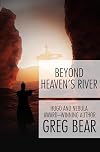
Beyond Heaven's River
by Greg Bear
On This Page
Description
Yoshio Kawashita is a great warrior until aliens whisk him away during World War II. They put him on a desolate planet far from his home, where he is destined to remain forever, leaving him alone in his new hell. Then Anna Nestor appears. This empress does not see planets as homes for their inhabitants; she sees exploitable real estate. Anna Nestor views Kawashita as a sideshow attraction until they fall in love. But the two lovebirds cannot be free until they find out who kidnapped
show more Kawashita and why. Tags
Recommendations
























Member Reviews
This is an early novel for Bear, and experimental, so it deserves a little generosity, but I still was disappointed in some ways, given the setup and premise that, as others have noted, is fascinating. It is unusual and it did keep me reading till the end, but I didn't find myself feeling much when I got there. The last 20 pages especially fell flat for me... but it's an early work and Bear is clearly trying to do something unusual here, so I can't quite pan the novel.
Still, it serves as an object lesson in how times change. I suspect this novel would not get published today, for a few reasons. (But it reminds me of Kim Stanley Robinson's Icehenge, another novel I think probably couldn't get published today by a newcomer, so maybe it's show more a 1980s thing?) show less
Still, it serves as an object lesson in how times change. I suspect this novel would not get published today, for a few reasons. (But it reminds me of Kim Stanley Robinson's Icehenge, another novel I think probably couldn't get published today by a newcomer, so maybe it's show more a 1980s thing?) show less
This is a curious little novel. The premise is an intruiging one but the treatment is unusual - certainly not what one would expect. I think this is what really made it interesting to read - the fact that one really did not know where it was going or what was going to happen. Many readers I'm sure might be bemused by the cosy domesticity of the story, particularly given the way it starts which promises all sorts of mysterious alien involvement, corporate skullduggery and extreme angst on the part of the protagonist, a WW2 Japanese pilot who is plucked from his sinking aircraft carrier and pullled 400 years into the future. None of this early promise is fulfilled, but I found it a gripping read anyway since I was wondering throughout show more exactly where this was all going. I'm not certain i would be anywhere as intrigued during a second read though.
Overall, an unusual little novel that is lacking in the usual fireworks and whiz bang one usual expects from Bear's novels. show less
Overall, an unusual little novel that is lacking in the usual fireworks and whiz bang one usual expects from Bear's novels. show less
I was a little disappointed in this because the premise - WW2 Japanese airman is captured by aliens and is released 400 years later for no apparent reason - promised much but didn't (for me ) deliver. I was expecting more gosh-wowery on the part of the Japanese protagonist at the world of the future and how everything turned out, and instead we got a competent future corporate thriller (as far as I remember - a while since I read it).
I didn't hate this, it was okay, but not amazing. I don't really feel like I understood some of it, and I dislike that feeling. Perhaps a closer reading was necessary, or maybe sloppy writing, not sure which was at fault.
Interesting concept and plot. Characters were a bit shallow.
Ratings
Members
- Recently Added By
Author Information

140+ Works 47,106 Members
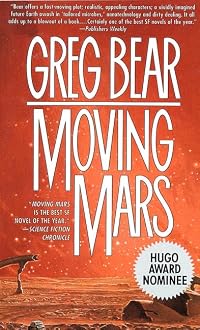
Greg Bear was born in San Diego, California, on August 20, 1951. He received a Bachelor of Arts degree from San Diego State University in 1973. At age 14, he began submitting pieces to magazines and at 15 he sold his first story to Robert Lowndes' Famous Science Fiction. It would be five years before he sold another piece, but by 23 he was selling show more stories regularly. He has written more than 30 science fiction and fantasy books and has won numerous awards for his work. In 1984, Hardfought and Blood Music won the Nebula Awards for best novella and novelette; Blood Music went on to win the Hugo Award. The novel version of that story, also called Blood Music, won the Prix Apollo in France. In 1987, Tangents won the Hugo and Nebula awards for best short story. He also won a Nebula in 1994 for Moving Mars and in 2001 for Darwin's Radio. Both Dinosaur Summer and Darwin's Radio have been awarded the Endeavour for best novel published by a Northwest science fiction author. He is also an illustrator and his work has appeared in Galaxy, Fantasy and Science Fiction, and Vertex, and in both hardcover and paperback books. He was a founding member of ASFA, the Association of Science Fiction Artists. His works include City at the End of Time, Hull Zero Three, The Mongoliad, Mariposa, Halo: Cryptum, Halo: Primordium and Halo: Silentium. (Bowker Author Biography) show less
Some Editions
Common Knowledge
- Original publication date
- 1980
Classifications
Statistics
- Members
- 398
- Popularity
- 77,696
- Reviews
- 5
- Rating
- (2.87)
- Languages
- English
- Media
- Paper, Ebook
- ISBNs
- 14
- ASINs
- 1