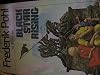
Black Star Rising
by Frederik Pohl
On This Page
Description
A violent ring slipped free of the alien spaceship. It spun on its axis twice, like a coin on a tabletop. Then it rushed toward them. Tsoong Delilah slapped quick fingers on the board, and their rocket bucked and tried to turn away. Thrust forward, she reached out despairingly toward the weaponry board, but there was no time to solve the riddles of the arming and aiming and launching of the missiles, either.Tags
Recommendations
























Member Reviews
I remember when this book came out. I was subscribed to a science fiction book club (that might've even been the name), and this was the book of the month. I was intrigued by the cover and made a mental note to check it out in the future. Decades later, I found it at one of the used book sales I frequent and picked it up.
What a disappointment.
It's easy enough to picture this as an alternate future where the US vs. USSR nuclear war has happened and the economic reforms of Deng Xiaoping have never happened. It's a bit stale, but not far-fetched. The far-fetched stuff comes later, after we meet the aliens. But I won't spoil that for any would-be readers.
The story starts off as satire, devolves to farce, and then falls flat trying to show more deliver some sort of message at the end.
The characters exist to advance the plot. I couldn't really root for any of them. We start with Castor, a man in his early 20s who has stars in his eyes but is pretty thick-headed about women. I felt a little bad for him early on, but that soon faded. There's a Chinese police detective in her 40s named Delilah who becomes Castor's sexual partner. Her constant denial of her feeling is over-the-top. Professor Fung Bohsien, aka Manyface, who has had the brains of dying people added to his in order to save their minds. The end result is a bit like multiple personality disorder. There are some alien characters, but to divulge anything about them would be a spoiler.
Pohl infuses the story with sexism and that attitude about sex that is common for sci-fi writers in the post "free love" era of the late 60s to mid-80s. It's very male fantasy oriented as that's who the target demographic was: teenaged boys and horny oldsci-fi writers men. As a teenager in the 80s, I didn't know any better, but later as an adult, I realized wasn't real at all.
The coolest part of this book is the cover and the title. I should've just stuck with that rather than read it. show less
What a disappointment.
It's easy enough to picture this as an alternate future where the US vs. USSR nuclear war has happened and the economic reforms of Deng Xiaoping have never happened. It's a bit stale, but not far-fetched. The far-fetched stuff comes later, after we meet the aliens. But I won't spoil that for any would-be readers.
The story starts off as satire, devolves to farce, and then falls flat trying to show more deliver some sort of message at the end.
The characters exist to advance the plot. I couldn't really root for any of them. We start with Castor, a man in his early 20s who has stars in his eyes but is pretty thick-headed about women. I felt a little bad for him early on, but that soon faded. There's a Chinese police detective in her 40s named Delilah who becomes Castor's sexual partner. Her constant denial of her feeling is over-the-top. Professor Fung Bohsien, aka Manyface, who has had the brains of dying people added to his in order to save their minds. The end result is a bit like multiple personality disorder. There are some alien characters, but to divulge anything about them would be a spoiler.
Pohl infuses the story with sexism and that attitude about sex that is common for sci-fi writers in the post "free love" era of the late 60s to mid-80s. It's very male fantasy oriented as that's who the target demographic was: teenaged boys and horny old
The coolest part of this book is the cover and the title. I should've just stuck with that rather than read it. show less
I picked this up in a used book store, intrigued by the initial premise and because I very much enjoyed some Pohl that I read years ago (Heechee saga). It starts out with an interesting what if -- what if the US and the USSR blew each other to smithereens, leaving China and India as the great world powers? We start in a rice paddy in Alabama, part of a US administered by the Red Chinese. It's all very interesting, in the way that alternative history is (though when written in 1985 it was actually a speculative future).
Then some aliens show up demanding to speak to the President of the US and the whole thing veers into farcical political satire -- very disappointing.
Then some aliens show up demanding to speak to the President of the US and the whole thing veers into farcical political satire -- very disappointing.
I like the mix of heavy satire and silly comic relief... it makes the themes more palatable. I'm not fond of the fact that we never learn what made the Yankees overwhelmingly Amazonian. I don't appreciate that it took half the book before it seemed worthy of my time... it could have been written more concisely. But overall it's a fun adventure with plenty of interesting things to think about.
The remaining superpowers being China and India, and how the Han Chinese treated the remainin Americans.
Manyface.
The Living Gods & genetic engineering.
How sex & gender affect how we reason... and how we don't.
The FTL device called a spaceway.
etc.
3.5 stars rounded up because when I closed the book I smiled at myself for perservering.
Do I recommend show more it? Eh, only if you happen to find a copy in a cabin or Little Free Library or thrift store, I think. show less
The remaining superpowers being China and India, and how the Han Chinese treated the remainin Americans.
Manyface.
The Living Gods & genetic engineering.
How sex & gender affect how we reason... and how we don't.
The FTL device called a spaceway.
etc.
3.5 stars rounded up because when I closed the book I smiled at myself for perservering.
Do I recommend show more it? Eh, only if you happen to find a copy in a cabin or Little Free Library or thrift store, I think. show less
review of
Frederik Pohl's Black Star Rising
by tENTATIVELY, a cONVENIENCE - February 8, 2014
This was a JOY to read.. or a HOOT.. or something.. Although.., actually, it sortof petered out by the end & was a bit of a disappointment. Still (moving), all in all (n'at), I had fun reading this. It's in the genre of a-culture-not-currently-dominating a-particular-nation becomes THE-culture-dominating a-particular-nation. Other examples of this genre being Philip K. Dick's The Man in the High Castle (1962) (in wch the Japanese have won WWII & are ruling the US), John Brunner's Times Without Number (1962) (in wch the Spanish Armada defeated the British navy in 1588 instead of the other way around) (see my review here: show more target="_top">http://www.goodreads.com/book/show/6343227-times-without-number ), & Harry Harrison's Tunnel Through The Deeps (1972) (in wch George Washington failed in the rebellion he led against the British Empire) (I'm reading this one now). In Black Star Rising (1985) the US & the USSR have fought a war that's destroyed most of the people in their respective countries & elsewhere & the Chinese & the Indians have stepped into the vacuum. Specifically, the Chinese now control what was the US. Much of the novel revolves around the resultant tension (but it goes much further):
"Castor's annoyance at her sarcasm exceeded his worry at being involved with the Renmin Police. In faultless Mandarin he answered her. "A high police officer will understand these things better than a peasant, I know."" - pp 4-5
Throughout most of this, Pohl has touches that add entertaining detail. Take, eg, Castor's witnessing the occupying Chinese government's remake of the western "High Noon": "So his mood was sulky. But it improved, as he got caught up in the grand old story of the Renmin marshal of a century earlier, fresh from Home, threatened by a gang of anti-Party elements. The marshal, whose part was sung by the famous Feng Wonfred, was all alone against six armed enemies, but aided by the schoolteacher and other cadres, he struggled against the anti-Party rightists and forced them to criticize themselves." (p 10)
& even tho the Chinese occupation wasn't an invasion (have the Chinese ever invaded anyone?) there's still the prejudice that they bring w/ them to give them an invader-like characteristic: "What Castor had mostly studied was space. Everything about space, theory and practice. It was his dream. Because it was only a dream, it was also a curse. He had discovered bitterly early that only an ethnic Han Chinese had any real prospect of receiving space-going training." (p 12)
As is usually the case w/ any reasonably well-written story, main determining elements are revealed slowly - rather than in an obvious chronological order:
"It was always cool under the water and so much cleaner than the land; the currents that fed the Gulf brought no muck, no industrial wastes, no city sewage—no reminders of the terrible wiped-out world of a century ago. Or not very many, anyway. There was always the death-glass." - p 15
"He wondered what the world had been like, in those days just before the United States and the old Soviet Union had thought about the unthinkable and reached the wrong conclusions. Suppose they hadn't? Suppose they had sometime said to each other, "Look here, there's no sense in stinging each other to death like scorpions in a bottle, let's toss these things away and think of something else to do with our hostilities."" - p 16
Most, if not ALL, of my life, I've felt like the outlaw that society tries to constantly force into a mold that I'm completely opposed to. It hardly matters whether that mold is provided by mainstream culture or some 'alternative' 'politically correct' subculture that I may largely agree w/ but still want to maintain independence from. I want to be a free thinker, I don't want fear of retaliation from people who disagree w/ me to determine either the way I publicly function or the way I privately think. Sometimes I imagine 'friends' of mine chafing at the bit to put me in a 're-education' camp. Hence, this passage 'appeals' to me as a dystopic critique:
"For criticism the platform held a single chair, with all the others arranged in arcs before it and below.
"Castor looked at the hot seat as a condemned felon might view the electric chair of old. To sit there was not an honor. To sit there was to be hopelessly and painfully alone. The man or woman sweating in the hot seat matched three hundred pairs of accusing eyes with his own abashed ones, heard three hundred condemning voices with his solitary pair of shamed ears, spoke in self-criticism or (foolishly, vainly) in defense in his own single stammering voice" - p 21
Castor, the main protagonist, 's hero's-journey-of-errors begins when he discovers a severed human head while farming. The victim turns out to be an enemy of the Chinese occupation:
""He was arrested twice while a university student. Both arrests were for counterrevolutionary activities. The first was for participating in a rightist meeting. The second was for defacing the people's property by spray-painting graffiti. He painted such slogans as 'America for Americans' and 'Chinese Go Home' on the walls of his dormitory. Apprentice Feng was expelled from the university after the second arrest and has since been the subject of observation."" - p 39
The differing perspectives on whether the Chinese are invaders or benefactors remind me of the ongoing nightmare of the US occupations of Afghanistan & Iraq:
""You Yanks! How many of you secretly hate us?"
""It is natural to hate one's conquerors," Castor replied boldly, sucking at the pipe.
""But we are not conquerors! We came here to help, when you and the Russians had stung each other to death—and nearly killed the whole world, too! We brought you doctors and teachers! We helped you rebuild your land!"" - p 43
""Except that you are still here," he said at last." - p 44
Even the Renmin police inspector's relatively privileged life isn't free of the disastrous consequences of the US/USSR war: "It took Castor only a moment to realize this, and to realize that Police Inspector Tsoong's home was built on the heaped-up ruins of what had once been some sort of town. From the reek of petroleum in the air he realized another fact. No matter what Tsoong Delilah had jokingly promised, there would be no tandem skin diving for them this time. There had obviously been an oil surge from the rickety old wells a hundred kilometers out on the Gulf, and swimming would be no pleasure." (p 44)
One of the biggest joys of reading this, for me, was the character of "Manyface" who initially appears to have multiple personalities:
""I am looking for—no, I'm not—PLEASE!—for Bama Repub—shut up—lic citizen, Pettyman Castor—aw, he's not there—PLEASE! LET HIM FIN—of Production Team—I want to watch the opera . . ."" - p 54
The name "Manyface" is a clandestine nickname for a high party functionary. His actual name is: "FUNG-HSANG-DIEN-POTTER-SU-ANGORAK-SHUM TSAI - CORELLI - HONG - GWAI Bohsien - Futsui - Kaichung - Alicia - Wonmu - Aglat - Hengdzhou - Mingwo - Anastasio - Ludzhen - Hunmong." (p 56)
However, the explanation for this complexity is a novel one that I don't want to give away here:
""No, not at all. Split personality—or as Professor Fung's colleagues describe it, 'multiple personality disorder,' is a psychological thing. It is trauma, usually from early childhood damage, that in some way causes a retreat from reality. Manyface is very real. So are all his voices."" - p 71
"an ancient named Daniel Patrick Moynihan once said that every society gets invaded by its own barbarians once in each generation—those barbarians it generates itself, the young males from seventeen to twenty-three." (p 148) I like this 'quote'. I tried to look at the Congressional bio for Moynihan online but cdn't connect to it so I went to Wikipedia instead. I found the following tidbit interesting:
"Moynihan was an Assistant Secretary of Labor for policy in the Kennedy Administration and in the early part of the Lyndon Johnson Administration. In that capacity, he did not have operational responsibilities, allowing him to devote all of his time to trying to formulate national policy for what would become the War on Poverty. He had a small staff including Paul Barton, Ellen Broderick, and Ralph Nader (who at 29 years of age, hitchhiked to Washington, D.C., and got a job working for Moynihan in 1963).
"They took inspiration from the book Slavery written by Stanley Elkins. Elkins essentially contended that slavery had made black Americans dependent on the dominant society, and that that dependence still existed a century later. This supported the concept that government must go beyond simply ensuring that members of minority groups have the same rights as the majority but must also "act affirmatively" in order to counter the problem." - http://en.wikipedia.org/wiki/Daniel_Patrick_Moynihan
In keeping w/ my previous comment that "main determining elements are revealed slowly":
"What Jupe had been doing was scouting a new nest site. (The detour to hunt inklings was an afterthought.) With a hundred and thirty-one sisters over the age of eight in their nest, it was time to fission. Everybody wanted a new nest when possible. A new nest meant one of the seniors could become a Mother Sister without waiting for Nancy-R to die. It meant even more that another male could be born, without upsetting the established 170-to-1 ration. It meant most of all that America was alive and well on World, and growing!" - p 153
I'm sure Pohl had fun providing this particular fantasy for his heterosexual male readers: 170 women for every man, all eager to fuck whenever possible.
""Oh, my God," said Miranda, when Jupe had finished explaining to her how the Mother Sister took her own ova, fertilized them in vitro with anonymous sperm from the banks, and implanted them in her "wife."" - p 180
Is that possible now? I recently had a boss who was a lesbian who gave birth to twins thru artificial insemination but I doubt that it also involved using the ova from her lover. Still, it's probably possible (or will be soon).
""Just that they are the other races the erks have helped," Jupe explained. "That's what they do, you remember? The erks have never failed to give aid to the oppressed, in all their history. Of course, it hasn't always worked out the way you'd want it, but still—"" - p 189
A touch of parody of the US as World Cop maybe?
"Ah, Hsang-the-psychologist! For him the Yanks were not merely a puzzle. They were a threat to his most basic beliefs.
"It happened that those beliefs were illicit, but that did not make them less strongly felt. As in most Socialist countries, the Han Chinese had early on repudiated the foul-smelling ravings of that degenerate toady of the bosses, Sigmund Freud. The sexual interpretation of dreams was not merely heretical in China. It was punishable by law." - pp 224-225
WELL, it never occurred to me that psychoanalysis might be banned in China. I find this fascinating. So I did a (very) little searching online for "Chinese law psychoanalysis" (after failing w/ "Sigmund Freud Chinese law") & opened up the 1st thing I found: Anne-Marie Schlösser's Oedipus in China: Can we Export Psychoanalysis? from wch I extract an opening paragraph:
"A night scene in an overfilled third class train carriage with wooden seats and dim lighting, somewhere in China. This is how the novel of Dai Sijie starts, “Mr. Muo’s travelling couch“. Mr. Muo keeps records of his dreams - his own, during his travels through China, and those of his fellow countrymen. He has just completed his training in analysis in France and now, after returning to China, sets out to apply his acquired insights to cope in a country that seems to him, at least in part, grotesquely altered. He is convinced that nobody, not even the “official representatives of law and order“ can escape the truth of psychoanalysis. It is his intention to bring this truth back to his homeland where for a long period of time psychoanalysis was prohibited. His undertaking evolves into something of a ludicrous adventure. And the question arises: is China ready for psychoanalysis? Do we have anything to offer and do Chinese people need it?" - p 4 of a downloaded PDF (This article is no earlier than 2007 b/c there're references from that time.)
&, yes, there's an implied lesson to be learned from Black Star Rising: "For the erks had never found an undivided civilization. There were always differences of opinion or policy or religion or habits of thought . . . and to the erks a difference meant a struggle." (p 248) SO, if there's no such thing as "an undivided civilization" & that's a problem, what's the solution? Of course, one can say that there's no solution b/c there's no problem. One can also say that these divisions are a form of codependency &/or symbiosis (as Pohl implies in one case). But does that help ease the suffering? Alas, no. show less
Frederik Pohl's Black Star Rising
by tENTATIVELY, a cONVENIENCE - February 8, 2014
This was a JOY to read.. or a HOOT.. or something.. Although.., actually, it sortof petered out by the end & was a bit of a disappointment. Still (moving), all in all (n'at), I had fun reading this. It's in the genre of a-culture-not-currently-dominating a-particular-nation becomes THE-culture-dominating a-particular-nation. Other examples of this genre being Philip K. Dick's The Man in the High Castle (1962) (in wch the Japanese have won WWII & are ruling the US), John Brunner's Times Without Number (1962) (in wch the Spanish Armada defeated the British navy in 1588 instead of the other way around) (see my review here: show more target="_top">http://www.goodreads.com/book/show/6343227-times-without-number ), & Harry Harrison's Tunnel Through The Deeps (1972) (in wch George Washington failed in the rebellion he led against the British Empire) (I'm reading this one now). In Black Star Rising (1985) the US & the USSR have fought a war that's destroyed most of the people in their respective countries & elsewhere & the Chinese & the Indians have stepped into the vacuum. Specifically, the Chinese now control what was the US. Much of the novel revolves around the resultant tension (but it goes much further):
"Castor's annoyance at her sarcasm exceeded his worry at being involved with the Renmin Police. In faultless Mandarin he answered her. "A high police officer will understand these things better than a peasant, I know."" - pp 4-5
Throughout most of this, Pohl has touches that add entertaining detail. Take, eg, Castor's witnessing the occupying Chinese government's remake of the western "High Noon": "So his mood was sulky. But it improved, as he got caught up in the grand old story of the Renmin marshal of a century earlier, fresh from Home, threatened by a gang of anti-Party elements. The marshal, whose part was sung by the famous Feng Wonfred, was all alone against six armed enemies, but aided by the schoolteacher and other cadres, he struggled against the anti-Party rightists and forced them to criticize themselves." (p 10)
& even tho the Chinese occupation wasn't an invasion (have the Chinese ever invaded anyone?) there's still the prejudice that they bring w/ them to give them an invader-like characteristic: "What Castor had mostly studied was space. Everything about space, theory and practice. It was his dream. Because it was only a dream, it was also a curse. He had discovered bitterly early that only an ethnic Han Chinese had any real prospect of receiving space-going training." (p 12)
As is usually the case w/ any reasonably well-written story, main determining elements are revealed slowly - rather than in an obvious chronological order:
"It was always cool under the water and so much cleaner than the land; the currents that fed the Gulf brought no muck, no industrial wastes, no city sewage—no reminders of the terrible wiped-out world of a century ago. Or not very many, anyway. There was always the death-glass." - p 15
"He wondered what the world had been like, in those days just before the United States and the old Soviet Union had thought about the unthinkable and reached the wrong conclusions. Suppose they hadn't? Suppose they had sometime said to each other, "Look here, there's no sense in stinging each other to death like scorpions in a bottle, let's toss these things away and think of something else to do with our hostilities."" - p 16
Most, if not ALL, of my life, I've felt like the outlaw that society tries to constantly force into a mold that I'm completely opposed to. It hardly matters whether that mold is provided by mainstream culture or some 'alternative' 'politically correct' subculture that I may largely agree w/ but still want to maintain independence from. I want to be a free thinker, I don't want fear of retaliation from people who disagree w/ me to determine either the way I publicly function or the way I privately think. Sometimes I imagine 'friends' of mine chafing at the bit to put me in a 're-education' camp. Hence, this passage 'appeals' to me as a dystopic critique:
"For criticism the platform held a single chair, with all the others arranged in arcs before it and below.
"Castor looked at the hot seat as a condemned felon might view the electric chair of old. To sit there was not an honor. To sit there was to be hopelessly and painfully alone. The man or woman sweating in the hot seat matched three hundred pairs of accusing eyes with his own abashed ones, heard three hundred condemning voices with his solitary pair of shamed ears, spoke in self-criticism or (foolishly, vainly) in defense in his own single stammering voice" - p 21
Castor, the main protagonist, 's hero's-journey-of-errors begins when he discovers a severed human head while farming. The victim turns out to be an enemy of the Chinese occupation:
""He was arrested twice while a university student. Both arrests were for counterrevolutionary activities. The first was for participating in a rightist meeting. The second was for defacing the people's property by spray-painting graffiti. He painted such slogans as 'America for Americans' and 'Chinese Go Home' on the walls of his dormitory. Apprentice Feng was expelled from the university after the second arrest and has since been the subject of observation."" - p 39
The differing perspectives on whether the Chinese are invaders or benefactors remind me of the ongoing nightmare of the US occupations of Afghanistan & Iraq:
""You Yanks! How many of you secretly hate us?"
""It is natural to hate one's conquerors," Castor replied boldly, sucking at the pipe.
""But we are not conquerors! We came here to help, when you and the Russians had stung each other to death—and nearly killed the whole world, too! We brought you doctors and teachers! We helped you rebuild your land!"" - p 43
""Except that you are still here," he said at last." - p 44
Even the Renmin police inspector's relatively privileged life isn't free of the disastrous consequences of the US/USSR war: "It took Castor only a moment to realize this, and to realize that Police Inspector Tsoong's home was built on the heaped-up ruins of what had once been some sort of town. From the reek of petroleum in the air he realized another fact. No matter what Tsoong Delilah had jokingly promised, there would be no tandem skin diving for them this time. There had obviously been an oil surge from the rickety old wells a hundred kilometers out on the Gulf, and swimming would be no pleasure." (p 44)
One of the biggest joys of reading this, for me, was the character of "Manyface" who initially appears to have multiple personalities:
""I am looking for—no, I'm not—PLEASE!—for Bama Repub—shut up—lic citizen, Pettyman Castor—aw, he's not there—PLEASE! LET HIM FIN—of Production Team—I want to watch the opera . . ."" - p 54
The name "Manyface" is a clandestine nickname for a high party functionary. His actual name is: "FUNG-HSANG-DIEN-POTTER-SU-ANGORAK-SHUM TSAI - CORELLI - HONG - GWAI Bohsien - Futsui - Kaichung - Alicia - Wonmu - Aglat - Hengdzhou - Mingwo - Anastasio - Ludzhen - Hunmong." (p 56)
However, the explanation for this complexity is a novel one that I don't want to give away here:
""No, not at all. Split personality—or as Professor Fung's colleagues describe it, 'multiple personality disorder,' is a psychological thing. It is trauma, usually from early childhood damage, that in some way causes a retreat from reality. Manyface is very real. So are all his voices."" - p 71
"an ancient named Daniel Patrick Moynihan once said that every society gets invaded by its own barbarians once in each generation—those barbarians it generates itself, the young males from seventeen to twenty-three." (p 148) I like this 'quote'. I tried to look at the Congressional bio for Moynihan online but cdn't connect to it so I went to Wikipedia instead. I found the following tidbit interesting:
"Moynihan was an Assistant Secretary of Labor for policy in the Kennedy Administration and in the early part of the Lyndon Johnson Administration. In that capacity, he did not have operational responsibilities, allowing him to devote all of his time to trying to formulate national policy for what would become the War on Poverty. He had a small staff including Paul Barton, Ellen Broderick, and Ralph Nader (who at 29 years of age, hitchhiked to Washington, D.C., and got a job working for Moynihan in 1963).
"They took inspiration from the book Slavery written by Stanley Elkins. Elkins essentially contended that slavery had made black Americans dependent on the dominant society, and that that dependence still existed a century later. This supported the concept that government must go beyond simply ensuring that members of minority groups have the same rights as the majority but must also "act affirmatively" in order to counter the problem." - http://en.wikipedia.org/wiki/Daniel_Patrick_Moynihan
In keeping w/ my previous comment that "main determining elements are revealed slowly":
"What Jupe had been doing was scouting a new nest site. (The detour to hunt inklings was an afterthought.) With a hundred and thirty-one sisters over the age of eight in their nest, it was time to fission. Everybody wanted a new nest when possible. A new nest meant one of the seniors could become a Mother Sister without waiting for Nancy-R to die. It meant even more that another male could be born, without upsetting the established 170-to-1 ration. It meant most of all that America was alive and well on World, and growing!" - p 153
I'm sure Pohl had fun providing this particular fantasy for his heterosexual male readers: 170 women for every man, all eager to fuck whenever possible.
""Oh, my God," said Miranda, when Jupe had finished explaining to her how the Mother Sister took her own ova, fertilized them in vitro with anonymous sperm from the banks, and implanted them in her "wife."" - p 180
Is that possible now? I recently had a boss who was a lesbian who gave birth to twins thru artificial insemination but I doubt that it also involved using the ova from her lover. Still, it's probably possible (or will be soon).
""Just that they are the other races the erks have helped," Jupe explained. "That's what they do, you remember? The erks have never failed to give aid to the oppressed, in all their history. Of course, it hasn't always worked out the way you'd want it, but still—"" - p 189
A touch of parody of the US as World Cop maybe?
"Ah, Hsang-the-psychologist! For him the Yanks were not merely a puzzle. They were a threat to his most basic beliefs.
"It happened that those beliefs were illicit, but that did not make them less strongly felt. As in most Socialist countries, the Han Chinese had early on repudiated the foul-smelling ravings of that degenerate toady of the bosses, Sigmund Freud. The sexual interpretation of dreams was not merely heretical in China. It was punishable by law." - pp 224-225
WELL, it never occurred to me that psychoanalysis might be banned in China. I find this fascinating. So I did a (very) little searching online for "Chinese law psychoanalysis" (after failing w/ "Sigmund Freud Chinese law") & opened up the 1st thing I found: Anne-Marie Schlösser's Oedipus in China: Can we Export Psychoanalysis? from wch I extract an opening paragraph:
"A night scene in an overfilled third class train carriage with wooden seats and dim lighting, somewhere in China. This is how the novel of Dai Sijie starts, “Mr. Muo’s travelling couch“. Mr. Muo keeps records of his dreams - his own, during his travels through China, and those of his fellow countrymen. He has just completed his training in analysis in France and now, after returning to China, sets out to apply his acquired insights to cope in a country that seems to him, at least in part, grotesquely altered. He is convinced that nobody, not even the “official representatives of law and order“ can escape the truth of psychoanalysis. It is his intention to bring this truth back to his homeland where for a long period of time psychoanalysis was prohibited. His undertaking evolves into something of a ludicrous adventure. And the question arises: is China ready for psychoanalysis? Do we have anything to offer and do Chinese people need it?" - p 4 of a downloaded PDF (This article is no earlier than 2007 b/c there're references from that time.)
&, yes, there's an implied lesson to be learned from Black Star Rising: "For the erks had never found an undivided civilization. There were always differences of opinion or policy or religion or habits of thought . . . and to the erks a difference meant a struggle." (p 248) SO, if there's no such thing as "an undivided civilization" & that's a problem, what's the solution? Of course, one can say that there's no solution b/c there's no problem. One can also say that these divisions are a form of codependency &/or symbiosis (as Pohl implies in one case). But does that help ease the suffering? Alas, no. show less
In a post-apocalyptic world in which the USA and USSR unleashed their nuclear arsenals at one another with devastating effect, Castor is a young man without a future. He is stuck on a Chinese-run grain collective near Biloxi, Mississippi and his entire life is already laid out for him - living, working and dying on the farm. Then, one day, as he's plying his trade in the rice paddy, he finds a severed human head. And his whole life changes.
An odd book. A very quick read with some interesting ideas - adding personalities to a person's being; a race of devoted mercenaries; a colony of space travelers breeding like rabbits, living in nests with a several hundred to 1 female to male ratio... But at the end of the day, just too weird...
An odd book. A very quick read with some interesting ideas - adding personalities to a person's being; a race of devoted mercenaries; a colony of space travelers breeding like rabbits, living in nests with a several hundred to 1 female to male ratio... But at the end of the day, just too weird...
Not up to Pohl's literary standard, but representative of his cynical humor. The sci-fi space tech is window-dressing for social commentary about patriotism, jingoism, stereotypes, and unintended consequences. Nothing particularly memorable in the story, in terms of characters or plot. Vehicle for Pohl's anti-war views? (I don't know anything about his personal twitches.)
Part of the Cold War "if this goes on" trope, of the apocalyptic strain, written only a few years before the Berlin Wall fell. (Red China is still around, and perfectly capable of the role it plays in Pohl's book.)
Did any of our sf writers ever pursue a "what if this doesn't go on?" approach to the Cold War and nuclear stand-off, or foresee the fall of the USSR? show more Certainly none of the paid experts ventured that prediction.
Money Quote, p. 170: "I propose that we consider the possibility that we have underestimated these erks. They are quite comic little creatures, to be sure. But they are not entirely ludicrous."
"Of course they're ludicruss..They're not even human."
"I think that is an incorrect view..They are all too human..Are they silly clowns, so foolish and inept that no one can take them seriously? No. They are too powerful for that. Are they so wicked that anyone would recoil from them? No. To speak of helping the oppressed become free is not wicked...they are not so unlike human beings as one might suspect. The erks are very like certain world powers of a hundred years ago. They have elevated slogans to the point of dogma in doing so, they have lost sight of the principles that made the slogans valid in the first place...they spoke, the one of "freedom" and the other of "equality," so loudly that neither could hear the rightness in what the other said."
*saw this in current events, 2014-03 (Russia & Ukraine crisis)
Russia and China decide to work together and make a deal. Russia gets Europe and China gets the US when the war is over. Then the two remaining big boys on the block live with an uneasy truce… for as long as they can.
NiteOwl on March 3, 2014 at 9:13 AM, HotAir.com "Western nations..." show less
Part of the Cold War "if this goes on" trope, of the apocalyptic strain, written only a few years before the Berlin Wall fell. (Red China is still around, and perfectly capable of the role it plays in Pohl's book.)
Did any of our sf writers ever pursue a "what if this doesn't go on?" approach to the Cold War and nuclear stand-off, or foresee the fall of the USSR? show more Certainly none of the paid experts ventured that prediction.
Money Quote, p. 170: "I propose that we consider the possibility that we have underestimated these erks. They are quite comic little creatures, to be sure. But they are not entirely ludicrous."
"Of course they're ludicruss..They're not even human."
"I think that is an incorrect view..They are all too human..Are they silly clowns, so foolish and inept that no one can take them seriously? No. They are too powerful for that. Are they so wicked that anyone would recoil from them? No. To speak of helping the oppressed become free is not wicked...they are not so unlike human beings as one might suspect. The erks are very like certain world powers of a hundred years ago. They have elevated slogans to the point of dogma in doing so, they have lost sight of the principles that made the slogans valid in the first place...they spoke, the one of "freedom" and the other of "equality," so loudly that neither could hear the rightness in what the other said."
*saw this in current events, 2014-03 (Russia & Ukraine crisis)
Russia and China decide to work together and make a deal. Russia gets Europe and China gets the US when the war is over. Then the two remaining big boys on the block live with an uneasy truce… for as long as they can.
NiteOwl on March 3, 2014 at 9:13 AM, HotAir.com "Western nations..." show less
Pettyman Castor: un operario de la Granja Colectiva del Grano Celeste en el Golfo de México, convertido sin esperarlo ni desearlo en Presidente de unos Estados Unidos dominados por la China Han.
Tsoong Delilah: una inspectora de la Policía Renmin, arrastrada por amor a tomar parte en una increíble aventura interestelar.
Profesor Fung Boshien, Muchascaras: un hombre con once cerebros en su cabeza, en persecución de una verdad inalcanzable.
Feng Miranda: una revolucionaria en busca de la liberación de una Norteamérica oprimida y de venganza por su hermano asesinado.
Júpiter, Jupe: un exiliado de un lejano planeta, un "yanqui" con ansias de devolver la soberanía a su añorada nación.
Los erks: unos antiguos animales de compañía, show more hechos inteligentes por sus dueños desaparecidos hace mucho tiempo, que intentan "ayudar" a otras razas a través de la guerra.
Estos son tan solo algunos de los personajes de una novela fascinante, más allá del tiempo y el espacio... show less
Tsoong Delilah: una inspectora de la Policía Renmin, arrastrada por amor a tomar parte en una increíble aventura interestelar.
Profesor Fung Boshien, Muchascaras: un hombre con once cerebros en su cabeza, en persecución de una verdad inalcanzable.
Feng Miranda: una revolucionaria en busca de la liberación de una Norteamérica oprimida y de venganza por su hermano asesinado.
Júpiter, Jupe: un exiliado de un lejano planeta, un "yanqui" con ansias de devolver la soberanía a su añorada nación.
Los erks: unos antiguos animales de compañía, show more hechos inteligentes por sus dueños desaparecidos hace mucho tiempo, que intentan "ayudar" a otras razas a través de la guerra.
Estos son tan solo algunos de los personajes de una novela fascinante, más allá del tiempo y el espacio... show less
Mar 7, 2023Spanish
Members
- Recently Added By
Author Information

638+ Works 42,751 Members
Frederik Pohl was born in New York City on November 26, 1919. More interested in writing than in school, he dropped out of high school in his senior year and took a job with a publishing company. After serving as a public relations officer in the United States Army from 1943 to 1945, he returned to publishing as copywriter for Popular Science, a show more literary agent for several sci-fi writers, and the editor for the magazines Galaxy and If from 1959 until 1969, with If winning three successive Hugo awards. His first published work, a poem entitled Elegy to a Dead Satellite: Luna, was printed in Amazing Stories magazine in 1937 under the pen name Elton Andrews. His first science fiction novels were published in the mid 1960's, some written in collaboration with other writers, others created alone. During his lifetime, he won over 16 major awards for his writing (much of which was published pseudonymously) including six Hugo Awards and three Nebula Awards. His works include Gateway, which won the Campbell Memorial, Hugo, Locus SF, and Nebula Awards, Beyond the Blue Event Horizon, and Jem, which won the National Book Award in 1979. He also embraced blogging in his later years, using his online journal as an ongoing sequel to his autobiography, The Way the Future Was. He died on September 2, 2013 at the age 93. (Bowker Author Biography) show less
Series
Belongs to Publisher Series
J'ai lu (2151)
Etiqueta Futura (18)
Bastei Science Fiction-Abenteuer (23081)
Science Fiction Book Club (01730)
Work Relationships
Is contained in
Has as a commentary on the text
Common Knowledge
- Canonical title
- Black Star Rising
- Original title
- Black Star Rising
- Original publication date
- 1985
- People/Characters
- Castor; Jupiter; Maria
- Important places
- Heavenly Grain Collective Farm
- First words
- Castor was halfway across the paddy, part of the long line of farm workers, when he stepped on the dead man's head.
- Last words
- (Click to show. Warning: May contain spoilers.)Over her shoulder she said, "Why, then we deserve what we get, don't we?"
- Original language*
- Inglés
*Some information comes from Common Knowledge in other languages. Click "Edit" for more information.
Classifications
Statistics
- Members
- 674
- Popularity
- 42,382
- Reviews
- 7
- Rating
- (3.11)
- Languages
- English, French, German, Spanish
- Media
- Paper
- ISBNs
- 11
- ASINs
- 6