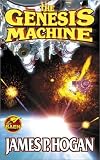
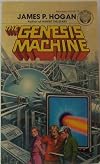
The Genesis Machine
by James P. Hogan
On This Page
Description
In an America becoming repressive in the face of world tensions, Brad Clifford, a young mathematical physicist, had been virtually drafted from academia to work on defense projects. But Brad's true dedication was to bring about the unification of all fields and forces, and his theory was too wild for his superiors to take seriously. So he defied the political authorities and went AWOL to work with a fellow maverick scientist. They built the machine that his theory made possible - but the show more machine made all weapons impotent, and could either wreck the world or save it. And the Powers That Be wanted to control it for their own benefit...... show lessTags
Recommendations
























Member Reviews
Mathematical physicist, Brad Clifford, rebels against a repressive military-industrial government to pursue a unified field theory. Along with a maverick colleague, he builds a groundbreaking machine that can manipulate gravity, annihilate matter, and render all conventional military weapons completely impotent.
Set in the early 21st century, the world is on the brink of a third global war, and scientific research is tightly controlled by paranoid government defense agencies. Basic, exploratory physics is heavily restricted unless it has an immediate military application.
Brad Clifford, working for a repressive government defense establishment, develops a Grand Unified Theory involving hyperspace, k-space, that reconciles quantum show more mechanics with classical physics. When his superiors suppress his findings, he leaves the military sector.
Alongside fellow visionary Aubrey Philipsz, Clifford creates a device that uses these new physics theories. The machine acts as a warp drive for interstellar travel but also wields the terrifying capability to destroy matter or serve as the ultimate, devastating superweapon.
Unsurprisingly, the military attempts to regain control of Clifford and his invention to build a massive doomsday weapon. Clifford must fiercely navigate politics, moral dilemmas, and the government's aggressive tactics.
Instead of creating a mercenary weapon that would only empower one side, Clifford engineers the machine’s full output to achieve the opposite: establish a force field that permanently disables all warheads. His ultimate goal is to force global unification, end the threat of war, and permanently open the galaxy to human exploration. show less
Set in the early 21st century, the world is on the brink of a third global war, and scientific research is tightly controlled by paranoid government defense agencies. Basic, exploratory physics is heavily restricted unless it has an immediate military application.
Brad Clifford, working for a repressive government defense establishment, develops a Grand Unified Theory involving hyperspace, k-space, that reconciles quantum show more mechanics with classical physics. When his superiors suppress his findings, he leaves the military sector.
Alongside fellow visionary Aubrey Philipsz, Clifford creates a device that uses these new physics theories. The machine acts as a warp drive for interstellar travel but also wields the terrifying capability to destroy matter or serve as the ultimate, devastating superweapon.
Unsurprisingly, the military attempts to regain control of Clifford and his invention to build a massive doomsday weapon. Clifford must fiercely navigate politics, moral dilemmas, and the government's aggressive tactics.
Instead of creating a mercenary weapon that would only empower one side, Clifford engineers the machine’s full output to achieve the opposite: establish a force field that permanently disables all warheads. His ultimate goal is to force global unification, end the threat of war, and permanently open the galaxy to human exploration. show less
An SF novel from 1978 set in a future -- well, a version of the mid-2000s -- in which the Cold War never ended and the world is threatened by a perpetual conflict between multiple superpowers. Scientific research is pretty tightly controlled and is supposed to be focused purely on practical military ends, but one scientist, working on the side, comes up with some ground-breaking new basic physics. While he regards it as purely theoretical at first, it turns out to have some powerful and astonishing applications.
This is one of those hard SF novels where science is practically the main character, and scientific discovery is half the plot. In this case, the other half involves attempts to harness that discovery for fighting war or show more enforcing peace. That part manages to be both predictable and far-fetched at the same time, but there is a certain wish-fulfillment appeal in the way it all comes out.
As these things go, it's not too bad. Not if you're really interested in physics and can deal with paper-thin characters and entire chapters that consist of nothing but info-dumping, anyway. In general, I don't have much patience with that sort of thing these days, so I was a little surprised by the fact that this book, while not the world's most gripping read, didn't actually bore me to death. In fact, it was more interesting when it was all about the science and less so when it was about global conflict. Hogan clearly has a good grasp of the field, and the speculative new physics he proposes here is really quite clever, well-thought-out, and plausible-sounding. He also does a pretty good job of depicting the way science really works, as opposed to the laughably inaccurate Hollywood version. There's a bit of the thrill of scientific discovery here, too; there were moments when I found myself catching the implications of something and going, "Ooh, that's kind of cool!" Unfortunately, Hogan's careful research doesn't change the fact that, well, this was written in the 1970s. There's no getting around the fact that his nifty imaginary physics is missing out on 35 years worth of significant scientific developments, something that will be difficult for even the geekiest readers -- or perhaps especially the geekiest readers -- to ignore. show less
This is one of those hard SF novels where science is practically the main character, and scientific discovery is half the plot. In this case, the other half involves attempts to harness that discovery for fighting war or show more enforcing peace. That part manages to be both predictable and far-fetched at the same time, but there is a certain wish-fulfillment appeal in the way it all comes out.
As these things go, it's not too bad. Not if you're really interested in physics and can deal with paper-thin characters and entire chapters that consist of nothing but info-dumping, anyway. In general, I don't have much patience with that sort of thing these days, so I was a little surprised by the fact that this book, while not the world's most gripping read, didn't actually bore me to death. In fact, it was more interesting when it was all about the science and less so when it was about global conflict. Hogan clearly has a good grasp of the field, and the speculative new physics he proposes here is really quite clever, well-thought-out, and plausible-sounding. He also does a pretty good job of depicting the way science really works, as opposed to the laughably inaccurate Hollywood version. There's a bit of the thrill of scientific discovery here, too; there were moments when I found myself catching the implications of something and going, "Ooh, that's kind of cool!" Unfortunately, Hogan's careful research doesn't change the fact that, well, this was written in the 1970s. There's no getting around the fact that his nifty imaginary physics is missing out on 35 years worth of significant scientific developments, something that will be difficult for even the geekiest readers -- or perhaps especially the geekiest readers -- to ignore. show less
A pretty good and engrossing "hard" science fiction book, set a few decades in the future, about what happens when a scientist laboring for the government discovers an entirely new way of looking at space and time which involves a couple of extra dimensions. The author actually does a good and plausible job of explaining this new science (although occasionally my eyes did glaze over). The payoff is when the scientist is blackballed for departing from his research which was leading to better weapons in the standoff against the East, and he and a fellow blackballed scientist are taken in by an independent research group, where their work is finally noticed by the government, which at first attempts to steal the research. When the show more scientist is coerced into developing a superweapon to defeat the East, his solution for bringing peace to a troubled planet while keeping to his own independent ethics is gratifying and satisfying. Imaginative science, pretty good characters with a nice wry humor and friendly intelligence. One of Hogan's better works. show less
I have never read a book so thick with technobabble before. Damned impressive.
Hogan started off writing science fiction with the emphasis on science, and here the science seems better than the fiction.
Dec 17, 2024 (Edited)English (UK)
Ratings
Members
- Recently Added By
Published Reviews
ThingScore 75
Insgesamt gesehen handelt es sich bei Die Schöpfungsmaschine aber um einen spannenden Roman, der besonders in seinen physikalischen Spekulationen zu beeindrucken vermag.
added by rat_in_a_cage
Author Information

78+ Works 11,739 Members
James P. Hogan was born in London on June 27, 1941. He left school at the age of sixteen and eventually began an intensive, broad-based five-year program at the Royal Aircraft Establishment covering the practical and theoretical sides of electrical, electronic, and mechanical engineering. He worked as a design engineer for several companies before show more moving to sales. He started writing science fiction books in the 1970s and became a full-time writer in 1979. He wrote 30 fiction and non-fiction books during his lifetime including Inherit the Stars, Voyage from Yesteryear, and Kicking the Sacred Cow. He won three Seiun-sho awards, which were voted for by Japanese science fiction fans. He died suddenly on July 12, 2010 at the age of 69. (Bowker Author Biography) show less
Some Editions
Awards and Honors
Awards
Series
Belongs to Publisher Series
Moewig Science Fiction (3564)
Common Knowledge
- Canonical title
- The Genesis Machine
- Original title
- The Genesis Machine
- Original publication date
- 1978-04
- People/Characters*
- Brad Clifford; Aubrey Philipsz; Wilbur Thompson; Richard Edwards; Walter Massey; Miles Corrigan (show all 41); Heinrich Zimmermann; Gus Craymer; Martin Borel; Sarah Clifford; Paul Newham; Lisa Clancey; Bernhard Clancey; Sheila Massey; Dennis Senchino; Jarrit; Jonathan Camerdene; Ollie Willie; Mark Simpson; Al Morelli; Peter Hughes; Ron Williams; William S. Forshaw; Harvey Miller; Joseph Kaine; Samuel Hatton; Patrick Cleary; Warren Keele; Harry Sultzinger; Perkoffski; Arwin Dalby; Robert Fuller; Straker; Franz Mueller; Alexander George Sherman; Donald Reyes; Melvin Chambers; Carlohm; Bornos Karenski; Tina Karenski; Maria Karenski
- Important places*
- Sudbury, Massachusetts, USA; Brunnermont
- Dedication
- Every Child is Born a Scientist
This book is dedicated to DEBBIE, JANE, and TINA
the three young scientists who taught me to distinguish reality from illusion by asking always:
"Who says so?"
"Who's... (show all) he?"
"How does he know?" - First words
- The familiar sign that marked the turnoff from the main highway leading toward Albuquerque, some thirty or so miles farther north, read:
ADVANCED COMMUNICATIONS
RESEARCH ESTABLISHMENT
GOVERNMENT PROPERTY
<... (show all)br>ABSOLUTELY NO ADMITTANCE
TO
UNAUTHORIZED PERSONS
SHOW PASSES - 1½ MILES AHEAD - Last words
- (Click to show. Warning: May contain spoilers.)How much of it was true, and how much of it wasn't is something that I don't suppose anyone will ever know for sure now."
- Blurbers
- Asimov, Isaac; Minsky, Marvin
- Original language*
- Englisch
*Some information comes from Common Knowledge in other languages. Click "Edit" for more information.
Classifications
Statistics
- Members
- 536
- Popularity
- 55,980
- Reviews
- 6
- Rating
- (3.70)
- Languages
- English, German
- Media
- Paper
- ISBNs
- 9
- UPCs
- 1
- ASINs
- 5