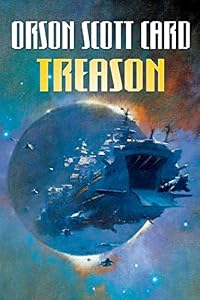
Treason
by Orson Scott Card
On This Page
Description
Lanik Mueller is a "rad"-radical regenerative-a freak who can regenerate injured flesh...and trade extra body parts to the Offworld oppressors for iron. On a planet without hard metals, or the means of escape, iron offers the promise of freedom through the chance to build a spacecraft. But it is a promise which may never be fulfilled, as Lanik uncovers a treacherous conspiracy beyond his imagination. Now charged with a mission of conquest-and exile-Lanik devises a bold and dangerous plan to show more finally break the vicious chain of rivalry and bloodshed that enslaves the people of the planet Treason. show lessTags
Recommendations






Member Reviews
I very much enjoyed the first half of this book. I felt that it set up an interesting situation and characters: Lanik is a young man from a clan which has learned to genetically regenerate themselves, making them undefeatable in battle and virtually immortal. Unfortunately, sometimes the genetic modification goes wrong, and rather than just regenerating lost or damaged limbs, etc, the body keeps growing new parts, requiring surgery, becoming monstrous. Usually, those people are harvested for extra parts - which are sold offworld. But since Lanik was the heir, he is spared that fate - and merely exiled.
So far, so good.
Lanik goes on a quest to discover the secret of why a rival clan is acquiring unprecedented amounts of metal - which show more their planet lacks. What are they selling offworld? He meets a powerful black woman, a leader of her tribe, who causes him to re-evaluate his racial beliefs. She's a wonderful character.
But rather than stopping here, and tying the story together, at this point the book becomes formulaic and overblown.
Lanik travels from tribe to tribe, at each one acquiring some kind of superpower. (Each tribe is descended from one genius scientist who has passed on their secrets and abilities to their descendants - which is a pretty dumb concept in and of itself.) However, Lanik pretty much remains an arrogant bastard with a sense of entitlement. When he discovers he has been deceived, and that there is some sort of plot going on, rather than investigating the motivations and reasons behind the secret plan, he commits genocide against the tribe that the deceivers came from, and without consulting anyone, makes a decision that will affect everyone on the planet.
Card obviously wishes the reader to contemplate the moral decisions that Lanik has made, but I also got the feeling that Card thinks that Lanik was right, that his actions, although unpleasant, were justified by the strength of Lanik's convictions that what he was doing was the right thing for his planet. However, I disagree quite strongly - I do not believe that because someone is stronger, or believes themselves to be more enlightened, that they have the moral right to make major decisions for others. I also do not feel that the deaths of innocents are justified merely because those innocents belong to the same race or tribe as people that you perceive have done you wrong. show less
So far, so good.
Lanik goes on a quest to discover the secret of why a rival clan is acquiring unprecedented amounts of metal - which show more their planet lacks. What are they selling offworld? He meets a powerful black woman, a leader of her tribe, who causes him to re-evaluate his racial beliefs. She's a wonderful character.
But rather than stopping here, and tying the story together, at this point the book becomes formulaic and overblown.
Lanik travels from tribe to tribe, at each one acquiring some kind of superpower. (Each tribe is descended from one genius scientist who has passed on their secrets and abilities to their descendants - which is a pretty dumb concept in and of itself.) However, Lanik pretty much remains an arrogant bastard with a sense of entitlement. When he discovers he has been deceived, and that there is some sort of plot going on, rather than investigating the motivations and reasons behind the secret plan, he commits genocide against the tribe that the deceivers came from, and without consulting anyone, makes a decision that will affect everyone on the planet.
Card obviously wishes the reader to contemplate the moral decisions that Lanik has made, but I also got the feeling that Card thinks that Lanik was right, that his actions, although unpleasant, were justified by the strength of Lanik's convictions that what he was doing was the right thing for his planet. However, I disagree quite strongly - I do not believe that because someone is stronger, or believes themselves to be more enlightened, that they have the moral right to make major decisions for others. I also do not feel that the deaths of innocents are justified merely because those innocents belong to the same race or tribe as people that you perceive have done you wrong. show less
When Card is good he is great (Ender's Game), but his misses are pretty bad (Homecoming Saga). This one is a miss.
Unique world, and enjoyable just for the discovery at first, but the plot felt very forced and the main character wasn't worth much; he keeps getting bailed out in extremely improbable (lucky) ways. And in doing it, he penetrates multiple "impenetrable" groups and gets handed their secrets / gains their superpowers. The first one just happens to be the thing that can fix an incurable genetic disease. I finished the book, but after a certain point I knew what was going to happen and just skimmed along to finish.
Unique world, and enjoyable just for the discovery at first, but the plot felt very forced and the main character wasn't worth much; he keeps getting bailed out in extremely improbable (lucky) ways. And in doing it, he penetrates multiple "impenetrable" groups and gets handed their secrets / gains their superpowers. The first one just happens to be the thing that can fix an incurable genetic disease. I finished the book, but after a certain point I knew what was going to happen and just skimmed along to finish.
I have such a complicated relationship with Card. It's a love the way he tells stories/disappointed in his involvement with the homophobic National Organization for Marriage.
Treason was written before the Ender series, and shows the genesis of many themes and values Card explores in later works. His emphasis on mysticism and supernatural skills which depend on bonding with the Earth baffle me when taken in the context of his later political leanings.
I've struggled with how to approach my relationship with his work, knowing what an awful person he is. The best I've been able to come up with is to purchase on the secondary market so he doesn't get money from me.
Treason was written before the Ender series, and shows the genesis of many themes and values Card explores in later works. His emphasis on mysticism and supernatural skills which depend on bonding with the Earth baffle me when taken in the context of his later political leanings.
I've struggled with how to approach my relationship with his work, knowing what an awful person he is. The best I've been able to come up with is to purchase on the secondary market so he doesn't get money from me.
Lanik Mueller’s birthright as heir to planet Treason’s most powerful rulership will never be realized. He is a “rad”—radical regenerative—a freak who can regenerate injured flesh and trade extra body parts to the Offworld oppressors for iron. On a planet without hard metals, or the means of escape, iron offers the promise of freedom through the chance to build a spacecraft. But it is a promise that may never be fulfilled, as Lanik uncovers a treacherous conspiracy beyond his imagination. Now charged with a mission of conquest—and exile—Lanik devises a bold and dangerous plan to break the vicious chain of rivalry and bloodshed that enslaves the people of Treason as the Offworld never could.
I had only been familiar with the Ender books, and so expected more of the same from "Treason". What I found instead was a treatise on human nature, ethics and potential. The potential of what are essentially shamanic disciplines developed in the face of extreme hardship is intriguing and made the early works of Carlos Castaneda come to mind. Another key theme was the development of societies when isolated from the parent civilization. The result pointed to the necessity of cooperation. Whenever I finish a book and am dismayed that there is no more of the same I consider that the book is very good indeed. I want more of "Treason"
Slow to get started, but once I got into it it was engrossing and very good. It takes place on a very Frank Herbert-ish world, although it's more fantasy than science fiction. There's a lot of stuff you just have to accept, that supposedly has some sort of rational explanation but is effectively magic. And there are a LOT of ideas in this book; themes and ideas from most of his more famous books are all mashed together into one little quest story. I guess he didn't want to hold anything back to save for later. It's also very different from any other Card novels I've read. It's very strange, and even a little edgy (at least for the 70s). If you don't like it, it will at least be memorable.
Really great book. Hard to find fault in anything, but just didn't "feel" like a 5-star read to me. However, a very quality and enjoyable story throughout.
OSC has a way about him creating new worlds. This world didn't immediately appeal to me, but the way he explored the world (as told through the eyes of the main character) was really enjoyable.
Highly recommend.
OSC has a way about him creating new worlds. This world didn't immediately appeal to me, but the way he explored the world (as told through the eyes of the main character) was really enjoyable.
Highly recommend.
Members
- Recently Added By
Lists

Space Colonization
100 works; 26 members
Talk Discussions
Past Discussions
Colonial science fiction adventure with transformation in Name that Book (September 2011)
Author Information

575+ Works 213,502 Members
Orson Scott Byron Walley Card, was born in 1951 and studied theater at Brigham Young University. He received his B.A. in 1975 and his M.A. in English in 1981. He wrote plays during that time, including Stone Tables (1973) and the musical, Father, Mother, Mother and Mom (1974). A Mormon, Scott served a two-year mission in Brazil before starting show more work as a journalist in Utah. He also designed games at Lucas Film Games, 1989-92. He is best known for his science fiction novels, including the popular Ender series. Well known titles include A Planet Called Treason (1979), Treasure Box (1996), and Heartfire (1998). He has also written the guide called How to Write Science Fiction and Fantasy (1990). His novel Ender's Game and its sequel Speaker for the Dead, both won Hugo and Nebula awards, making Card the only author to win both prizes in consecutive years. His titles Shadows in Flight, Ruins and Ender's Game made The New York Times Best Seller List. He is also the author of The First Formic War Series, which includes the titles Earth Unaware, Earth Afire, and Earth Awakens. (Bowker Author Biography) show less
Some Editions
Series
Belongs to Publisher Series
Work Relationships
Is an expanded version of
Common Knowledge
- Canonical title
- Treason
- Original title
- Treason
- Original publication date
- 1988
- People/Characters
- Lanik Mueller; Ensel Mueller; Dinte Mueller; Helmut Scwartz; Mwabao Mawa; Saranna Mueller (show all 13); Barton Britton; Glain Britton; Percy Barton Britton; Ruva Mueller; Vran Britton; Man-Who-Fell-on-His-Ass; Man-Who-Knows-it-All
- Important places
- Treason (planet); Mueller; Nkumai; Ku Kuei; Schwartz
- Dedication
- To
My brother Bill, who lent me Catseye;
MaryJo, who led me to Bradbury's Body Electric;
Laura Dene, who put Asimov's Foundation in my hands;
Dale and Maria, who made me read the
Ch... (show all)ronicles of Narnia;
and the libraries in
Santa Clara, California, and Mesa, Arizona,
who made it possible for me to find
Poul Anderson's "Call Me Joe"
and Lloyd Biggle's "Tunesmith,"
Andre Norton's Galactic Derelict
and Robert Heinlein's Tunnel in the Sky:
You set me to dreaming.
I hope I don't wake up. - First words
- I was the last one to know what was happening to me.
- Last words
- (Click to show. Warning: May contain spoilers.)Here among the shepherds, my cup is filled with the water of life; it overflows.
- Original language
- English
- Disambiguation notice
- Do NOT combine with "A Planet Called Treason" -- this book is a reworking of that earlier work, and roughly 10% of it is new material.
Classifications
Statistics
- Members
- 1,374
- Popularity
- 17,234
- Reviews
- 22
- Rating
- (3.81)
- Languages
- 5 — Dutch, English, French, German, Spanish
- Media
- Paper, Audiobook, Ebook
- ISBNs
- 19
- ASINs
- 7