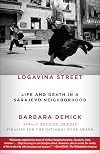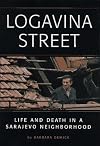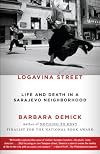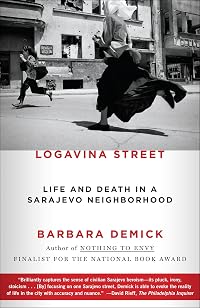
Logavina Street: Life and Death in a Sarajevo Neighborhood
by Barbara Demick
On This Page
Description
Logavina Street was a microcosm of Sarajevo, a six-block-long history lesson. For four centuries, it existed as a quiet residential area in a charming city long known for its ethnic and religious tolerance. On this street of 240 families, Muslims and Christians, Serbs and Croats lived easily together, unified by their common identity as Sarajevans. Then the war tore it all apart. As she did in her groundbreaking work about North Korea, Nothing to Envy, award-winning journalist Barbara Demick show more tells the story of the Bosnian War and the brutal and devastating three-and-a-half-year siege of Sarajevo through the lives of ordinary citizens, who struggle with hunger, poverty, sniper fire, and shellings. Logavina Street paints this misunderstood war and its effects in vivid strokes--at once epic and intimate--revealing the heroism, sorrow, resilience, and uncommon faith of its people. show lessTags
Recommendations


















Member Reviews
“I knew the street I wanted to write about the first time I walked up it. Even battered by war, it was a beautiful street…”
Logavina Street is a marvel. A hard-hitting, unflinching look at the two years Demick spent on this “six-block long history lesson”. She followed along with several families, in this Sarajevo neighborhood, as they led their daily lives, under a terrifying siege. Sniper fire and mortar-attacks came in a flash, leaving carnage and destruction. Dealing with food shortages, lack of electricity and water. Burning anything they could find, to keep warm. Despite this bleak and forbidding existence, the spirit and determination of these people is triumphant.
This is also the best book on the Bosnian conflict, that show more I have read, giving me a much better and detailed understanding of what happened in those war-ravaged countries. It also reminded me, how poorly the American response was to this atrocity. Funny, the US seems to go to war at the drop of a hat, these days but in the 90s, we sat on our hands, while genocide swept this area of eastern Europe. That’s tragic.
“To know Logavina is to know Sarajevo, and to understand what this city once was, and what it has become. To know Logavina is to witness the strength and ingenuity that ordinary people can muster to survive.” show less
Logavina Street is a marvel. A hard-hitting, unflinching look at the two years Demick spent on this “six-block long history lesson”. She followed along with several families, in this Sarajevo neighborhood, as they led their daily lives, under a terrifying siege. Sniper fire and mortar-attacks came in a flash, leaving carnage and destruction. Dealing with food shortages, lack of electricity and water. Burning anything they could find, to keep warm. Despite this bleak and forbidding existence, the spirit and determination of these people is triumphant.
This is also the best book on the Bosnian conflict, that show more I have read, giving me a much better and detailed understanding of what happened in those war-ravaged countries. It also reminded me, how poorly the American response was to this atrocity. Funny, the US seems to go to war at the drop of a hat, these days but in the 90s, we sat on our hands, while genocide swept this area of eastern Europe. That’s tragic.
“To know Logavina is to know Sarajevo, and to understand what this city once was, and what it has become. To know Logavina is to witness the strength and ingenuity that ordinary people can muster to survive.” show less
 This review was written for LibraryThing Early Reviewers.
Barbara Demick is skilled at illustrating the realities of life in awful places. I was introduced to her work through Nothing to Envy, when I had previously known very little about North Korea. Logavina Street has shown me life in Sarajevo during the war, which I only had the vaguest idea about - I was an elementary student at the time, and "Europe" was a far-away land that wasn't quite real, much less any of the former Soviet countries. But I wasn't completely unaware, even if my memory blurred the Siege of Sarajevo with the Kosovo War a few years later, and even if I didn't fully understand the gravity of my coworker's history, when he told me that he is in the USA as a refugee from Sarajevo, and that his father died while fighting show more for the Bosnian army (my coworker is a few years younger than myself and has since returned to Bosnia; he didn't care to talk about it much, at any rate, and I didn't want to dredge up bad memories).
I went from this state of having a poor understanding of the war to being very familiar with the situation, thanks to Logavina Street. While I might not know all the political details, I can speak to the general causes and what it was like to live in Sarajevo at the time. Demick has done a wonderful job at making the war personal while still including the important (basic?) facts for people like me. I admire the strength of the families she reports on, and I am sad about the destruction of a city I have never seen.
It is interesting that the book is being republished with minor revisions, a new preface, final chapter, and epilogue, near the 20th anniversary of the start of the Siege. Well, I say "interesting", but maybe "important" is a better word. Has Sarajevo been forgotten in the West? Perhaps. I know that if it weren't for my coworker, I probably wouldn't have thought much about it - it was just another conflict as the USSR dissolved, and it's in the past, too early for me to remember. But I read Logavina Street and I see what is going on in different places right now, and it strikes me that this awful thing is happening again and again. How can we stop the destruction? If we remember the past, perhaps we can avoid repeating the mistakes, and we can see how one way of solving a problem didn't work, so we should try another. (16 years on, and Sarajevo still has not recovered economically or politically, as I understand from Demick's descriptions.)
Logavina Street is written from the perspective of those trapped in Sarajevo, the ones being shelled and shot at by the Republica Srpska. All sympathies lie with the Bosnians and none with the Serb Aggressors. Is this an even-handed portrayal of events? Did the Serbs have any legitimacy in their actions? You could say that the book is one-sided and doesn't take into account the history of the Serbs, but really, what could ever cast a positive light on the Siege and snipers killing civilians as they wait for water or ride, trapped, in a tram? show less
I went from this state of having a poor understanding of the war to being very familiar with the situation, thanks to Logavina Street. While I might not know all the political details, I can speak to the general causes and what it was like to live in Sarajevo at the time. Demick has done a wonderful job at making the war personal while still including the important (basic?) facts for people like me. I admire the strength of the families she reports on, and I am sad about the destruction of a city I have never seen.
It is interesting that the book is being republished with minor revisions, a new preface, final chapter, and epilogue, near the 20th anniversary of the start of the Siege. Well, I say "interesting", but maybe "important" is a better word. Has Sarajevo been forgotten in the West? Perhaps. I know that if it weren't for my coworker, I probably wouldn't have thought much about it - it was just another conflict as the USSR dissolved, and it's in the past, too early for me to remember. But I read Logavina Street and I see what is going on in different places right now, and it strikes me that this awful thing is happening again and again. How can we stop the destruction? If we remember the past, perhaps we can avoid repeating the mistakes, and we can see how one way of solving a problem didn't work, so we should try another. (16 years on, and Sarajevo still has not recovered economically or politically, as I understand from Demick's descriptions.)
Logavina Street is written from the perspective of those trapped in Sarajevo, the ones being shelled and shot at by the Republica Srpska. All sympathies lie with the Bosnians and none with the Serb Aggressors. Is this an even-handed portrayal of events? Did the Serbs have any legitimacy in their actions? You could say that the book is one-sided and doesn't take into account the history of the Serbs, but really, what could ever cast a positive light on the Siege and snipers killing civilians as they wait for water or ride, trapped, in a tram? show less
This review was written for LibraryThing Early Reviewers.The subject is the Siege of Sarajevo during the Bosnian War of the early 1990s.
Barbara Demick uses Logavina Street as an example that illustrates the whole to show you what life in Sarajevo was like during that period: the starvation, the freezing and, most of all, the constant death toll and endless parade of horrific injuries from mortars and snipers. She takes you inside the homes of many of the families in this short street—some Muslim, some Serbian, others Jewish or Croatian—to show you how no one escaped unscathed.
I have to say it's a book that makes me angry. The Serbian and Croatian aggressors make me angry. Radovan Karadžić, Slobodan Milošević and Ratko Mladić really make me angry. The three-and-a-half year apathy of show more most of the world makes me angry. My own country's inclusion in the latter really makes me angry. I'm not so naïve as to think that there weren't atrocities that went the other way—Serbs who just wanted to be left alone getting killed in retaliation—but, by and large, the victims were the inhabitants of a city that pretty much wanted to be left alone to continue its tradition of ethnic and religious tolerance.
It's capable of making you feel that anger because it's articulate and smooth, drawing you right into the unreality that was Sarajevo. Demick comments that, in editing what she wrote, she realized that it was the work of a younger, less cynical author, but I think that's fine. It's good to have a book like this republished to remind us in the hopes that, eventually, we won't forget the resolutions made about never again. show less
Barbara Demick uses Logavina Street as an example that illustrates the whole to show you what life in Sarajevo was like during that period: the starvation, the freezing and, most of all, the constant death toll and endless parade of horrific injuries from mortars and snipers. She takes you inside the homes of many of the families in this short street—some Muslim, some Serbian, others Jewish or Croatian—to show you how no one escaped unscathed.
I have to say it's a book that makes me angry. The Serbian and Croatian aggressors make me angry. Radovan Karadžić, Slobodan Milošević and Ratko Mladić really make me angry. The three-and-a-half year apathy of show more most of the world makes me angry. My own country's inclusion in the latter really makes me angry. I'm not so naïve as to think that there weren't atrocities that went the other way—Serbs who just wanted to be left alone getting killed in retaliation—but, by and large, the victims were the inhabitants of a city that pretty much wanted to be left alone to continue its tradition of ethnic and religious tolerance.
It's capable of making you feel that anger because it's articulate and smooth, drawing you right into the unreality that was Sarajevo. Demick comments that, in editing what she wrote, she realized that it was the work of a younger, less cynical author, but I think that's fine. It's good to have a book like this republished to remind us in the hopes that, eventually, we won't forget the resolutions made about never again. show less
This review was written for LibraryThing Early Reviewers.I was quite mesmerized by Nothing to Envy a couple years ago, so got this earlier book, republished recently, as soon as I knew it existed. The style is similar, focused on a small set of ordinary people caught up in national politics, in that case the bizarro delusion of North Korea, in this case the disintegration of Yugoslavia. The author was a journalist stationed in Eastern Europe in the mid 1990s, and arrived in Sarajevo after world “empathy fatigue” had set in. Slovenia and Croatia and Bosnia had declared independence, and Sarajevo was surrounded by Serb nationalists lobbing bombs and shooting bullets into public spaces. The newspaper editors suggested that she choose a street, and interview its residents over time. A page at show more the beginning indicates the scale: a map of nations after the Dayton peace accord showing the location of Sarajevo, a map of Sarajevo surrounded by Serb front lines showing the location of Logavina street, a map of Logavina street showing the locations of its residents and other landmarks. Though electricity was intermittent, plumbing was nonexistent, and food was scarce, Sarajevo citizens took pride in their multi-ethnic enclave. The author captures both the fear and the moral resistance in day to day life. North Korea is tough to beat for compelling reading, and through no fault of its own this book falls short, but it’s still immersive and insightful and well worth attention.
(read 6 Dec 2013) show less
(read 6 Dec 2013) show less
A view of war from the perspective of the citizens trapped under it. While Logavina Street is on the surface a record of the Bosnian war, this is less a book about a conflict and more a book about a place and the people in it. What small bits of information Demick provides regarding the politics and maneuvering of armies and politicians is only there for context. Most of the book turns away from all of that and focuses on every day people coping with extreme external pressure in the form of snipers, bombs, and blockades.
Demick does an excellent job of bringing together the universals of the human psyche and the uniqueness of place and culture. Her observations on how people struggle to maintain normalcy and dignity in extreme show more situations humanize people that many my age know nothing about outside the genocide there. The more I read the more I shared the Logavina Street residents' shock that such a place could succumb so quickly to the horror of war. It read almost as a cautionary tale for taking things for granted at times.
Though death and injury were constant themes in the book, what mattered were the people who were living, and in that sense it felt almost optimistic. Logavina Street manages to cover the full breadth of human emotion through the microcosm of a single street in crisis. Quite an achievement. show less
Demick does an excellent job of bringing together the universals of the human psyche and the uniqueness of place and culture. Her observations on how people struggle to maintain normalcy and dignity in extreme show more situations humanize people that many my age know nothing about outside the genocide there. The more I read the more I shared the Logavina Street residents' shock that such a place could succumb so quickly to the horror of war. It read almost as a cautionary tale for taking things for granted at times.
Though death and injury were constant themes in the book, what mattered were the people who were living, and in that sense it felt almost optimistic. Logavina Street manages to cover the full breadth of human emotion through the microcosm of a single street in crisis. Quite an achievement. show less
This review was written for LibraryThing Early Reviewers.Logavina Street follows the lives of citizens on one street in Bosnia's capital, Sarajevo, during the Bosnian War. Although the book was originally published in 1996, the new preface, final chapter, and epilogue in this new edition make it worth reading again or for the first time. The time to reflect, and to compare Bosnia with more recent conflicts (Iraq, Afghanistan, Arab Spring uprisings), leads to a question that is not only interesting, but crucial to the future of humanity: Can we truly build a stable, integrated multiethnic society?
For years, even decades, Serbs, Croats, and Muslims lived together peacefully under the Ottoman and then Communist regimes. However, once left to their own devices, nationalist and religious show more differences began to surface, and some members of some groups, more specifically the Serbs, wanted to build their "own" nation. This problem of nationalism and who belongs where or in what category is a perennial cause of aggression, motivated, probably by economics and class divisions, but "justified" by higher authorities. However, as Demick shows, there were at least an anecdotal majority in Sarajevo who wanted to live together, were even willing to fight for tolerance. But after years of deprivation, being thrust suddenly from the first into the third world, these same people accepted a settlement that left them and their neighbors divided. Some of these Bosnian Muslims, so tolerant at the beginning of the war, that a Muslim cleric whose wife was killed by Serb shelling defended the contionued existence of Serb Orthodox churches in Sarajevo, felt they "could never trust a Serb again." Is this the fate of tolerance? Demick's conclusion seems only begrudgingly optimistic.
I absolutely recommend Logavina Street to anyone interested in the Bosnian War, especially someone like me who grew up in the 1990s and has only vague memories. Demuck does an excellent job of making the book relatable to recent events, but in any case, the characters she portrays are timeless. These are real people suffering, and you will cry and starve with them, and hopefully emerge with more sympathy for humanity and the conviction, "Never again!." I'm not sure how we're getting to that place, but this book is a step on the road. show less
For years, even decades, Serbs, Croats, and Muslims lived together peacefully under the Ottoman and then Communist regimes. However, once left to their own devices, nationalist and religious show more differences began to surface, and some members of some groups, more specifically the Serbs, wanted to build their "own" nation. This problem of nationalism and who belongs where or in what category is a perennial cause of aggression, motivated, probably by economics and class divisions, but "justified" by higher authorities. However, as Demick shows, there were at least an anecdotal majority in Sarajevo who wanted to live together, were even willing to fight for tolerance. But after years of deprivation, being thrust suddenly from the first into the third world, these same people accepted a settlement that left them and their neighbors divided. Some of these Bosnian Muslims, so tolerant at the beginning of the war, that a Muslim cleric whose wife was killed by Serb shelling defended the contionued existence of Serb Orthodox churches in Sarajevo, felt they "could never trust a Serb again." Is this the fate of tolerance? Demick's conclusion seems only begrudgingly optimistic.
I absolutely recommend Logavina Street to anyone interested in the Bosnian War, especially someone like me who grew up in the 1990s and has only vague memories. Demuck does an excellent job of making the book relatable to recent events, but in any case, the characters she portrays are timeless. These are real people suffering, and you will cry and starve with them, and hopefully emerge with more sympathy for humanity and the conviction, "Never again!." I'm not sure how we're getting to that place, but this book is a step on the road. show less
This review was written for LibraryThing Early Reviewers.here is just something so incredibly poignant and heartbreaking when one reads about real families in a war zone trying to keep living somewhat normal lives in very unnormal and dangerous circumstances. This book really brought the Bosnian Serbian conflict home to me. When people are forced to live in the backrooms or inner rooms of their homes, trying to keep their families safe and healthy, with very little in the way of food or medical care, work their gardens while being randomly bombed or shot at, it cannot fail but make a deep impression. Demick actually lived in this neighborhood' with these courageous people, talked and ate with them. I admire her greatly for writing this book and bringing to light the real people affected by show more this horrible conflict. show less
Members
- Recently Added By
Author Information

7 Works 4,478 Members
Common Knowledge
- Canonical title
- Logavina Street: Life and Death in a Sarajevo Neighborhood
- Original title
- Logavina Street: Life and Death in a Sarajevo Neighbourhood
- Alternate titles
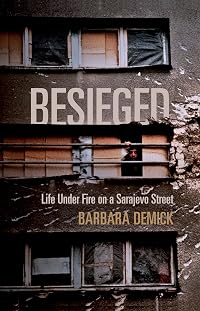
- Besieged: Life Under Fire on a Sarajevo Street (UK edition) (UK edition)
- Important places
- Sarajevo, Bosnia and Herzegovina
- Disambiguation notice
- Besieged: Life Under Fire on a Sarajevo Street should not be combined with Logavina Street. It is a separate work as it is updated by the author with a look at Logavina Street 20 years later.
Logavina Street has been ... (show all)updated, I understand - but the reissue and the original in the US have already been combined on here, and the reviews are all for the 2011/2012 edition - Besieged is the UK title for the updated edition.
Classifications
- Genres
- Nonfiction, General Nonfiction, History
- DDC/MDS
- 949.703 — History & geography History of Europe Greece, Albania, Yugoslavia, Serbia, Romania, Bulgaria Former Yugoslavia (Bosnia and Herzegovina ∙ Croatia ∙ Kosovo ∙ Montenegro ∙ Macedonia ∙ Serbia ∙ Slovenia) [formerly also Bulgaria]
- LCC
- DR1313.32 .S27 .D46 — History of Europe, Asia, Africa and Oceania Balkan Peninsula History of Balkan Peninsula Yugoslavia History By period 1918-
- BISAC
Statistics
- Members
- 135
- Popularity
- 242,295
- Reviews
- 22
- Rating
- (4.16)
- Languages
- English, German, Polish
- Media
- Paper, Ebook
- ISBNs
- 5
- ASINs
- 2