On This Page
Description
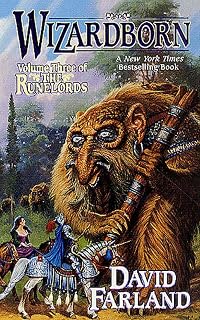
Wizardborn continues the story of the struggle of Gaborn, now the Earth King, who has lost his powers but continues to lead his people. He must contend with the threat of the huge, inhuman Reavers, whose myriads Gaborn and his forces must now pursue across the nation. It has become Gaborn's fate to follow, even into the depths. Raj Ahten, the great warlord endowed with the strength and qualities of thousands of men, once the primary threat to Gaborn, now struggles to retain his own empire. show more His war of conquest thwarted, his very life is now threatened by the Reaver thousands. And a young girl, Averan, who has eaten a Reaver and absorbed some of its memories, becomes a keystone in the search for the dark Reaver lair. show lessTags
Recommendations
Member Reviews
I like the hints of new directions going on in this one. The different kinds of wizards, in particular. I can do without the walnuts, but the whole learning-depth about reavers, about fire, and about water seems very promising.
Oh! And let's not forget about our fair observers who are so preoccupied with time! :)
I say this is a promising series. Epic in the sense that it is epic fantasy, yes, and not as grandiose as some, but much bigger in a few ways than most. Many, many shadow worlds? I likey. Worlds out of kilter? You bet! Ravening hoards pouring out of the earth, destroying whole cities overnight? Yep!
Most interestingly is the magic system in general. The attribute-based one. Metabolism additions make people live faster. They die show more faster, too, but the whole world slows down around them while they become super fast to everyone else. Giving that to horses is very funny... horses who run as fast as cars on a highway. :) The whole thing is pretty awesome as long as I don't think about the one little snag. (That's a pretty huge snag.)
Anyone who gives an attribute like Wit or Stamina or Metabolism then LOSES all but a tiny tiny portion. That means there need to be gigantic institutions set up for idiots, the energy-less, and the peeps who sleep for 20 years. Each addition comes with a subtraction, and most of those are severely glossed over in these books. Because if the givers die, the person currently enjoying 2 times normal strength will lose that addition. If the person has a thousand additions, that means there has to be a welfare state of a thousand taking care of the victims or the recipient will lose it all. If there's an army with an average of 20 or so additions per warrior and a hundred per captain and thousands in the army, then there ought to be a vast ocean of idiots and weaklings and sleepers left at home. Who is taking care of them? WHO???
Okay. So let's ignore that and enjoy the fantasy for what it is.
It's fun! Comfortable! It stretches some interesting boundaries in fantasy! It makes me interested in the rules and how to break them! I want to break them! Or at least write some stories about the seedy underside of patient management. :) show less
Oh! And let's not forget about our fair observers who are so preoccupied with time! :)
I say this is a promising series. Epic in the sense that it is epic fantasy, yes, and not as grandiose as some, but much bigger in a few ways than most. Many, many shadow worlds? I likey. Worlds out of kilter? You bet! Ravening hoards pouring out of the earth, destroying whole cities overnight? Yep!
Most interestingly is the magic system in general. The attribute-based one. Metabolism additions make people live faster. They die show more faster, too, but the whole world slows down around them while they become super fast to everyone else. Giving that to horses is very funny... horses who run as fast as cars on a highway. :) The whole thing is pretty awesome as long as I don't think about the one little snag. (That's a pretty huge snag.)
Anyone who gives an attribute like Wit or Stamina or Metabolism then LOSES all but a tiny tiny portion. That means there need to be gigantic institutions set up for idiots, the energy-less, and the peeps who sleep for 20 years. Each addition comes with a subtraction, and most of those are severely glossed over in these books. Because if the givers die, the person currently enjoying 2 times normal strength will lose that addition. If the person has a thousand additions, that means there has to be a welfare state of a thousand taking care of the victims or the recipient will lose it all. If there's an army with an average of 20 or so additions per warrior and a hundred per captain and thousands in the army, then there ought to be a vast ocean of idiots and weaklings and sleepers left at home. Who is taking care of them? WHO???
Okay. So let's ignore that and enjoy the fantasy for what it is.
It's fun! Comfortable! It stretches some interesting boundaries in fantasy! It makes me interested in the rules and how to break them! I want to break them! Or at least write some stories about the seedy underside of patient management. :) show less
This book was better than the 2nd one. It still bothers me that it takes so freakin' long for everything to happen in such a short amount of time. It just seems a bit unrealistic to have the entire world change in the course of a week.
However, I really enjoyed the development between Borenson and Myrrima. (And by the way, what the heck is Borenson's first name? Why does not even his wife call him by his first name?) It wasn't a cheesy love story (kind of like Gaborn's and Iome's relationship, however good it may be), but it was one based on sacrifice, respect, and devotion. I would have been extremely annoyed if Myrrima had really died. I'm glad that things are good between them again. They're probably going to die in like a day though. show more So at the end of the 4th book.
I am impressed with the way Farland is able to characterize Averan. She is one of the most real characters to me—nothing about her seems made up or fake. Her journey is the most unpredictable, and therefore the most exciting, for me. I hope she doesn't have to eat any more reavers, because my stomach just doesn't like all this talk about eating reaver brains.
Overall, I was quite satisfied with this book, though there is definitely room for improvement. For some reason, every time I read about Raj Ahten I would get extremely bored, and the pacing of the novel is hard to keep up with (or rather, slow down with). However, the storyline is good. I think Farland will end the first part of the series with a great lesson for all of us. show less
However, I really enjoyed the development between Borenson and Myrrima. (And by the way, what the heck is Borenson's first name? Why does not even his wife call him by his first name?) It wasn't a cheesy love story (kind of like Gaborn's and Iome's relationship, however good it may be), but it was one based on sacrifice, respect, and devotion. I would have been extremely annoyed if Myrrima had really died. I'm glad that things are good between them again. They're probably going to die in like a day though. show more So at the end of the 4th book.
I am impressed with the way Farland is able to characterize Averan. She is one of the most real characters to me—nothing about her seems made up or fake. Her journey is the most unpredictable, and therefore the most exciting, for me. I hope she doesn't have to eat any more reavers, because my stomach just doesn't like all this talk about eating reaver brains.
Overall, I was quite satisfied with this book, though there is definitely room for improvement. For some reason, every time I read about Raj Ahten I would get extremely bored, and the pacing of the novel is hard to keep up with (or rather, slow down with). However, the storyline is good. I think Farland will end the first part of the series with a great lesson for all of us. show less
Like so many SF books, WIZARDBORN is part of a series. I hate waiting, so I did not start this until they were all finished and then read them all in one go. This was probably a good thing, as I doubt I’d have remembered the details well enough if there’d been long gaps in between.
After the main character, Gaborn, misused his near-omnipotent powers in the final pages of the second book, BROTHERHOOD OF THE WOLF, he was stripped of his Earth powers just when he needed them most. This was not just the cliff-hanger rap on the knuckles, but rather a serious and debilitating blow.
From the start, it was clear that Farland's magic systems, particularly the basic one, the Endowments, were novel. He thematically explores not only the price show more of power - what Orson Scott Card calls "the cost of magic" - but also the ethical dilemmas to that cost: who pays that price, who sets it, and who forecloses when payment cannot be met.
With WIZARDBORN, Farland delves deeper into the ethical responsibilities those who wield magic have in his world. For the powers that are the source of those magicks, the ends do not justify the means ... no matter what the consequences.
The lead characters are filled out more in this volume, though I find some of them a bit cartoonish and predictable. I’m struggling with the idea of the 9 year old Averan as a game changer. I could also have screamed at some of the heavy handed writing – if I’d been told once more the reavers had ‘crystalline’ teeth, I may well have taken a war hammer to the author.
Having said all that, it is an easy and enjoyable read, with some interesting new approaches. It will be interesting to see how Farland rounds this all off in book 4. show less
After the main character, Gaborn, misused his near-omnipotent powers in the final pages of the second book, BROTHERHOOD OF THE WOLF, he was stripped of his Earth powers just when he needed them most. This was not just the cliff-hanger rap on the knuckles, but rather a serious and debilitating blow.
From the start, it was clear that Farland's magic systems, particularly the basic one, the Endowments, were novel. He thematically explores not only the price show more of power - what Orson Scott Card calls "the cost of magic" - but also the ethical dilemmas to that cost: who pays that price, who sets it, and who forecloses when payment cannot be met.
With WIZARDBORN, Farland delves deeper into the ethical responsibilities those who wield magic have in his world. For the powers that are the source of those magicks, the ends do not justify the means ... no matter what the consequences.
The lead characters are filled out more in this volume, though I find some of them a bit cartoonish and predictable. I’m struggling with the idea of the 9 year old Averan as a game changer. I could also have screamed at some of the heavy handed writing – if I’d been told once more the reavers had ‘crystalline’ teeth, I may well have taken a war hammer to the author.
Having said all that, it is an easy and enjoyable read, with some interesting new approaches. It will be interesting to see how Farland rounds this all off in book 4. show less
I'm not sure if I'll be continuing with this series. Don't get me wrong, it's a good story, and great writing. It's just not my type of fantasy. Maybe I'll revisit it in a year or two, considering I own almost the entire series. We shall see.
This book continues the story of the new "Earth King-Gaborn as he follows the horde of Reavers. He has lost his powers and now questions whether or not the Earth will help in the upcoming fight in which man-kind will soon face. Raj Ahten who has more endowment and thus the most powerful man in the world is struggling just to keep his empire under his rule. This book is well written and bridges the gap between "Brotherhood of the Wolf" and "The Lair of Bones." The narrator Ray Porter does a good job of bring the book to life in this audible edition of the print book. I would recommend this book for any Epic Fantasy book readers.
The third book in the Runelords series. This series has some interesting and different concepts, but the characters are a bit weak.
Members
- Recently Added By
Lists

Jean's Sci Fi/Fantasy Reading list
189 works; 12 members
Author Information

140+ Works 14,683 Members
Series

Belongs to Publisher Series
Knaur Excalibur (70147)
Work Relationships
Common Knowledge
- Canonical title
- Wizardborn
- Original title
- Wizardborn
- Original publication date
- 2001-03-14
- People/Characters
- Gaborn Val Orden; Iome Sylvarresta; Raj Ahten; Myrrima; Binnesman; Ivarian Borenson (show all 10); Erin Connall; Averan; Spring; Prince Celinor
- First words
- In South Crowthen, King Anders had been entertaining guests all night.
- Last words
- (Click to show. Warning: May contain spoilers.)"Take me to the vectors," she said. "I'll lead you the best that I can."
Classifications
Statistics
- Members
- 1,248
- Popularity
- 19,748
- Reviews
- 7
- Rating
- (3.59)
- Languages
- English, French, German
- Media
- Paper, Audiobook, Ebook
- ISBNs
- 19
- ASINs
- 8