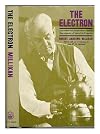
The electron, its isolation and measurement and the determination of some of its properties
by Robert Andrews Millikan
29 Members (4.25)
On This Page
Tags
Recommendations

















Member Reviews
Members
- Recently Added By
Author Information

30 Works 164 Members
An American experimental physicist, Robert Millikan graduated from Oberlin College in 1891 and received his M.A. there in 1893. He earned his Ph.D. from Columbia University in 1895. One year later, Millikan joined the faculty at the University of Chicago and remained there until 1921, with the exception of the time he spent in government and show more military service during World War I. From Chicago Millikan went to the California Institute of Technology, where he spent the rest of his career. Millikan made the first determination of the charge of the electron and of Planck's constant. He was awarded the 1923 Nobel Prize in physics for these contributions. The determination of the charge on the electron proved experimentally that electrons are particles of electricity. Millikan accomplished this feat by designing an experiment studying the fall of oil droplets in an electric field. He conjectured that the droplets would take up integral multiples of electrical charge. By measuring the strength of the field required to counteract the gravitational force on the droplets, he was able to compute a highly accurate unit charge for the particle. Millikan also studied the photoelectric effect experimentally in 1916, confirming Albert Einstein's equation relating the kinetic energy of a particle emitted by incident radiation to the frequency of that radiation. Until his retirement, Millikan studied cosmic rays and the ultraviolet spectra of many elements. (Bowker Author Biography) show less
Some Editions
Common Knowledge
- Original publication date
- 1917
- Dedication
- To Albert A. Michelson and Martin A. Ryerson, this small outgrowth of their inspiration and generosity is respectfully dedicated.
- First words
- Perhaps it is merely a coincidence that the man who first noticed that the rubbing of amber would induce in it a new and remarkable state now known as the state of electrification was also the man who first gave expression to... (show all) the conviction that there must be some great unifying principle which links together all phenomena and is capable of making them rationally intelligible; that behind all the apparent variety and change of things there is some primordial element, out of which all things are made and the search for which must be the ultimate aim of all natural science.
- Last words
- (Click to show. Warning: May contain spoilers.)In conclusion there is given a summary of the most important physical constants the values of which it has been possible to fix, within about the limits indicated, through the isolation and measurement of the electron.
- Original language
- English
Classifications
Statistics
- Members
- 29
- Popularity
- 955,724
- Rating
- (4.25)
- Languages
- English, German
- Media
- Paper
- ISBNs
- 5
- ASINs
- 5