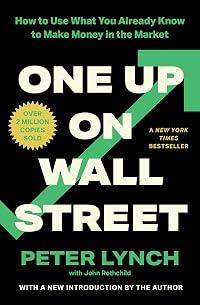
One Up On Wall Street: How To Use What You Already Know To Make Money In The Market
by Peter Lynch
Peter Lynch (1)
On This Page
Description
STOCKS ARE THE NUMBER ONE MONEY-MAKING INVESTMENT TODAY. HERE'S HOW YOU CAN MAKE MONEY IN THE MARKET! Manager of the $9 billion Fidelity Magellan Fund, he has earned investors a 190, 000 return on a 10, 000 investment over the last twelve years. Now Peter Lynch shows how you can make a profit on Wall Street with the knowledge you already have. Discover: - Why smart money is not so smart -- and why you may be a better stock picker than the pros - How to follow your hunches -- and back them up show more with facts - Why you should forget everything you hear about the economy and how to pick your own time to buy and sell - How to determine which kinds of stocks are best for you From price-earnings ratios to cash assets, from low growth stocks to "The Twelve Silliest Things People Say About Stock Prices, " here is a powerful guide to investing. show lessTags
Recommendations
Member Reviews
For all of the financial capital under their control, it has always amazed me how anonymous most portfolio managers are. Money management companies (e.g., Fidelity, Putnam, Vanguard) are well-known, but the men and women who actually make the investment decisions typically are not, particularly to non-groupies who don’t stay glued to CNBC. Of course, Peter Lynch is an exception; his performance record while running Fidelity’s Magellan fund was so spectacular that the firm simply could not keep him hidden.
This is the first of two books—Beating the Street being the other—that crystallizes his “power of the little guy” investment philosophy. If Ben Graham is the quintessential value investor, Lynch embodies the GARP (Growth at show more a Reasonable Price) strategy. His straightforward approach is based on two imminently sensible ideas: (1) good, well-run companies with expanding franchises make the best investments over the long run, and (2) individual investors often have an advantage over institutional investors because, as everyday consumers of goods and services, they are in a better position to gather information on the quality of those firms.
Lynch develops these ideas in a practical and approachable manner, usually illustrating his points with examples from his own experience. Although some of these stories feel a little dated by now (e.g., Micron Technology, Service Corporation International), the wisdom inherent in his approach is timeless. He was truly a master at the art of building a stock portfolio from the bottom up and much of that accumulated wisdom is captured in this volume; in fact, the chapter on 'Some Famous Numbers' is worth price of the book alone. show less
This is the first of two books—Beating the Street being the other—that crystallizes his “power of the little guy” investment philosophy. If Ben Graham is the quintessential value investor, Lynch embodies the GARP (Growth at show more a Reasonable Price) strategy. His straightforward approach is based on two imminently sensible ideas: (1) good, well-run companies with expanding franchises make the best investments over the long run, and (2) individual investors often have an advantage over institutional investors because, as everyday consumers of goods and services, they are in a better position to gather information on the quality of those firms.
Lynch develops these ideas in a practical and approachable manner, usually illustrating his points with examples from his own experience. Although some of these stories feel a little dated by now (e.g., Micron Technology, Service Corporation International), the wisdom inherent in his approach is timeless. He was truly a master at the art of building a stock portfolio from the bottom up and much of that accumulated wisdom is captured in this volume; in fact, the chapter on 'Some Famous Numbers' is worth price of the book alone. show less
Scratch the 'If you bought X in 1958, you would've made Y!' sentences and the 90s-focused political commentary and this is actually a great and timeless book about investing.
This is a short book, but long on advice even, and especially, after the financial meltdown. It took me about 40 - 45 minutes to go through the book, but I'll read it again tomorrow and maybe again next week allowing the content to set in.
The book is a fun read and gives novices, such as myself, some basic fundamentals and concepts before we rush in (again) to lose our money (again) while the big boys rake all the profits (again) in the casino we all know as the stock market. There is no specific advice in this book other than to spend as much time researching a stock as you would buying a new refrigerator; however I found the general concepts interesting and informative.
But reader beware, even though the book is short Lynch does get show more the point across that choosing your own stocks is and making money is a combination of perspiration and luck. I've made the mistake of rushing in to buy a certain stock that was "hot", sometimes it worked out but mostly I lost money. show less
The book is a fun read and gives novices, such as myself, some basic fundamentals and concepts before we rush in (again) to lose our money (again) while the big boys rake all the profits (again) in the casino we all know as the stock market. There is no specific advice in this book other than to spend as much time researching a stock as you would buying a new refrigerator; however I found the general concepts interesting and informative.
But reader beware, even though the book is short Lynch does get show more the point across that choosing your own stocks is and making money is a combination of perspiration and luck. I've made the mistake of rushing in to buy a certain stock that was "hot", sometimes it worked out but mostly I lost money. show less
Quite funny and full of wisdom. Many (almost all) points are absolutely correct, for example, long-term holding, waiting for correct price, avoiding hot stocks.
A must read for any serious small investor interested in direct stock ownership.
One thing to avoid: book talks about tenbaggers as they are easy to find, and more importantly it is possible to time buying/selling to lowest/highest prices. But something like that happens by coincidence. One must consider self very lucky if he/she can time a tenbagger perfectly.
A must read for any serious small investor interested in direct stock ownership.
One thing to avoid: book talks about tenbaggers as they are easy to find, and more importantly it is possible to time buying/selling to lowest/highest prices. But something like that happens by coincidence. One must consider self very lucky if he/she can time a tenbagger perfectly.
I found this an interesting book about how one man made decisions about what companies were worth investing in. It's not a practical guide but it shows you Lynch's perspective on the process, the rewards and the pitfalls, and how to view companies as an investor. It made the whole thing less mystifying. I didn't come away feeling I could necessarily make the best decisions, but I did come away feeling I could spot someone making poor decisions, especially poor decisions for me.
I love all three of Peter Lynch's books, but this is the best. It contains within it the secret of successful stockpicking and much wit and wisdom. Lynch was a successful fund manager, a claim to fame in itself, with a disarmingly simple style. Follow it and you will be casing department stores and cozying up to investor relations departments in no time. You see: "All you have to do is put as much effort into picking your stocks as you do into buying your groceries."
The perspective given in this book comes from someone who's been involved for a great number of years in picking stocks for Fidelity Mutual. It offers a lot of caution, while at the same time pointing out that practically anyone can beat the picks of wall street. His rationale is that fund managers and the like are constrained by a variety of rules that practically guarantee that the hot stock they pick has already had its largest gain. Only individuals can spot a potentially hot stock and have the freedom to invest. At the same time, he offers a lot of advice on avoiding common investing mistakes. The book is nothing earth-shattering, but it does provide good words of wisdom that I found very useful.
Members
- Recently Added By
Author Information

13 Works 3,084 Members
Peter Lynch is the vice-chairman of Fidelity Management and Research. Lynch wrote "One Up on Wall Street," "Beating the Street," and "Learning to Earn," all of which are guides to investing, tracking, and reading the stock market. (Bowker Author Biography)
Awards and Honors
Distinctions
Series

Work Relationships
Common Knowledge
- Original publication date
- 1989
- Dedication
- To Carolyn, my wife and best friend for over twenty years, whose support and sacrifices have been critically important to me.
To my children, Mary, Annie, and Beth, whose love for each other and their parents has meant so ... (show all)very much.
To my colleagues at Fidelity Investments, whose extra efforts have made Magellan's performance possible but who have received none of the favorable publicity.
To one million shareholders in Magellan, who have entrusted their savings to me and who have sent thousands of letters and made thousands of calls over the years, comforting me during declines in the market and reminding me that the future will be fine.
To Holy God for all the incredible blessings I have been given in my life. - First words
- There's no such thing as a hereditary knack for picking stocks.
- Quotations
- If you can't convince yourself "When I'm down 25 percent, I'm a buyer" and banish forever the fatal thought "When I'm down 25 percent, I'm a seller," then you'll never make a decent profit in stocks.
- Last words
- (Click to show. Warning: May contain spoilers.)You have to keep your priorities straight, if you plan to do well in stocks.
Classifications
Statistics
- Members
- 1,622
- Popularity
- 14,017
- Reviews
- 18
- Rating
- (3.81)
- Languages
- 6 — Chinese, English, Finnish, German, Hindi, Spanish
- Media
- Paper, Audiobook, Ebook
- ISBNs
- 21
- UPCs
- 1
- ASINs
- 10