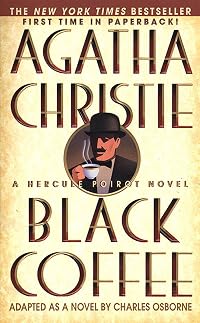
Black Coffee: Novelisation
by Agatha Christie, Charles Osborne (Adapter)
Hercule Poirot (Novelisation — 1998)
On This Page
Description
Sir Claud Amory's formula for a powerful new explosive has been stolen, presumably by a member of his large household. Sir Claud assembles his suspects in the library and locks the door, instructing them that the when the lights go out, the formula must be replaced on the table -- and no questions will be asked. But when the lights come on, Sir Claud is dead. Now Hercule Poirot, assisted by Captain Hastings and Inspector Japp, must unravel a tangle of family feuds, old flames, and suspicious show more foreigners to find the killer and prevent a global catastrophe. show lessTags
Recommendations












Member Reviews
"‘George,’ he called, ‘please take my heavy tweed suit and my dinner jacket and trousers to the cleaners. I must have them back by Friday, as I am going to the Country for the Weekend.’ He made it sound like the Steppes of Central Asia and for a lifetime."
Tweed? No, I cannot....no to Poirot in tweeds.
I am all in favour of fan fiction, especially when it is done well. Unfortunately, Black Coffee fell flat on so many counts.
What is, in my opinion, even worse is that the book was authorised, even commissioned, by Christie's estate. Subsequently it was published as part of the official Agatha Christie catalogue. This is just plain wrong.
Christie did write the play Black Coffee in 1929 to experiment with play-writing herself after show more stage adaptations of her previous books failed to impress her. However, I guess she must have had her reasons for not developing this particular story into a full novel - although many, many elements in the story do appear in later stories.
Or maybe Charles Osborne would just regurgitate the tricks and techniques of Dame Agatha's better known works to cover his lack of imagination? After all, he did write the book some 20 years after Christie's death.
My dismay at Agatha Christie Ltd and the publishers for allowing this book to be published as part of the official series is not, however, solely because it is so obvious that it was a financial decision to milk the franchise.
I'm disliking that this book should be the best available work of fan fiction and should be worthy of publication - especially when readers may pick this up and actually think it was written by Christie.
The obvious lack in sincerity in Osborne's portrayal of the characters is downright upsetting. So, not only does he make Poirot wear tweeds, but he also turns him into something that he is not. For all of Poirot's eccentricities, the Poirot Christie had created may have had high standards but he has always had some empathy with other people.
"An inveterate snob, he was already predisposed in Sir Claud’s favour by virtue of his title. If he were to be found in Who’s Who, a volume in which the details of Poirot’s own career could also be discovered, then perhaps this Sir Claud was someone with a valid claim on his, Hercule Poirot’s, time and attention."
No. Just, no. show less
Tweed? No, I cannot....no to Poirot in tweeds.
I am all in favour of fan fiction, especially when it is done well. Unfortunately, Black Coffee fell flat on so many counts.
What is, in my opinion, even worse is that the book was authorised, even commissioned, by Christie's estate. Subsequently it was published as part of the official Agatha Christie catalogue. This is just plain wrong.
Christie did write the play Black Coffee in 1929 to experiment with play-writing herself after show more stage adaptations of her previous books failed to impress her. However, I guess she must have had her reasons for not developing this particular story into a full novel - although many, many elements in the story do appear in later stories.
Or maybe Charles Osborne would just regurgitate the tricks and techniques of Dame Agatha's better known works to cover his lack of imagination? After all, he did write the book some 20 years after Christie's death.
My dismay at Agatha Christie Ltd and the publishers for allowing this book to be published as part of the official series is not, however, solely because it is so obvious that it was a financial decision to milk the franchise.
I'm disliking that this book should be the best available work of fan fiction and should be worthy of publication - especially when readers may pick this up and actually think it was written by Christie.
The obvious lack in sincerity in Osborne's portrayal of the characters is downright upsetting. So, not only does he make Poirot wear tweeds, but he also turns him into something that he is not. For all of Poirot's eccentricities, the Poirot Christie had created may have had high standards but he has always had some empathy with other people.
"An inveterate snob, he was already predisposed in Sir Claud’s favour by virtue of his title. If he were to be found in Who’s Who, a volume in which the details of Poirot’s own career could also be discovered, then perhaps this Sir Claud was someone with a valid claim on his, Hercule Poirot’s, time and attention."
No. Just, no. show less
Es importante aclarar que este libro realmente no fue escrito por Agatha Christie, es una adaptación a una obra de teatro, que si fue escrita por ella, esta obra fue escrita por ella en 1930 mientras que la adaptación para la novela por hecha por parte de Charles Osborne en 1998.
Si bien es cierto que Osborne hizo un muy buen trabajo en la adaptación y que a pesar de que no conozco la obra original es fácil ver el espíritu de Agatha y su ingenio en la obra, nadie podría escribir sobre venenos como ella y nadie podría enmarañar una escena como Agatha, sin embargo, es inevitable darse cuenta que este libro realmente no está escrito por ella, a pesar de que Osborne intenta presentar el carácter único de Poirot no lo logra, si, show more Poirot es un hombre muy pagado de sí mismo, pero no al punto en que aquí se presenta y suena raro cuando habla de sí mismo como único en el mundo, vamos, que si es petulante, pero creo que Agatha nunca habría sido tan burda en este sentido y puedo enumerar otros pequeños, muy pequeños detalles en los que se nota que la pluma es otra a pesar de que toda la historia si es de Agatha.
Me ha gustado, pero no he podido evitar ver esos detalles en los que noto que el libro no fue escrito por Agatha, el sentimiento de la falta de ambientación correcta, no se explicarlo y eso me ha dejado con un poquito de mal sabor de boca, es un buen libro, es una buena historia, pero algo me ha faltado y quiero creer que es precisamente la pluma exquisita de Agatha.
Osborne lo ha hecho muy bien, mejor que bien y hay que tener talento y pantalones para adentrarse en adaptar a novela algo de Agatha sabiendo que la comparación sería inevitable.
Sin embargo, es una buena historia super entretenida y por supuesto se lee en una sentada, literal. show less
Si bien es cierto que Osborne hizo un muy buen trabajo en la adaptación y que a pesar de que no conozco la obra original es fácil ver el espíritu de Agatha y su ingenio en la obra, nadie podría escribir sobre venenos como ella y nadie podría enmarañar una escena como Agatha, sin embargo, es inevitable darse cuenta que este libro realmente no está escrito por ella, a pesar de que Osborne intenta presentar el carácter único de Poirot no lo logra, si, show more Poirot es un hombre muy pagado de sí mismo, pero no al punto en que aquí se presenta y suena raro cuando habla de sí mismo como único en el mundo, vamos, que si es petulante, pero creo que Agatha nunca habría sido tan burda en este sentido y puedo enumerar otros pequeños, muy pequeños detalles en los que se nota que la pluma es otra a pesar de que toda la historia si es de Agatha.
Me ha gustado, pero no he podido evitar ver esos detalles en los que noto que el libro no fue escrito por Agatha, el sentimiento de la falta de ambientación correcta, no se explicarlo y eso me ha dejado con un poquito de mal sabor de boca, es un buen libro, es una buena historia, pero algo me ha faltado y quiero creer que es precisamente la pluma exquisita de Agatha.
Osborne lo ha hecho muy bien, mejor que bien y hay que tener talento y pantalones para adentrarse en adaptar a novela algo de Agatha sabiendo que la comparación sería inevitable.
Sin embargo, es una buena historia super entretenida y por supuesto se lee en una sentada, literal. show less
This book sucked which is why I kicked it to the proverbial curb when I got to 40 pages in. I often say that a good DNF review can steer potential readers away from a book that the reviewer articulates why it would be a waste of time. Honestly, all you have to know is that Agatha Christie did not write this novel. Instead, Christie wrote a play called "Black Coffee." However it was not turned into a novel. Decades later, Charles Osborne would take up the mantle and write this. I have no idea why anyone thought the guy could pull this off, and the foreword by Christie's nephew talking about what a good job Osborne did must have been in jest.
This is a bad novel aping to sound like Christie. I don't know how else to spell it out. It's like show more trying to see your reflection through a really dirty mirror. You can almost see yourself, but then you move a little and that's all she wrote. I just could not get past how unlike Poirot this sounds in Osborne's hands. He obviously did not get our egg head shaped detective at all. Yes, Poirot is vain, but is not so far up his own ass that he would be acting like he does in this book.
The overall mystery, did not interest me either. Poirot is called in when a man named Claud Amory is worried that someone in his home is hoping to steal secret formula.
Don't even get me started on why Amory doesn't just leave his home and come to Poirot. That would make too much sense. Instead Poirot goes to Amory's home to help and of course finds him dead. Amory has been poisoned by coffee he had after dinner. Of course my first thought is who drinks coffee after dinner. I can't drink coffee after noon or I will be up all night. Insomnia sucks. Oh wait, back to this terrible book. Poirot now has a household of suspects. Hastings is also in this one and of course just like Poirot acts so alien you think he and Poirot have been body snatched by aliens.
I finally called it a day at page 40. Back to the library this book goes. Well I got my first DNF of 2017, maybe the Book gods are coming back....sigh. show less
This is a bad novel aping to sound like Christie. I don't know how else to spell it out. It's like show more trying to see your reflection through a really dirty mirror. You can almost see yourself, but then you move a little and that's all she wrote. I just could not get past how unlike Poirot this sounds in Osborne's hands. He obviously did not get our egg head shaped detective at all. Yes, Poirot is vain, but is not so far up his own ass that he would be acting like he does in this book.
The overall mystery, did not interest me either. Poirot is called in when a man named Claud Amory is worried that someone in his home is hoping to steal secret formula.
Don't even get me started on why Amory doesn't just leave his home and come to Poirot. That would make too much sense. Instead Poirot goes to Amory's home to help and of course finds him dead. Amory has been poisoned by coffee he had after dinner. Of course my first thought is who drinks coffee after dinner. I can't drink coffee after noon or I will be up all night. Insomnia sucks. Oh wait, back to this terrible book. Poirot now has a household of suspects. Hastings is also in this one and of course just like Poirot acts so alien you think he and Poirot have been body snatched by aliens.
I finally called it a day at page 40. Back to the library this book goes. Well I got my first DNF of 2017, maybe the Book gods are coming back....sigh. show less
Black Coffee was originally a 1930s play by Agatha Christie but this is a novelized version by Charles Osborne which was published in 1998. Although most of the writing is Christie's’, this new author has left his stamp on the book as well. Hercule Poirot, the Belgium detective, comes across quite British in this version and the usually placid Hastings calls Poirot out as an “arrogant snob” - words I do not believe that Ms. Christie would have allowed her character to utter.
This story involves the poisoning of a prominent scientist at his country manor attended by the usual assortment of characters who all had a reason to want the man dead. By the process of elimination and close observation, Poirot points out the correct murderer show more to the police and is able to help a young couple put their suspicions of each other behind them.
Although this is certainly not one of my favorite Poirot stories, I did find the book a light, enjoyable read. show less
This story involves the poisoning of a prominent scientist at his country manor attended by the usual assortment of characters who all had a reason to want the man dead. By the process of elimination and close observation, Poirot points out the correct murderer show more to the police and is able to help a young couple put their suspicions of each other behind them.
Although this is certainly not one of my favorite Poirot stories, I did find the book a light, enjoyable read. show less
Poirot on Stage
A review of the William Morrow eBook (September 28, 2004) of the 1988 novelization by Charles Osborne of Agatha Christie's original stage play [book:Black Coffee: A Mystery Play in Three Acts|645754] (Hercule Poirot #7 - 1930).
See cover at show more target="_top">https://breakingcharacter.com/wp-content/uploads/2023/09/ACL-Black-Coffee-1-1024...
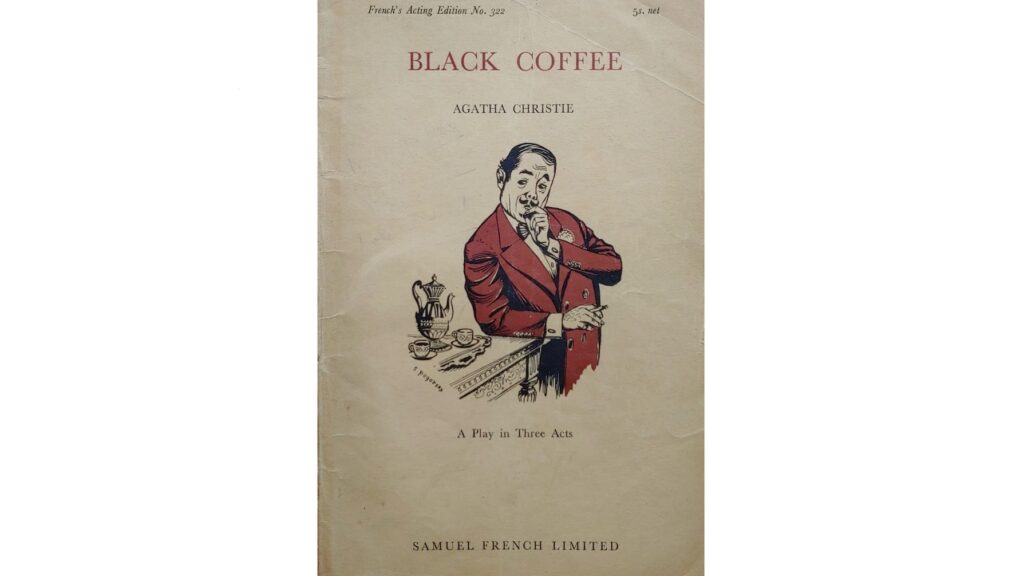
The cover of one of the later Black Coffee playscript editions (Samuel French 1934). Image sourced from Agatha Christie's Plays from Playscripts to Playbills..
[3.5 rounded up to a GR 4]
Agatha Christie had not been happy with [book:Alibi: A Play in Three Acts From a Story By Agatha Christie|148959507] (1928) which was [author:Michael Morton|513657]'s adaptation of Christie's breakthrough novel [book:The Murder of Roger Ackroyd|16328] (Hercule Poirot #4 - 1926). She decided to write her own Hercule Poirot stage play and it had a modest success when mounted in 1930.
She would go on to write over a dozen theatrical plays with successes that rivaled her published novels and stories. Famously, [book:The Mousetrap: A Play|2125922] (1952) has been running on stage at the St. Martin's Theatre in London, England since 1974 (except for a break due to the COVID pandemic), holding the record for the longest running stage play in the world.
In 1988, the Christie Estate approved Australian writer Charles Osborne's novelization of the Black Coffee stage play and thus Hercule Poirot #7.5 was added to the canon 12 years after Christie's passing, and almost 50 years after its first appearance.
The plot is fairly standard locked room. An unlikeable scientist has found a formula for a rare explosive material but it has been stolen from his personal safe. Before anyone can leave, he locks everyone in the household in a room and calls on Poirot to arrive to investigate. Upon Poirot's arrival (with Hastings in tow), it is discovered that the inventor has been murdered, likely due to poisoned coffee. The paper with the formula is somewhere inside the room itself as the culprit had no opportunity to leave with it. Poirot interviews everyone and deduces the location of the formula and the identity of the thief/murderer.
This was standard Poirot with all of the now regular cliches of Hastings' fantastical proposed solutions and his distraction by attractive females, Poirot's neatness obsessions and his belief in his own genius and the power of the "little grey cells."
Trivia and Links
See film poster at https://upload.wikimedia.org/wikipedia/en/4/45/Black_Coffee_1931.jpg
The stage play was also quickly adapted for the film Black Coffee in 1931 but the film itself is now considered lost. Read further about the stage play and its adaptations (Note: Plot spoiler alert) at Wikipedia. show less
A review of the William Morrow eBook (September 28, 2004) of the 1988 novelization by Charles Osborne of Agatha Christie's original stage play [book:Black Coffee: A Mystery Play in Three Acts|645754] (Hercule Poirot #7 - 1930).
The assembled company stared at the stranger. What they saw was an extraordinary-looking little man, hardly more than five feet four inches in height, who carried himself with great dignity. His head was exactly the shape of an egg, and he carried it at a slight angle, like an enquiring terrier. His moustache was distinctly stiff and military. He was very neatly dressed.
‘Hercule Poirot, at your service,’ said the stranger, and bowed.
See cover at show more target="_top">https://breakingcharacter.com/wp-content/uploads/2023/09/ACL-Black-Coffee-1-1024...
The cover of one of the later Black Coffee playscript editions (Samuel French 1934). Image sourced from Agatha Christie's Plays from Playscripts to Playbills..
[3.5 rounded up to a GR 4]
Agatha Christie had not been happy with [book:Alibi: A Play in Three Acts From a Story By Agatha Christie|148959507] (1928) which was [author:Michael Morton|513657]'s adaptation of Christie's breakthrough novel [book:The Murder of Roger Ackroyd|16328] (Hercule Poirot #4 - 1926). She decided to write her own Hercule Poirot stage play and it had a modest success when mounted in 1930.
She would go on to write over a dozen theatrical plays with successes that rivaled her published novels and stories. Famously, [book:The Mousetrap: A Play|2125922] (1952) has been running on stage at the St. Martin's Theatre in London, England since 1974 (except for a break due to the COVID pandemic), holding the record for the longest running stage play in the world.
In 1988, the Christie Estate approved Australian writer Charles Osborne's novelization of the Black Coffee stage play and thus Hercule Poirot #7.5 was added to the canon 12 years after Christie's passing, and almost 50 years after its first appearance.
The plot is fairly standard locked room. An unlikeable scientist has found a formula for a rare explosive material but it has been stolen from his personal safe. Before anyone can leave, he locks everyone in the household in a room and calls on Poirot to arrive to investigate. Upon Poirot's arrival (with Hastings in tow), it is discovered that the inventor has been murdered, likely due to poisoned coffee. The paper with the formula is somewhere inside the room itself as the culprit had no opportunity to leave with it. Poirot interviews everyone and deduces the location of the formula and the identity of the thief/murderer.
This was standard Poirot with all of the now regular cliches of Hastings' fantastical proposed solutions and his distraction by attractive females, Poirot's neatness obsessions and his belief in his own genius and the power of the "little grey cells."
Trivia and Links
See film poster at https://upload.wikimedia.org/wikipedia/en/4/45/Black_Coffee_1931.jpg
The stage play was also quickly adapted for the film Black Coffee in 1931 but the film itself is now considered lost. Read further about the stage play and its adaptations (Note: Plot spoiler alert) at Wikipedia. show less
I would suggest the reader of Black Coffe remind themselves repeatedly that this is not entirely her work and therefore not her fault. There is too much of a feeling of staging for this to work as a novel. Every step is presented for the reader/audience to see so that the mystery isn't a mystery at all. Most jolting to me were the theatrical gasps/screams and near faints from the fragile female characters which harken back to the olden days of theatre.
Summary: Poirot is too late to help Sir Claud, who has been fatally poisoned and his secret formula stolen by someone in his household.
I like my coffee black. But I think I would pass were I visiting the home of Sir Claud Amory.
Black Coffee was actually Agatha Ch4ristie’s first stage play, overshadowed by the widely staged The Mousetrap. The play was moderately successful, playing in several theatres from December 1930 through June 1931. It also appeared as a film version in 1931. Among those over the years who played the suspicious Italian Dr. Carellia was Charles Osborne. Forty years later he approached the Christie Estate with a proposal to novelize the stage play. This book, published in 1998, was the result.
Sir Claud Amory show more reaches out to Poirot for help. He is working on an atomic formula that would create a powerful weapon. He suspects someone in his house wants to steal it. Before Poirot arrives, he finds the formula missing. He stages an elaborate effort to recover the formula at a dinner party with members of the household and guests. He locks them into the library. After coffee is served, he tells them the lights will be turned off, the thief can return the formula, and life will go on. Then he drinks his coffee, the lights go out and come on just as Poirot arrives.
An envelope is by his side. But Sir Claud is very dead. And the envelope is empty.
The authorities ask the guest to remain. Beside servants, there is Sir Claud’s sister Caroline, his spirited niece Barbara, his son Richard, who is in financial straits, Richard’s wife, Lucia, who he recently married in Italy, Sir Claud’s efficient secretary Edward Raynor, and Dr. Carelli, ostensibly Lucia’s friend. Instead, he is blackmailing her, threatening to reveal her past.
Poirot is accompanied by Captain Hastings. Soon they learn that someone used hyoscine to poison Sir Claud’s coffee, explaining the bitterness he complained of when drinking it. Suspicion focuses on Lucia, who had been seen taking some tablets from a medicine box they had been looking at earlier in the evening. She had served the coffee. And there was her past. She was the daughter Selma Goetz, an international spy. She had tried to keep this secret from the family but Dr. Carelli knew and Sir Claud had received a cryptic warning about her as well.
Poirot knows she isn’t the murderer, nor her husband, who confesses to protect her. Eventually he sets a trap to catch the thief and murderer. But the murderer turns the tables, using the same poison in Poirot’s drink.
This is a short piece, and while a bit formulaic, makes for a diverting read. It makes sense that this was a stage play. All the action takes place in the library. The character of Poirot is consistent with the other novels. Although the stage play preceded the nuclear age, the story also raises the question about the morality of such super weapons. Although this is not up to the standard of The Murder of Roger Ackroyd and And Then There Were None, any Christie and Poirot lovers will want to read this, particularly to learn the plot of Christie’s first stage play. show less
I like my coffee black. But I think I would pass were I visiting the home of Sir Claud Amory.
Black Coffee was actually Agatha Ch4ristie’s first stage play, overshadowed by the widely staged The Mousetrap. The play was moderately successful, playing in several theatres from December 1930 through June 1931. It also appeared as a film version in 1931. Among those over the years who played the suspicious Italian Dr. Carellia was Charles Osborne. Forty years later he approached the Christie Estate with a proposal to novelize the stage play. This book, published in 1998, was the result.
Sir Claud Amory show more reaches out to Poirot for help. He is working on an atomic formula that would create a powerful weapon. He suspects someone in his house wants to steal it. Before Poirot arrives, he finds the formula missing. He stages an elaborate effort to recover the formula at a dinner party with members of the household and guests. He locks them into the library. After coffee is served, he tells them the lights will be turned off, the thief can return the formula, and life will go on. Then he drinks his coffee, the lights go out and come on just as Poirot arrives.
An envelope is by his side. But Sir Claud is very dead. And the envelope is empty.
The authorities ask the guest to remain. Beside servants, there is Sir Claud’s sister Caroline, his spirited niece Barbara, his son Richard, who is in financial straits, Richard’s wife, Lucia, who he recently married in Italy, Sir Claud’s efficient secretary Edward Raynor, and Dr. Carelli, ostensibly Lucia’s friend. Instead, he is blackmailing her, threatening to reveal her past.
Poirot is accompanied by Captain Hastings. Soon they learn that someone used hyoscine to poison Sir Claud’s coffee, explaining the bitterness he complained of when drinking it. Suspicion focuses on Lucia, who had been seen taking some tablets from a medicine box they had been looking at earlier in the evening. She had served the coffee. And there was her past. She was the daughter Selma Goetz, an international spy. She had tried to keep this secret from the family but Dr. Carelli knew and Sir Claud had received a cryptic warning about her as well.
Poirot knows she isn’t the murderer, nor her husband, who confesses to protect her. Eventually he sets a trap to catch the thief and murderer. But the murderer turns the tables, using the same poison in Poirot’s drink.
This is a short piece, and while a bit formulaic, makes for a diverting read. It makes sense that this was a stage play. All the action takes place in the library. The character of Poirot is consistent with the other novels. Although the stage play preceded the nuclear age, the story also raises the question about the morality of such super weapons. Although this is not up to the standard of The Murder of Roger Ackroyd and And Then There Were None, any Christie and Poirot lovers will want to read this, particularly to learn the plot of Christie’s first stage play. show less
Members
- Recently Added By
Lists

Agatha Christie Poirot
43 works; 2 members

Books About Murder
313 works; 7 members

Books whose title names an object usually found in the kitchen
171 works; 14 members

Books Read in 2026
1,933 works; 66 members
Author Information

2,153+ Works 440,313 Members
One of the most successful and beloved writer of mystery stories, Agatha Mary Clarissa Christie was born in 1890 in Torquay, County Devon, England. She wrote her first novel, The Mysterious Affair at Styles, in 1920, launching a literary career that spanned decades. In her lifetime, she authored 79 crime novels and a short story collection, 19 show more plays, and six novels written under the name of Mary Westmacott. Her books have sold over a billion copies in the English language with another billion in 44 foreign languages. Some of her most famous titles include Murder on the Orient Express, Mystery of the Blue Train, And Then There Were None, 13 at Dinner and The Sittaford Mystery. Noted for clever and surprising twists of plot, many of Christie's mysteries feature two unconventional fictional detectives named Hercule Poirot and Miss Jane Marple. Poirot, in particular, plays the hero of many of her works, including the classic, The Murder of Roger Ackroyd (1926), and Curtain (1975), one of her last works in which the famed detective dies. Over the years, her travels took her to the Middle East where she met noted English archaeologist Sir Max Mallowan. They married in 1930. Christie accompanied Mallowan on annual expeditions to Iraq and Syria, which served as material for Murder in Mesopotamia (1930), Death on the Nile (1937), and Appointment with Death (1938). Christie's credits also include the plays, The Mousetrap and Witness for the Prosecution (1953; film 1957). Christie received the New York Drama Critics' Circle Award for 1954-1955 for Witness. She was also named Dame Commander of the Order of the British Empire in 1971. Christie died in 1976. (Bowker Author Biography) show less

Charles Osborne's acclaimed Complete Operas series includes books on the operas of Mozart, Puccini, Verdi, and Richard Strauss. All are available in paperback from Da Capo Press.
Some Editions
Awards and Honors
Awards
Series

Belongs to Publisher Series
Work Relationships
Common Knowledge
- Canonical title
- Black Coffee: Novelisation
- Original title
- Black Coffee
- Original publication date
- 1998
- People/Characters
- Hercule Poirot; Arthur Hastings (Captain); Sir Claud Amory; Richard Amory (son of Sir Claud); Lucia Amory (wife of Richard); Barbara Amory (cousin of Richard) (show all 11); Caroline Amory (sister of Sir Claud); Edward Raynor (secretary of Sir Claud); Dr. Kenneth Graham; Inspector Japp; Dr. Carelli
- Important places
- Market Cleve
- First words
- Hercule Poirot sat at breakfast in his small but agreeably cosy flat in Whitehall Mansions.
- Last words
- (Click to show. Warning: May contain spoilers.)'Ah!' he exclaimed as he went to the mantelpiece over the fireplace and straightened the spill vase. 'Voilá! Now, order and neatness are restored.' With that, Poirot walked towards the door with an air of immense satisfaction.
- Disambiguation notice
- Black Coffee was originally a play by Agatha Christie published in 1934 by A. Ashley and son. It was adapted as a novel by Charles Osborne, published 1998 by St. Martin Press. Please do not merge the two records.
Classifications
Statistics
- Members
- 2,201
- Popularity
- 9,204
- Reviews
- 57
- Rating
- (3.27)
- Languages
- 18 — Danish, Dutch, English, Estonian, Finnish, French, German, Hungarian, Italian, Japanese, Polish, Portuguese, Russian, Serbian, Spanish, Swedish, Thai, Turkish
- Media
- Paper, Audiobook, Ebook
- ISBNs
- 82
- ASINs
- 21