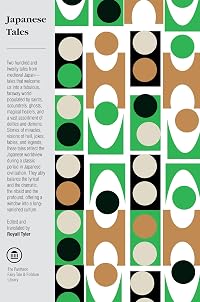
Japanese Tales
by Royall Tyler
On This Page
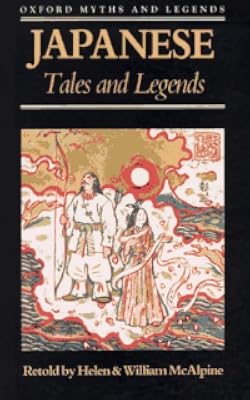
Description
Contains over 200 tales from medieval Japan.Tags
Recommendations











Member Reviews
This collection of folk tales from medieval Japan is just a total delight. Aimed halfway between Japanese literature specialists and total newbies (of which I am one), it’s beautifully packaged, well-translated and includes a great introduction by Japanophile Royall Tyler
The tales themselves are often totally madcap, full of shapeshifting gods and severely unfair turns of fate. They’re full of… not exactly wisdom… but something approaching wisdom, packaged in such a way as to make you think they could just be totally random. Frequently I’d settle into a tale thinking “I see where this is going, that evil emperor is going to get his comeuppance”, and then he wouldn’t, and the innocent pauper would get cursed by a river show more demon for being in the wrong place at the wrong time.
I am reminded never to turn ugly old women away from the door of my castle. Or do. It’s unclear. show less
The tales themselves are often totally madcap, full of shapeshifting gods and severely unfair turns of fate. They’re full of… not exactly wisdom… but something approaching wisdom, packaged in such a way as to make you think they could just be totally random. Frequently I’d settle into a tale thinking “I see where this is going, that evil emperor is going to get his comeuppance”, and then he wouldn’t, and the innocent pauper would get cursed by a river show more demon for being in the wrong place at the wrong time.
I am reminded never to turn ugly old women away from the door of my castle. Or do. It’s unclear. show less
This collection of medieval Japanese stories was a very entertaining read. It begins with an introduction that provides context for the tales to come. I really appreciated this since I have very minimal knowledge of this period of Japanese history. The tales themselves were organized in groups of similar themes, but the stories were all unique and diverse. I really enjoyed reading this selection!
Book Description: New York, New York, U.S.A.: Pantheon Books, 1987. First American Edition. Hardcover book with dust jacket, dj has edge wear/ small edge rip, book itself is clean/tight/undamaged.
Members
- Recently Added By
Lists

Books About Non-Abrahamic Religions
98 works; 2 members
Author Information

16+ Works 1,266 Members
When Royall Tyler courted the young Abigail Adams, her father, John Adams (see Vol. 3), wrote to his wife that he disapproved of Tyler's suit. He suggested that Tyler drop his literary aspirations and focus on the law. A man of contrasts, Royall Tyler found neither occupation mutually exclusive; he distinguished himself as a lawyer and a military show more officer, as well as a poet and dramatist. Born William Clark Tyler to a well-established Boston family on July 18, 1757, Tyler was quickly schooled in colonial politics. His father was a member of the Massachusetts House of Representatives and was actively opposed to British interference. When the senior Tyler died in 1771, his fourteen-year-old son adopted his father's name---Royall. Tyler graduated from Harvard and received an honorary degree from Yale. In 1779 he was awarded a Master of Arts degree from Harvard, and in 1780 he was admitted to the Massachusetts bar. During his college years, Tyler served briefly as a military aide in 1778. During the 1780s, Tyler acted on the government's behalf in quelling Shays's Rebellion, a farmer's revolt in western Massachusetts. Tyler proved himself an excellent counselor and barrister; in 1807 he became chief justice of the Supreme Court of Vermont, as well as a trustee and law professor at the University of Vermont. In 1794 Tyler married Mary Palmer, the daughter of the family with whom he had resided during the time of Shays's Rebellion. Concurrent with his civic career, Royall Tyler enjoyed another vocation. A prolific writer, particularly of drama, Tyler saw his first play, The Contrast, produced in 1787. Like much of his work, this play dealt with the theme of American exceptionalism. Unlike some of his contemporaries, Tyler refused to mimic continental themes and forms and sought to create uniquely American works. Critics have commented at some length on his use of dialect and satire and upon his indictment of duplicitous European influences on the naive and upright American character. Tyler's papers and manuscripts are collected at the Vermont Historical Society, Montpelier, Vermont. (Bowker Author Biography) show less
Series
Belongs to Publisher Series
Common Knowledge
- Canonical title
- Japanese Tales
- Original publication date
- 1987
- Dedication
- for Liz
- First words
- (Introduction): These tales from medieval Japan are by turns curious, touching, disturbing, funny, gross, and sublime.
In Kurita county of Ōmi province there once grew a giant oak tree. - Last words
- (Click to show. Warning: May contain spoilers.)The young man lived a very pleasant life indeed.
Classifications
Statistics
- Members
- 1,010
- Popularity
- 25,830
- Reviews
- 3
- Rating
- (4.02)
- Languages
- English, Polish
- Media
- Paper, Ebook
- ISBNs
- 5
- ASINs
- 6