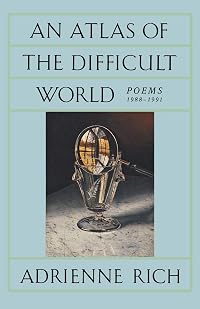
An Atlas of the Difficult World: Poems 1988-1991
by Adrienne Rich
On This Page
Description
Winner of the Los Angeles Times Book Prize.Tags
Recommendations








Member Reviews
XIII (Dedications)
I know you are reading this poem
late, before leaving your office
of the one intense yellow lamp-spot and the darkening window
in the lassitude of a building faded to quiet
long after rush-hour. I know you are reading this poem
standing up in a bookstore far from the ocean
on a grey day of early spring, faint flakes driven
across the plains’ enormous spaces around you.
I know you are reading this poem
in a room where too much has happened for you to bear
where the bedclothes lie in stagnant coils on the bed
and the open valise speaks of flight
but you cannot leave yet. I know you are reading this poem
as the underground train loses momentum and before running
up the stairs
toward a new kind of love
your life has show more never allowed.
I know you are reading this poem by the light
of the television screen where soundless images jerk and slide
while you wait for the newscast from the intifada.
I know you are reading this poem in a waiting-room
of eyes met and unmeeting, of identity with strangers.
I know you are reading this poem by fluorescent light
in the boredom and fatigue of the young who are counted out,
count themselves out, at too early an age. I know
you are reading this poem through your failing sight, the thick
lens enlarging these letters beyond all meaning yet you read on
because even the alphabet is precious.
I know you are reading this poem as you pace beside the stove
warming milk, a crying child on your shoulder, a book in your
hand
because life is short and you too are thirsty.
I know you are reading this poem which is not in your language
guessing at some words while others keep you reading
and I want to know which words they are.
I know you are reading this poem listening for something, torn
between bitterness and hope
turning back once again to the task you cannot refuse.
I know you are reading this poem because there is nothing else
left to read
there where you have landed, stripped as you are. show less
I know you are reading this poem
late, before leaving your office
of the one intense yellow lamp-spot and the darkening window
in the lassitude of a building faded to quiet
long after rush-hour. I know you are reading this poem
standing up in a bookstore far from the ocean
on a grey day of early spring, faint flakes driven
across the plains’ enormous spaces around you.
I know you are reading this poem
in a room where too much has happened for you to bear
where the bedclothes lie in stagnant coils on the bed
and the open valise speaks of flight
but you cannot leave yet. I know you are reading this poem
as the underground train loses momentum and before running
up the stairs
toward a new kind of love
your life has show more never allowed.
I know you are reading this poem by the light
of the television screen where soundless images jerk and slide
while you wait for the newscast from the intifada.
I know you are reading this poem in a waiting-room
of eyes met and unmeeting, of identity with strangers.
I know you are reading this poem by fluorescent light
in the boredom and fatigue of the young who are counted out,
count themselves out, at too early an age. I know
you are reading this poem through your failing sight, the thick
lens enlarging these letters beyond all meaning yet you read on
because even the alphabet is precious.
I know you are reading this poem as you pace beside the stove
warming milk, a crying child on your shoulder, a book in your
hand
because life is short and you too are thirsty.
I know you are reading this poem which is not in your language
guessing at some words while others keep you reading
and I want to know which words they are.
I know you are reading this poem listening for something, torn
between bitterness and hope
turning back once again to the task you cannot refuse.
I know you are reading this poem because there is nothing else
left to read
there where you have landed, stripped as you are. show less
Shortly after we moved back to California after nearly 25 years in Savannah, Georgia, my mother-in-law found an article in a Sunday Supplement of her newspaper and she cut it out for me because she knew I was having trouble adjusting to this new place I was now living. The article was about Adrienne Rich and her move to California and it included the opening section of the title poem in this book which is description of the Central Valley as she saw it when she drove through. There were two phrases in that section that struck me full force and started me on the road to “feeling at home” here in the Central Valley where my husband was raised but I had never known. In the summer here all the hills turn brown because the only things show more that stay green are irrigated. I spent a lot of time driving up to my parents’ house in Northern California and I found these brown hills dreary. A phrase from the poem—“the cattle on their blond hills” -- became something Hubby and started saying every time we made the trip, and changed my perception of this phenomenon. To this day I still think of that phrase with a smile as I pass the “blond hills.” The section ends with the following lines: “These are not the roads you knew me by. But the woman driving, walking, watching for life and death, is the same.” That’s when I realized I had only changed my place of living, I had not lost myself—I was still the same.
It is now over 13 years later and I have finally read the entire poem and I still find it all as powerful as it was to me when I really needed that first fragment. The second half of the book are other poems she wrote during the years 1988-1991 and are also very good. This is my first encounter with a complete book of Adrienne Rich poems, although I have known her name and I’m sure have probably read a poem or two of hers in anthologies. Now I am going to be seeking her out and reading her more carefully. I highly recommend this book to anyone who loves poetry. She is not easy but she is definitely worth the effort. show less
It is now over 13 years later and I have finally read the entire poem and I still find it all as powerful as it was to me when I really needed that first fragment. The second half of the book are other poems she wrote during the years 1988-1991 and are also very good. This is my first encounter with a complete book of Adrienne Rich poems, although I have known her name and I’m sure have probably read a poem or two of hers in anthologies. Now I am going to be seeking her out and reading her more carefully. I highly recommend this book to anyone who loves poetry. She is not easy but she is definitely worth the effort. show less
Engaging with societal concerns and documenting America's progressions and concerns, this collection is a powerful and graceful statement of poetic need and the possibilities inherent in literature. Each poem is a graceful engagement with historical and/or societal concern, both heartbreaking and hopeful. Rich's unflinching prose is both documentary and progressive, working for change, and for awareness.
Eloquent, masterful, clear: this collection is not just for poetry readers, but for any reader at all. Absolutely recommended.
Eloquent, masterful, clear: this collection is not just for poetry readers, but for any reader at all. Absolutely recommended.
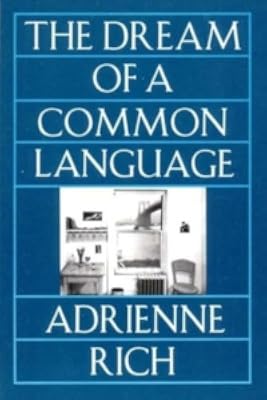
Winner of the Los Angeles Times Book Prize. In this, her thirteenth book of verse, the author of "The Dream of a Common Language" and "Snapshots of a Daughter-in-Law" writes of war, oppression, the future, death, mystery, love and the magic of poetry.
Ratings
Members
- Recently Added By
Author Information

105+ Works 9,943 Members
Adrienne Cecile Rich was born in Baltimore, Maryland on May 16, 1929. In 1951 she graduated from Radcliffe College and was selected for the Yale Series of Younger Poets prize by W.H. Auden. She began teaching for City College of New York in 1968, and was also a lecturer and adjunct professor at Swarthmore College and Columbia University School of show more the Arts. She taught in CUNY's basic writing program during the early 1970s. In the 1970s, she started to be active in the women's liberation movement. Her work has been characterized as confrontational, treating women's role in society, racism, and the Vietnam War. In addition to many collections of poetry, she has also written several books of nonfiction prose, such as Arts of the Possible: Essays and Conversations, What is Found There: Notebooks on Poetry and Politics, and Of Woman Born: Motherhood as Experience and Institution. Her last poetry collection was entitled Tonight No Poetry Will Serve: Poems 2007-2010. She has won numerous literary awards, including the 1986 Ruth Lilly Poetry Prize, the 1992 Poets' Prize, the 1997 Wallace Stevens Award of the Academy of American Poets, the 2004 National Book Critics Circle Award in Poetry, and the 2006 National Book Foundation Medal of Distinguished Contribution to American Letters. She has also received the Bollingen Prize, the Lannan Lifetime Achievement Award, the Academy of American Poets Fellowship, the Lenore Marshall Poetry Prize, and a MacArthur Fellowship. In 1974, she refused to receive as an individual the National Book Award for Poetry, instead accepting it on behalf of all silenced women. She also refused the National Medal of Arts in 1997, stating that "I could not accept such an award from President Clinton or this White House because the very meaning of art, as I understand it, is incompatible with the cynical politics of this administration." In 2012, she won the Lifetime Recognition Award from the Griffin Poetry Prize. She died from long-term rheumatoid arthritis on March 27, 2012. (Bowker Author Biography) show less
Awards and Honors
Awards
Work Relationships
Common Knowledge
- Original publication date
- 1991
- Dedication
- for John Benedict, in memory
- Blurbers
- Heilbrun, Carolyn G.; Merwin, W.S.; Olds, Sharon
Classifications
Statistics
- Members
- 431
- Popularity
- 71,873
- Reviews
- 4
- Rating
- (4.04)
- Languages
- Catalan, English
- Media
- Paper, Ebook
- ISBNs
- 4
- ASINs
- 1