On This Page
Description
Swagger becomes interested in exploring JFK's assassination, asking questions few have asked before.Tags
Recommendations
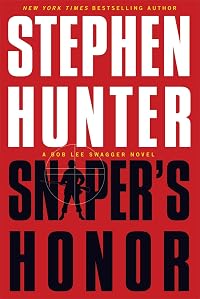



Member Reviews
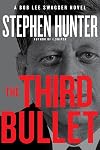
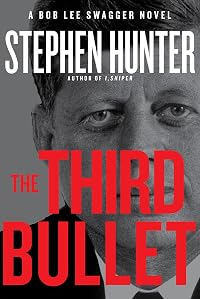
It's not even a clue. It's a whisper, a trace, a ghost echo, drifting down through the decades via chance connections so fragile that they would disintegrate in the puff of a breath. But it's enough to get legendary former Marine sniper Bob Lee Swagger interested in the events of November 22, 1963, and the third bullet that so decisively ended the life of John F. Kennedy and set the stage for one of the most enduring controversies of our time.
Insightful theory about the JFK assassination provides the plot for an excellent entry in the already very good Bob Lee Swagger thriller series. Lots of "gun stuff" for the NRA crowd with deft explanations, even a drawing, for those who are not aficionados. Bob, the 65 year old super sniper, continues to cut down potential assassins from Moscow to rural Connecticut. Hunter delves into the arcane world of Galton, Nabokov and Jorge Luis Borges and couples it with the New Criticism as an analytical tool to produce a puzzle for Bob to solve. With dogged perseverance, innate, untrained but excellent analytical skills seasoned by dogged rural orneriness; he does locate the rogue CIA officer who masterminded the "grassy knoll" murder scenario show more that set up Lee Harvey Oswald as a very willing dupe. show less
The Third Bullet is a bit of a mixed bag. I am always one for a good conspiracy theory, and although I’m not steeped in the JFK assassination conspiracies, it seemed like a good premise. There were parts of this book that moved at a good pace, were intriguing, and had quality writing. There were other parts that just dragged on and on. To make matters worse, there was a serious lack of drama at times in the story. The way parts of the narration worked, the conspirator of the JFK assassination would go on long soliloquies about the assassination and then Bobby Lee Swagger would be investigating and trying to put the pieces together, but the reader already has put the pieces together because we just read about it. It seemed to be a show more pointless way to narrate the story. I think a third if not a half of this novel could have been chopped off, and it would have made for a better read.
There were times when I was really into the novel, such as when Bob Lee Swagger was on the chase in Dallas and Russia, but just when things were going good there would be a long-winded narrative about bullets and rifles and it would take me out of the story. The ending of the novel was so utterly unrealistic to the point of being ludicrous. The novel ended on a down note, but on balance I liked it more than I didn’t, and it’s worth a read.
Carl Alves – author of Conjesero show less
There were times when I was really into the novel, such as when Bob Lee Swagger was on the chase in Dallas and Russia, but just when things were going good there would be a long-winded narrative about bullets and rifles and it would take me out of the story. The ending of the novel was so utterly unrealistic to the point of being ludicrous. The novel ended on a down note, but on balance I liked it more than I didn’t, and it’s worth a read.
Carl Alves – author of Conjesero show less
I liked this book. It was a real adventure to read and even though it plodded along at times (I wouldn't call it a "thriller."), I guess it was kind of a suspense novel. Bob Lee Swagger is a former Marine sniper who gained fame in Vietnam. Now, he's approached by the widow of a writer who was murdered in DC, potentially because he was on to something new with JFK's assassination. So Bob takes this on, goes to Dallas, and starts snooping around. And almost immediately is the target of an assassination attempt, which he thwarts through some good shooting. Ah, the author is a gun man. He's knows his guns and even though at times it feels like he's nearly arrogant about his knowledge, he does make things seem realistic. Since the dead show more assassin is Russian, Swagger goes to Russia to look into some things and is attacked there. He escapes through some good shooting and the help of a colleague, a fellow sniper. At this point in the book, the author does something odd. He starts narrating chapters through the "diary" of the mastermind behind JFK's assassination and it adds and takes away from the story. It adds, because we find out how it was actually accomplished and it's fascinating reading. It takes away because it's not entirely believable. As we go through the course of the story and Swagger gets closer to the truth, the diarist starts writing in "real time," which obviously can't be happening in real time. It stretches the imagination. Oh, there was indeed a second shooter, in a neighboring building. And there was a support team. And Oswald was a puppet. And the author is good. This really reads like nonfiction. Every tiny little detail is laid out for inspection, and then related to the reader as plausible, and it really works. While Swagger is debunking conspiracy theories, the author essentially creates a new one which is the best one I've heard/read yet. It's really possible, or so you're led to think. Of course, our hero -- Swagger -- has to track down the culprit and the final pages are action packed, so perhaps it's a bit of a thriller, but the book has a largely satisfying ending, so that's good. I've read a lot of reviews that say this book doesn't stack up to other books by Hunter and some that have problems with the mastermind's diary, like me, but I'm able to overlook that and enjoy, for the most part. Still, I've got to knock it down from five to four stars for that. However, it was a very detailed, well thought out book and I heartily recommend it. show less
I really enjoyed this novel since I'm a avid J.F.K. assassination conspiracy enthusiast, the author gives his theory of what might have happened that dreadful day in Nov. 1963. Most of the things he talks about I've already read in other books about this assassination, but some of the subject matters that he talks about were new too me, getting me too more research too see if these matters had any validity to them. Hopefully some day these questions will be answered, since most that were there that day are passed away.
It is not often I simply give up on a book - this was one of the rare occurrences. The lead character - Bob Lee Swagger - did absolutely nothing for me. I understand he is a recurring primary character in many of the author's novels. Compared to many of the recurring "thriller" characters (Reacher, Pendergast, etc.) he is a pale comparison.
The plot centers of Swagger trying to solve the mystery of Kennedy's assassination. This is a tired and worn out issue. I have never bought in to conspiracy theories, so...
Steven King's approach to the Kennedy assasination in 11/22/63 was much more novel and unique - of course it was written by Steven King !
The plot centers of Swagger trying to solve the mystery of Kennedy's assassination. This is a tired and worn out issue. I have never bought in to conspiracy theories, so...
Steven King's approach to the Kennedy assasination in 11/22/63 was much more novel and unique - of course it was written by Steven King !
Author's afterwords pulled it all together. I think of this a two books folded together; an action Swaggar story plus a dry trade craft story. This time Hunter's style of going back in time a few hours to tell the story for a different point of view worked for me.
Members
- Recently Added By
Author Information

39+ Works 12,466 Members
Stephen Hunter was born on March 25, 1946, in Kansas City, Missouri. He received a bachelor's degree in journalism from Northwestern University in 1968. He spent two years in the United States Army as a ceremonial soldier in Washington, D.C., and later wrote for a military paper, the Pentagon News. In 1971, he joined The Baltimore Sun as a copy show more editor and he became its film critic in 1982. He won the American Society of Newspaper Editors Distinguished Writing Award in the criticism category in 1998 and the Pulitzer Prize for Criticism in 2003. He is the author of several books including The Master Sniper, The Second Saladin, Dirty White Boys, and Soft Target. He is also the author of the Bob Lee Swagger series and the Earl Swagger series. He has written non-fiction books including Violent Screen: A Critic's 13 Years on the Front Lines of Movie Mayhem, American Gunfight, and Now Playing at the Valencia. (Bowker Author Biography) show less
Series

Common Knowledge
- Canonical title
- The Third Bullet
- Alternate titles
- The Third Bullet: A Bob Lee Swagger Novel
- Original publication date
- 2013
- People/Characters
- Bob Lee Swagger
Classifications
Statistics
- Members
- 488
- Popularity
- 62,177
- Reviews
- 12
- Rating
- (3.58)
- Languages
- English, German
- Media
- Paper, Audiobook, Ebook
- ISBNs
- 15
- ASINs
- 4