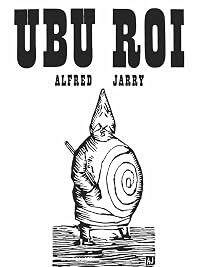
King Ubu
by Alfred Jarry
On This Page
Description
A stunning, controversial work that immediately outraged audiences with its scatological references during the 1896 premiere, the farce satirizes the tendency of the successful bourgeois to abuse his authority and become irresponsibly complacent. Championed as the first absurdist drama, Ubu Roi features a main character that is cruel, gluttonous, and grotesque.
Tags
Recommendations

















Member Reviews
یه پارودی از مکبث محسوب میشه... نسبت به سال اجرا شدنش که ۱۸۹۶ بوده یه نمایشنامهی آوانگارد محسوب میشده و مؤلفههای داداییسم و سوررئالیسم رو که بعد از جنگ جهانی اول همهگیر میشه رو در خودش داره و رو خود جلد هم زده اولین نمایشنامهی ابزورد جهان! و ابزورد هم تا بعد از جنگ دوم جهانی به وجود نمیاد. یه جورایی «تریسترام شندی» ادبیات نمایشیه.
به شدت من رو یاد فیلمهایی مثل دیگتاتور یا نمایشنامهی امپراتور جونز show more یوجین اونیل یا حتی «دموکراسی یا دموقراضه» مینداخت. تجربهی باحالیه خوندنش. show less
به شدت من رو یاد فیلمهایی مثل دیگتاتور یا نمایشنامهی امپراتور جونز show more یوجین اونیل یا حتی «دموکراسی یا دموقراضه» مینداخت. تجربهی باحالیه خوندنش. show less
Alfred Jarry is probably in my top 20 favorite writers & this is his most famous bk. It's also one of the ones that I find least interesting. It's basically juvenilia - striking in its clear rebelliousness & biting satire but not necessarily THAT great otherwise. Nonetheless, I HAVE 7 EDITIONS OF THIS - 4 IN ENGLISH, 1 IN SPANISH, & 2 IN FRENCH. & mon Français est minimale (et mauvais) & I don't speak Spanish at all. Each of the editions is interestingly different. This particular New Directions edition is illustrated by Franciszka Themerson & I don't even really like her drawings - but I still like the edition w/ its handwritten text & generally SCRAWLING layout. One of the English editions that I have is translated as "King Turd"! I show more haven't read that one yet - it claims to be the 1st complete edition of all of Jarry's Ubu writings. show less
At a time when everything seems absurd, this play casts a shining light on society and government. As long as systems of government are corrupt this, this play will have meaning.
Ubu roi is first and foremost a piece of theater and thus is better seen in performance than read. I first heard of this play during a lecture by Jean Baudrillard at Columbia back in 2005. Baudrillard claimed to be a pataphysician, a "philosophy" that he traced back to Alfred Jarry's Ubu roi. I don't claim to even now have a firm grasp of exactly what pataphysics "means" (neither Baudrillard nor Ubu roi were (are) particularly illuminating on the subject) other than that it purports to be the "science of imaginary solutions" and parodies the theory and methods of modern science. What this has to do with Ubu roi itself is a bit mystifying, other than that both philosophy and play are "expressed in nonsensical language."
In any case, I show more first read the play when the folio edition accidentally came my way (I believe a friend's son had read it in a French class). Accident, absurdity and contradiction are intrinsic both to the philosophy and the play, so my accidental reading of it was in synch with the work itself. In December 2008 a local experimental theater group in Santa Rosa, The Imaginists, staged Ubu Roi in their converted storefront theater. I attended and must admit that the play is quite entertaining as theater, since it incorporates masks, puppets, and all manner of slapstick and buffoonery. And so, of course, I had to re-read the play after seeing it performed. I had the same reaction to the play as text on a second reading that I had on the first. The play is billed (and blurbed) as having become "a universal symbol of the absurdity of power, despotism and cruelty." In short, an updated version of the old tale of the Emperor Who Has No Clothes. Nothing too revolutionary but fun to watch when performed by a talented crew such as The Imaginists. Leave the book on the shelf and get thee to the theater would be my advice. show less
In any case, I show more first read the play when the folio edition accidentally came my way (I believe a friend's son had read it in a French class). Accident, absurdity and contradiction are intrinsic both to the philosophy and the play, so my accidental reading of it was in synch with the work itself. In December 2008 a local experimental theater group in Santa Rosa, The Imaginists, staged Ubu Roi in their converted storefront theater. I attended and must admit that the play is quite entertaining as theater, since it incorporates masks, puppets, and all manner of slapstick and buffoonery. And so, of course, I had to re-read the play after seeing it performed. I had the same reaction to the play as text on a second reading that I had on the first. The play is billed (and blurbed) as having become "a universal symbol of the absurdity of power, despotism and cruelty." In short, an updated version of the old tale of the Emperor Who Has No Clothes. Nothing too revolutionary but fun to watch when performed by a talented crew such as The Imaginists. Leave the book on the shelf and get thee to the theater would be my advice. show less
It's kindof interesting that Franciszka Themerson illustrated not just one but TWO editions of this Jarry play. I didn't like her 1st version made for New Directions in 1961 that much, I like this one from 9 yrs later more. In the meantime, she designed the stage setting for a Stockholm production in 1964. I mean, either she was really into Ubu Roi or she somehow got pigeonholed as the Ubu Roi visualizer. I'll assume it was the former. Her drawings here, as w/ the ND version, are somewhat deceptively seeming scribbles but there's more to them than one might initially notice. The drawings go outside the comic-bk framing, there are multiple layers & multiple line thicknesses. It seems that she deliberately kept to a 'primitive' style to show more stay in keeping w/ Jarry's bludgeoningly reductionist parody. I wonder what her style was like otherwise? Did she ever make meticulously rendered drawings for different subjects? Outside of the Ubu Roi context I'm not familiar w/ her at all. show less
Like most of the participants in Ubu Week, I am at a bit of a loss when it comes to actually writing about Alfred Jarry's aggressively odd contribution to French theatre. Having only read the first play in the series, Ubu roi (which I understand is not the best), I am left with an impression of frat-boy humor that is somehow also a revolutionary step toward surrealism; a piece that invites comparison to everything from Shakespeare's Falstaff, to Monty Python's exploding man sketch, to some kind of appalling reality show on competitive cannibalism or something. ("Next, on FOX...") Seriously, what to say?
Regular readers may remember that I'm slowly and very casually compiling a reading list around the literary treatment of disgust and show more the disgusting, and this is probably the angle from which Ubu roi most interests me. Its main character and raison d'être, Père Ubu, is viscerally disgusting both morally and physically, and indeed eliciting shock and disgust, and expressing Jarry's own disgust with certain personality types and social assumptions, seems to have been a major goal of the plays to begin with. As such, they're a great jumping-off point for a catalog of possible sources of literary revulsion.
So, what's so disgusting about Père Ubu? His physical form, famously obese and with a head and face distorted to the point of inhumanity, makes a good start. The costume suggested by Jarry even includes a mask, which further separates Père Ubu from the world of the human.
From Dorian Grey's portrait to Lord Voldemort's snake face, it's always tempting to make a morally repugnant character physically repulsive as well, and even before Ubus père and mère become splattered with brains, they are a pretty repellent pair. (I question whether a production staged with marionettes, as this one sometimes has been, could achieve quite the levels of disgust possible for flesh-and-blood actors, although the puppets would add an extra level of inhumanity.) Père Ubu looks like the grotesque embodiment of id that his actions quickly prove him to be, with a giant spiral marking his insatiable stomach or "gidouille," the pit into which more or less anything is liable to vanish, and the before-mentioned mask obscuring his facial expressions just as the monotone voice which Jarry recommended for him, would mask vocal intonation.
Père Ubu's physical form, then, combines at least three modalities of disgust: the disgusting-as-distorted-or-out-of-place (the mask, the grotesque proportions); the disgusting-as-corporeal (his messiness and fatness; the references to his various orifices); and, in seeming contradiction to the second, the disgusting-as-void, a modality which might even verge on the eerie or frightening, rather than the disgusting. Anything can be subsumed into Père Ubu's gidouille, and while it's certainly disgusting to think of ingesting human flesh, for example, it's also horrifying to think of being eaten and thereby eliminated, subsumed into another. I think it's the combination of all three modalities that makes for a true coup de dégoût: Père Ubu combines the monstrous and bestial with the undeniably and uncomfortably human in a way that can't fail to repulse.
The speech and actions of the Ubus, of course, only reinforce this triple threat of repugnance. From the famous first word ("Merdre," a verbing of the French word "merde" or "shit"), the couple's odd coinages continue the theme of distortion and the out-of-place while at the same time making words and ideas that were already obscene, even grosser and messier. At the same time, Père Ubu's behavior takes the corporeal aspect of disgust to new levels: before a dinner party, for example, he gorges himself on the food laid out for the guests, then sits in a corner groaning about how fat and full he is, before proceeding to poison the food that all his guests are eating. The disgust of satiety is well represented in this scene: not only are we confronted with someone who has stuffed themselves to bursting before the meal even begins, but Mère Ubu's menu is comically large (thinking of eating so much food is disgusting), and features such delicacies as choux-fleurs à la merdre, or cauliflower à la shitting (thinking of eating this is disgusting all by itself). Add to the ideas of surfeit and coprophagia the body's reaction to having consumed poison, as well as Père Ubu's frequent threats to eat Mère Ubu, and you get a very disgusting scene indeed.
Interestingly, the most morally reprehensible actions in the play are the ones I, at least, found least viscerally disgusting. The murder of the Polish king, for example, is not particularly played for the gross-out. Nor is the scene (which I found to be one of the funniest in the play) when Père Ubu and his two lackies are attacked by a bear, and Père Ubu lets the lackies kill the beast while cowering in a corner—later telling them, in a very Falstaffian move, that
This, and the seemingly random and jubilant execution of the nobles (the moral vacuum of which scene Amateur Reader addresses here), are the scenes that perhaps should disgust us the most—in the scene of cowardice, even Père Ubu's lackey calls him a revolting swine. But at least for me, they're not the most disgusting, which is an interesting commentary. Our perceptions of moral and physical disgust are so intertwined (often, of course, mistakenly, although not in the case of Ubu roi—this is an aspect of the play that's not particularly subversive), that it's easy to believe that a character who looks and speaks like Père Ubu will act in a cowardly, cruel way. What one does not expect, however jaded one might be, are threats of debraining.
Perhaps, also, one needs a deep sense of a victim's humanity before one is able to feel deeply disgusted by moral flaws like cruelty and cowardice. This is the point of those human-interest stories highlighting individuals who, for example, lost their retirement savings due to the greed of Enron executives, or their homes as a result of speculation on the housing market. Moral outrages tend to sicken only when embodied, when we can see the concrete pain that has been caused. Since all characters in the Ubu plays are broad, satirical sketches, not intended as real-seeming humans, and since Père Ubu's more reaching atrocities tend to be oddly uncoupled from the extreme embodiment found in the shit-eating, debraining, and cannibalism sections of the plays, said atrocities often achieve comedy and occasionally horror, but seem (especially by contrast) strangely devoid of disgust.
So. Are we all grossed out yet? One more note on disgust in Ubu roi: it interested me, especially given the prominence of the husband/wife duo, that sex-as-source-of-disgust doesn't really feature in this play. Those who have read the next in the cycle, Ubu cocu, can tell me: does it feature in that one? For a work that seems methodically to hit all the major categories of disgust, it seems a glaring omission, especially since Père Ubu's void-like gidouille functions like a kind of ungendered vagina dentata: the monstrous and amoral body part that will consume whatever comes into contact with it.
And with that, my friends, I'm off to take a shower and brush my teeth. Thoroughly. Several times. show less
Regular readers may remember that I'm slowly and very casually compiling a reading list around the literary treatment of disgust and show more the disgusting, and this is probably the angle from which Ubu roi most interests me. Its main character and raison d'être, Père Ubu, is viscerally disgusting both morally and physically, and indeed eliciting shock and disgust, and expressing Jarry's own disgust with certain personality types and social assumptions, seems to have been a major goal of the plays to begin with. As such, they're a great jumping-off point for a catalog of possible sources of literary revulsion.
So, what's so disgusting about Père Ubu? His physical form, famously obese and with a head and face distorted to the point of inhumanity, makes a good start. The costume suggested by Jarry even includes a mask, which further separates Père Ubu from the world of the human.
From Dorian Grey's portrait to Lord Voldemort's snake face, it's always tempting to make a morally repugnant character physically repulsive as well, and even before Ubus père and mère become splattered with brains, they are a pretty repellent pair. (I question whether a production staged with marionettes, as this one sometimes has been, could achieve quite the levels of disgust possible for flesh-and-blood actors, although the puppets would add an extra level of inhumanity.) Père Ubu looks like the grotesque embodiment of id that his actions quickly prove him to be, with a giant spiral marking his insatiable stomach or "gidouille," the pit into which more or less anything is liable to vanish, and the before-mentioned mask obscuring his facial expressions just as the monotone voice which Jarry recommended for him, would mask vocal intonation.
Père Ubu's physical form, then, combines at least three modalities of disgust: the disgusting-as-distorted-or-out-of-place (the mask, the grotesque proportions); the disgusting-as-corporeal (his messiness and fatness; the references to his various orifices); and, in seeming contradiction to the second, the disgusting-as-void, a modality which might even verge on the eerie or frightening, rather than the disgusting. Anything can be subsumed into Père Ubu's gidouille, and while it's certainly disgusting to think of ingesting human flesh, for example, it's also horrifying to think of being eaten and thereby eliminated, subsumed into another. I think it's the combination of all three modalities that makes for a true coup de dégoût: Père Ubu combines the monstrous and bestial with the undeniably and uncomfortably human in a way that can't fail to repulse.
The speech and actions of the Ubus, of course, only reinforce this triple threat of repugnance. From the famous first word ("Merdre," a verbing of the French word "merde" or "shit"), the couple's odd coinages continue the theme of distortion and the out-of-place while at the same time making words and ideas that were already obscene, even grosser and messier. At the same time, Père Ubu's behavior takes the corporeal aspect of disgust to new levels: before a dinner party, for example, he gorges himself on the food laid out for the guests, then sits in a corner groaning about how fat and full he is, before proceeding to poison the food that all his guests are eating. The disgust of satiety is well represented in this scene: not only are we confronted with someone who has stuffed themselves to bursting before the meal even begins, but Mère Ubu's menu is comically large (thinking of eating so much food is disgusting), and features such delicacies as choux-fleurs à la merdre, or cauliflower à la shitting (thinking of eating this is disgusting all by itself). Add to the ideas of surfeit and coprophagia the body's reaction to having consumed poison, as well as Père Ubu's frequent threats to eat Mère Ubu, and you get a very disgusting scene indeed.
Interestingly, the most morally reprehensible actions in the play are the ones I, at least, found least viscerally disgusting. The murder of the Polish king, for example, is not particularly played for the gross-out. Nor is the scene (which I found to be one of the funniest in the play) when Père Ubu and his two lackies are attacked by a bear, and Père Ubu lets the lackies kill the beast while cowering in a corner—later telling them, in a very Falstaffian move, that
Vous pouvez vous flatter que si vous êtes encore vivants et si vous foulez encore la neige de Lithuanie, vous le devez à la vertue magnanime du Maître des Finances, qui s'est évertué, échiné et égosillé à débiter des patenôtres pour votre salut, et qui a manié avec autant de courage le glaive spirituel de la prière que vous avez manié avec adresse le temporel de l'ici présent Palotin Cotice coup-de-poing explosif.
You can flatter yourselves that if you're still alive to tread the snow of Lituania, you owe it to the magnanimous virtue of the Master of Finances [Père Ubu himself], who strove with great effort, yelling at the top of his voice, to discharge Pater Nosters for your health, and who handled with such courage the spiritual sword of prayer while you took on the here-present temporal weapon of the Knight Errant's explosive fist-punches.
This, and the seemingly random and jubilant execution of the nobles (the moral vacuum of which scene Amateur Reader addresses here), are the scenes that perhaps should disgust us the most—in the scene of cowardice, even Père Ubu's lackey calls him a revolting swine. But at least for me, they're not the most disgusting, which is an interesting commentary. Our perceptions of moral and physical disgust are so intertwined (often, of course, mistakenly, although not in the case of Ubu roi—this is an aspect of the play that's not particularly subversive), that it's easy to believe that a character who looks and speaks like Père Ubu will act in a cowardly, cruel way. What one does not expect, however jaded one might be, are threats of debraining.
Perhaps, also, one needs a deep sense of a victim's humanity before one is able to feel deeply disgusted by moral flaws like cruelty and cowardice. This is the point of those human-interest stories highlighting individuals who, for example, lost their retirement savings due to the greed of Enron executives, or their homes as a result of speculation on the housing market. Moral outrages tend to sicken only when embodied, when we can see the concrete pain that has been caused. Since all characters in the Ubu plays are broad, satirical sketches, not intended as real-seeming humans, and since Père Ubu's more reaching atrocities tend to be oddly uncoupled from the extreme embodiment found in the shit-eating, debraining, and cannibalism sections of the plays, said atrocities often achieve comedy and occasionally horror, but seem (especially by contrast) strangely devoid of disgust.
So. Are we all grossed out yet? One more note on disgust in Ubu roi: it interested me, especially given the prominence of the husband/wife duo, that sex-as-source-of-disgust doesn't really feature in this play. Those who have read the next in the cycle, Ubu cocu, can tell me: does it feature in that one? For a work that seems methodically to hit all the major categories of disgust, it seems a glaring omission, especially since Père Ubu's void-like gidouille functions like a kind of ungendered vagina dentata: the monstrous and amoral body part that will consume whatever comes into contact with it.
And with that, my friends, I'm off to take a shower and brush my teeth. Thoroughly. Several times. show less
Absurd and likely some of the inspiration of the Dada art and literature movement. This is not for everyone but in it's ridiculousness there are some kernels of wisdom. Remarkably relevant to today's environment.
Members
- Recently Added By
Lists

Favourite Books
1,820 works; 316 members

19th Century
190 works; 16 members

1890s
49 works; 6 members

Favourite Theatre of the Absurd
30 works; 4 members

Yet another list
69 works; 1 member

Llibres que he llegit el 2025
81 works; 2 members
Author Information

153+ Works 3,472 Members
Alfred Jarry, eccentric dramatist, poet, and humorist, was born in Laval, France, in 1873. He was the co-founder, with Remy de Gourmont in 1894, of the magazine L'ymagier, which literally translated is "the maker of prints." This magazine, in existence only two years, presented texts and art images from a number of literary avant-garde artists of show more the late 19th century. Jarry is perhaps best known for the satirical and farcical play Ubu Roi (King Ubu), the first in a series of Ubu plays, published in 1896. Jarry died in 1907 in Paris. (Bowker Author Biography) show less
Some Editions
Awards and Honors
Series
Belongs to Publisher Series
Work Relationships
Is contained in
Has as a student's study guide
Common Knowledge
- Canonical title
- King Ubu
- Original title
- Ubu roi
- Alternate titles
- Ubu Roi
- Original publication date
- 1896
- Original language
- French
Classifications
Statistics
- Members
- 1,156
- Popularity
- 21,875
- Reviews
- 16
- Rating
- (3.50)
- Languages
- 17 — Catalan, Czech, Dutch, English, Esperanto, Finnish, French, German, Hungarian, Italian, Lithuanian, Polish, Spanish, Swedish, Turkish, Walloon, Portuguese (Portugal)
- Media
- Paper, Audiobook, Ebook
- ISBNs
- 92
- UPCs
- 1
- ASINs
- 20