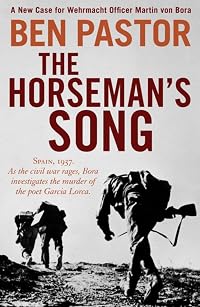
The Horseman's Song
by Ben Pastor
Martin Bora | Chronological (Summer 1937 | 1), Martin Bora | English publication order (6)
On This Page
Description
Spain, July 1937. The tragic prelude to World War II is played out in the Spanish Civil War. Among Franco's troops is Martin Bora, the young German officer and detective, assigned to the Spanish Foreign Legion in the sierras of Aragon. When Bora happens on the body of Federico García Lorca, the brilliant Spanish poet and playwright, he begins a perilous investigation of the murder. His inquiry paradoxically proceeds alongside that of Walton, his opposite number with the International show more Brigades and a friend of the poet. Soon the German and the New Englander join forces, and their cooperation culminates in a thrilling chase after Lorca's suspected killer. show lessTags
Recommendations




























Member Recommendations
Member Reviews
This book is one of Ben Pastor’s six detective novels featuring German intelligence officer Martin Bora and a prequel to novels covering Bora’s activities during the Second World War.
As the book opens, it’s summer 1937, in the midst of the Spanish Civil War. Two tiny encampments located high in the rocky sierras of Aragon overlook a valley, a cane-lined brook, and the small town of Teruel. Bora heads one of these camps, comprising about seven Nationalists; the other, near enough for occasional sniper-fire, is similarly sized and led by American volunteer Philip Walton. Walton is a World War I veteran, a couple of decades older than Bora, and has joined the Republican side less because of conviction and more because he can’t show more think of anything better to do.
The men in both camps are a ragtag bunch and more prone to follow their own inclinations than any official orders. Neither unit is interested in attacking the other, preferring to save their energies for a big battle rumored to be coming soon. The proximity of these two encampments is illustrated by the fact that both Bora and Walton both visit the same prostitute high on the mountaintop. For Bora, the encounters with this young woman are life-changing; for Walton, they’re a painful reminder he’s aging. Yet they inspire destructive sexual jealousy.
Bora finds the body of a stranger shot in the head on the road below his encampment and wonders how this stranger ended up there. Walton also knows about the corpse, plus he knows who the man is: his friend Federico García Lorca, the revered poet and playwright, homosexual, and staunch Republican. Walton and his men bury García Lorca’s partway up the mountain; Bora’s scouts find the grave, remove the body, and bury it elsewhere. The official story—in the novel as well as in real life—is that García Lorca was murdered in 1936 outside Granada. The authorities on both sides would prefer that Bora and Walton let the official story stand unquestioned.
Separately, they conduct a somewhat clandestine investigation of the events of the fatal night and the motives of various people who might have been involved. It’s slow going, because Walton and Bora are mostly otherwise engaged. The times themselves dampen progress further. If Bora wants to send a message to Teruel, someone has to get on a donkey and take it. A response won’t arrive for hours. If Walton wants to investigate an event in the village of Castellar, he must climb the mountain to do so. The overall impression is of a hostile environment that’s dusty and hot, hot, hot. Author Pastor does an admirable job evoking the landscape, the conditions, and the way things got done (or not) eight decades ago.
With their murder investigations limping along, there is ample opportunity for exploring the characters of both Walton and Bora, as well as several of their underlings. Pastor’s writing style is dense and full of psychological insight. Her short scenes feel almost like an hour-by-hour bulletin on camp activities. And, of course, writing about García Lorca gives the opportunity for pithy epigrams from his wonderful poems.
Ben Pastor is the pseudonym for Maria Verbena Volpi. Born in Rome, she holds dual citizenship in Italy and the United States. Though Martin Bora is fictional, he was inspired by Claus von Stauffenberg, best known for his leading role in the July 1944 attempt to assassinate Adolf Hitler. show less
As the book opens, it’s summer 1937, in the midst of the Spanish Civil War. Two tiny encampments located high in the rocky sierras of Aragon overlook a valley, a cane-lined brook, and the small town of Teruel. Bora heads one of these camps, comprising about seven Nationalists; the other, near enough for occasional sniper-fire, is similarly sized and led by American volunteer Philip Walton. Walton is a World War I veteran, a couple of decades older than Bora, and has joined the Republican side less because of conviction and more because he can’t show more think of anything better to do.
The men in both camps are a ragtag bunch and more prone to follow their own inclinations than any official orders. Neither unit is interested in attacking the other, preferring to save their energies for a big battle rumored to be coming soon. The proximity of these two encampments is illustrated by the fact that both Bora and Walton both visit the same prostitute high on the mountaintop. For Bora, the encounters with this young woman are life-changing; for Walton, they’re a painful reminder he’s aging. Yet they inspire destructive sexual jealousy.
Bora finds the body of a stranger shot in the head on the road below his encampment and wonders how this stranger ended up there. Walton also knows about the corpse, plus he knows who the man is: his friend Federico García Lorca, the revered poet and playwright, homosexual, and staunch Republican. Walton and his men bury García Lorca’s partway up the mountain; Bora’s scouts find the grave, remove the body, and bury it elsewhere. The official story—in the novel as well as in real life—is that García Lorca was murdered in 1936 outside Granada. The authorities on both sides would prefer that Bora and Walton let the official story stand unquestioned.
Separately, they conduct a somewhat clandestine investigation of the events of the fatal night and the motives of various people who might have been involved. It’s slow going, because Walton and Bora are mostly otherwise engaged. The times themselves dampen progress further. If Bora wants to send a message to Teruel, someone has to get on a donkey and take it. A response won’t arrive for hours. If Walton wants to investigate an event in the village of Castellar, he must climb the mountain to do so. The overall impression is of a hostile environment that’s dusty and hot, hot, hot. Author Pastor does an admirable job evoking the landscape, the conditions, and the way things got done (or not) eight decades ago.
With their murder investigations limping along, there is ample opportunity for exploring the characters of both Walton and Bora, as well as several of their underlings. Pastor’s writing style is dense and full of psychological insight. Her short scenes feel almost like an hour-by-hour bulletin on camp activities. And, of course, writing about García Lorca gives the opportunity for pithy epigrams from his wonderful poems.
Ben Pastor is the pseudonym for Maria Verbena Volpi. Born in Rome, she holds dual citizenship in Italy and the United States. Though Martin Bora is fictional, he was inspired by Claus von Stauffenberg, best known for his leading role in the July 1944 attempt to assassinate Adolf Hitler. show less
A slog. As compared to Bora's World War II adventures, much inferior. I was bored and the book dragged but I forced myself to read to the end.
Ratings
Members
- Recently Added By
Author Information

29+ Works 722 Members
Some Editions
Series

Martin Bora | Chronological
13 works (Summer 1937 | 1)

Martin Bora | English publication order
7 works (6)
Belongs to Publisher Series
Common Knowledge
- Canonical title
- The Horseman's Song
- Original publication date
- 2003
- People/Characters
- Martin Bora
- Important events
- Spanish Civil War (1936 | 1939)
Classifications
Statistics
- Members
- 31
- Popularity
- 954,457
- Reviews
- 2
- Rating
- (3.38)
- Languages
- English, Italian
- Media
- Paper, Ebook
- ISBNs
- 6
- ASINs
- 2