
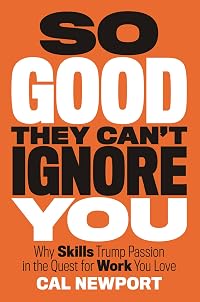
So Good They Can't Ignore You
by Cal Newport
On This Page
Description
In an unorthodox approach, Georgetown University professor Cal Newport debunks the long-held belief that "follow your passion" is good advice, and sets out on a quest to discover the reality of how people end up loving their careers.Not only are pre-existing passions rare and have little to do with how most people end up loving their work, but a focus on passion over skill can be dangerous, leading to anxiety and chronic job hopping. Spending time with organic farmers, venture capitalists, show more screenwriters, freelance computer programmers, and others who admitted to deriving great satisfaction from their work, Newport uncovers the strategies they used and the pitfalls they avoided in developing their compelling careers.
Cal reveals that matching your job to a pre-existing passion does not matter. Passion comes after you put in the hard work to become excellent at something valuable, not before. In other words, what you do for a living is much less important than how you do it.
With a title taken from the comedian Steve Martin, who once said his advice for aspiring entertainers was to "be so good they can't ignore you," Cal Newport's clearly written manifesto is mandatory reading for anyone fretting about what to do with their life, or frustrated by their current job situation and eager to find a fresh new way to take control of their livelihood. He provides an evidence-based blueprint for creating work you love, and will change the way you think about careers, happiness, and the crafting of a remarkable life. show less
Tags
Recommendations
Member Reviews
Cal Newport's So Good They Can't Ignore You was a wake-up call for me. The advice was acutely relevant to my situation at the time that I remember being depressed for a few days. It's sobering to be reminded that if you want to be good at something, let's say good enough to warrant a nice salary increase, there's no way around the hard work that's required to get there.
Cal's Rule #1 I've heard before but not nearly enough given how important it is: Don't Follow Your Passion. It's not saying don't be passionate. Just don't lead with passion. It's an inefficient step at best; catastrophic at worst. Instead of passion, lead with Rule #2: Be So Good They Can't Ignore You. Or, stated differently, work hard to acquire rare and valuable show more skills. This advice sounds blisteringly obvious, but in a way it's like dieting and exercise—it's hard, often boring and terribly un-sexy, and therefore we naturally avoid it.
Rules #1 and #2 are the crux of the whole book. Rule's #3 and #4, dealing with the importance of control and the importance of mission, are worth checking out, but they only build on the first two. All in all, So Good They Can't Ignore You doesn't waste your time. Cal gets his point across and then wraps it up. Similarly, the book is organized well enough that it's easy to jump around if needed. I especially recommend the audiobook. show less
Cal's Rule #1 I've heard before but not nearly enough given how important it is: Don't Follow Your Passion. It's not saying don't be passionate. Just don't lead with passion. It's an inefficient step at best; catastrophic at worst. Instead of passion, lead with Rule #2: Be So Good They Can't Ignore You. Or, stated differently, work hard to acquire rare and valuable show more skills. This advice sounds blisteringly obvious, but in a way it's like dieting and exercise—it's hard, often boring and terribly un-sexy, and therefore we naturally avoid it.
Rules #1 and #2 are the crux of the whole book. Rule's #3 and #4, dealing with the importance of control and the importance of mission, are worth checking out, but they only build on the first two. All in all, So Good They Can't Ignore You doesn't waste your time. Cal gets his point across and then wraps it up. Similarly, the book is organized well enough that it's easy to jump around if needed. I especially recommend the audiobook. show less
I hate this book, and never have I been happier to have stolen one.
While the accusation that this book is little more than a way to keep the poor complacent is overblown, it feels close to accurate. This is certainly the impression you would get if you placed Cal Newport in front of a room full of miners or septic tank cleaners. But Mr. Newport's advice feels genuine enough.
It's just really stupid advice, and it is very poorly reasoned.
Newport fashions one of the dumbest false dichotomies I have ever encountered. He pits passion against craftsmanship, arguing that passion is solely passive and craftsmanship gets things done. This is patently absurd. In one attempt to prove this (and all of Newport's examples will leave you feeling like show more you might have missed something, as does his use of phrases such as 'As I have now demonstrated...') Newport cites a woman who gives up a comfortable job to pursue her passion of Yoga. He mentions, however, that this young woman then takes a month long class to prepare for this. I am sorry, but if this is the case then I think the better argument would be that this woman lacked the passion to begin with. If the extent of her knowledge was the months long class, can we really call her passionate about Yoga? I would argue not.
But even if we take into consideration the possibility that she has taken other classes, and that had in fact years upon years of thoughts theories and classes under her belt regarding the teaching of yoga, passion may not be enough to achieve _financial_ success. And I think that it is at that nucleus that we find the core fault in Newport's reasoning; financial success is not a road to happiness, and that Newport thinks this is the case leads readers to assume that he is little more than a spoiled rich boy.
The reality is that the person in question may be a thousand times happier as a failed yoga instructor than as a successful person in the advertising world.
We could weigh this against another example Newport brings up; that of a young guitarist who works very diligently on his music making. The possibility that this young guitarist is passionate about his music making is something Newport just pens off as irrelevant in light of his hard work. That one might determine the other is completly lost on Newport, and from the quality of his writing we start to suspect that he likely has experienced neither passion or the drive to hard work (this latter you can see from his poor writing style) in his life.
But I think the absolute worst of this is the broad sweeping statements he makes ex nihlo without bothering to try for any form of justification. "Whereas the craftsman mindset focuses on what you can offer the world, the passion mindset focuses instead on what the world can offer you"? That right there, is pure bullshit, and there are hundreds of passionate figures from history we can look to to disprove it. Newport feels like he can just get away with saying such nonsense and therefore it being true.
But I have wasted in enough of my time and yours over this book. The title is advice lifted from the comedian Steve Martin, so if the title interests you find his book instead. For the rest, the only redeeming message this book gives us is to work hard, and I for one did not need this clown to tell me so. show less
While the accusation that this book is little more than a way to keep the poor complacent is overblown, it feels close to accurate. This is certainly the impression you would get if you placed Cal Newport in front of a room full of miners or septic tank cleaners. But Mr. Newport's advice feels genuine enough.
It's just really stupid advice, and it is very poorly reasoned.
Newport fashions one of the dumbest false dichotomies I have ever encountered. He pits passion against craftsmanship, arguing that passion is solely passive and craftsmanship gets things done. This is patently absurd. In one attempt to prove this (and all of Newport's examples will leave you feeling like show more you might have missed something, as does his use of phrases such as 'As I have now demonstrated...') Newport cites a woman who gives up a comfortable job to pursue her passion of Yoga. He mentions, however, that this young woman then takes a month long class to prepare for this. I am sorry, but if this is the case then I think the better argument would be that this woman lacked the passion to begin with. If the extent of her knowledge was the months long class, can we really call her passionate about Yoga? I would argue not.
But even if we take into consideration the possibility that she has taken other classes, and that had in fact years upon years of thoughts theories and classes under her belt regarding the teaching of yoga, passion may not be enough to achieve _financial_ success. And I think that it is at that nucleus that we find the core fault in Newport's reasoning; financial success is not a road to happiness, and that Newport thinks this is the case leads readers to assume that he is little more than a spoiled rich boy.
The reality is that the person in question may be a thousand times happier as a failed yoga instructor than as a successful person in the advertising world.
We could weigh this against another example Newport brings up; that of a young guitarist who works very diligently on his music making. The possibility that this young guitarist is passionate about his music making is something Newport just pens off as irrelevant in light of his hard work. That one might determine the other is completly lost on Newport, and from the quality of his writing we start to suspect that he likely has experienced neither passion or the drive to hard work (this latter you can see from his poor writing style) in his life.
But I think the absolute worst of this is the broad sweeping statements he makes ex nihlo without bothering to try for any form of justification. "Whereas the craftsman mindset focuses on what you can offer the world, the passion mindset focuses instead on what the world can offer you"? That right there, is pure bullshit, and there are hundreds of passionate figures from history we can look to to disprove it. Newport feels like he can just get away with saying such nonsense and therefore it being true.
But I have wasted in enough of my time and yours over this book. The title is advice lifted from the comedian Steve Martin, so if the title interests you find his book instead. For the rest, the only redeeming message this book gives us is to work hard, and I for one did not need this clown to tell me so. show less
"Follow your passion" has always been the advice given to people that I've run into. If you love what you do, good things will follow. This book goes completely against that, and I love it for it. The alternate route to passion is following what you're good at, and what you can make a living at, and let passion follow. The premise is that passion follows expertise, and as you get better at something, your passion for it will increase.
The anecdotal stories told by people who "followed their passion" leading them to change their lifestyle only to realize it wasn't their passion after all were compelling as well. For example dropping everything to join a Buddhist Monastery only to realize it's the wrong life path. I could see a lot of show more amazing advice in this that could counteract the prevailing culture of bad advice on this same subject. show less
The anecdotal stories told by people who "followed their passion" leading them to change their lifestyle only to realize it wasn't their passion after all were compelling as well. For example dropping everything to join a Buddhist Monastery only to realize it's the wrong life path. I could see a lot of show more amazing advice in this that could counteract the prevailing culture of bad advice on this same subject. show less
I liked his other books MUCH better. This one could have been condensed into a lengthy paper. There was far too much repetition, end of chapter summaries, etc. that seemed almost like filler to make a full length book. Unlike his college advice books, Newport relied very heavily on the anecdotes from the examples to make his case. In his second college advice book he interviewed students(45 listed in acknowledgements) and then distilled his advice, not padding it with anecdotes and summaries.
Still, his main points are well taken and worth sharing, especially to college students and early professionals. I do wonder if he is leaving out a broader audience. His contention that one has to work in a field and develop some expertise before show more he/she can truly enjoy the work would extend to many professions and trades that require many different levels of education and training. However, Newport relies almost exclusively (except for musicians) on examples that require graduate work.
I also think his book is weaker because he is still pretty early on in his own career. show less
Still, his main points are well taken and worth sharing, especially to college students and early professionals. I do wonder if he is leaving out a broader audience. His contention that one has to work in a field and develop some expertise before show more he/she can truly enjoy the work would extend to many professions and trades that require many different levels of education and training. However, Newport relies almost exclusively (except for musicians) on examples that require graduate work.
I also think his book is weaker because he is still pretty early on in his own career. show less
I really like the basic premise of this book: that focusing on what you're good at is more satisfying in the long run than doing what you love (and hoping the money will follow). I still like that premise, and I think Cal Newport makes some excellent points in the first chapter or two. After chapter 1 I was prepared to give it five stars.
But as I kept going, I became increasingly annoyed with the predominantly male, affluent, probably white examples. In fact, of the (few) women mentioned in the book, most of them are negative examples--they followed their passion without enough experience to back it up, or they just weren't realistic about financial realities, the poor little dears. Perhaps the title of this book should have been "So show more Good They Can't Ignore You--As Long As You're A Guy With An Ivy League Degree and Well-Off Parents Who Supported You In Pursuing Everything You Ever Showed The Slightest Interest In."
It's an interesting book--although many of the ideas he talks about are kind of old, in Internet time, like Malcolm Gladwell's 10,000-hour rule. It is probably fairly inspiring, and even valuable, if you're a young person who just graduated from a good college and you're casting around for how to build your career. But if you've been out in the work world for a decade or more, you might come away from this book with the crushing sense that it's too late to ever be successful at anything. Or you might just come away thinking that Cal Newport will see things differently when he's 45. :-) show less
But as I kept going, I became increasingly annoyed with the predominantly male, affluent, probably white examples. In fact, of the (few) women mentioned in the book, most of them are negative examples--they followed their passion without enough experience to back it up, or they just weren't realistic about financial realities, the poor little dears. Perhaps the title of this book should have been "So show more Good They Can't Ignore You--As Long As You're A Guy With An Ivy League Degree and Well-Off Parents Who Supported You In Pursuing Everything You Ever Showed The Slightest Interest In."
It's an interesting book--although many of the ideas he talks about are kind of old, in Internet time, like Malcolm Gladwell's 10,000-hour rule. It is probably fairly inspiring, and even valuable, if you're a young person who just graduated from a good college and you're casting around for how to build your career. But if you've been out in the work world for a decade or more, you might come away from this book with the crushing sense that it's too late to ever be successful at anything. Or you might just come away thinking that Cal Newport will see things differently when he's 45. :-) show less
"Working right trumps finding the right work."
In "So Good They Can't Ignore You" by Cal Newport
After having finished "The Subtle Art of Not Giving a F*ck", I wanted to read this one to work as a counterpoint. I'm glad I did.
When I was younger, I watched Jurassic Park one and two, and I wanted to be Steven Spielberg! Doing well in my dance classes made me want to be a professional tap dancer. Watching Top Hat and West Side Story made me want to combine both aspirations to become a director of musicals, both film and theatre! By the time I was in secondary school, the arts were not viewed as a viable career option, and out of law, engineering, and other traditional subjects, I choose to become a Computer Scientist. I was in my final year show more at university studying Computer science, and I'd happily have remained a gentleman-in-waiting for several more years to save up and see the world! (I didn't have a career goal that I was passionate about).
A more honest job description I’d have gladly apply for: “applicant must be willing to perform multiple jobs, cheerfully and deferentially: selling books to rich peeps who read to "better themselves;" babysitting the rich peeps' kids; writing a "creative" blog that conforms to someone else's tastes and dictates; "circulating" among the rich peeps, perhaps by carrying the cheese platters; teaching creative writing courses to rich peeps who read to better themselves; and serving as a promotional prop, the "creative intellectual " rich peeps will speak of amusingly after they jet home. But maybe that would be not so good.
My books-related experience with an A-lister in Lisbon many eons ago too place with Bryn Adams (for those of you who don’t know, Bryan lived many years in Lisbon when he was a teenager; I was running into him all the time in Cascais, our Portuguese Cannes):
Bryan Adams walked into the Bertrand bookstore, my favourite bookstore at the time, accompanied by a tall blonde who was presumably his girlfriend, and a guy with a working-class English accent, who I guessed was his agent or some other sort of factotum. The blonde headed straight for the Romance novels, while the agent asked me to show him the Self-help section. Mr. Adams, apparently not a reader, stood just inside the doorway. Most people will at least aimlessly browse if they're not book lovers. Not Mr. Adams. He stood fidgeting, not giving the shelves of books a glance. After a few minutes, his patience exhausted, Adams put fingers to lips and whistled. The blonde dutifully scampered to his side. The agent brought a couple self-help books to the counter and paid for them while Adams fumed. I looked around but everyone pretended to be paying attention (yes, we Portuguese are very polite and friendly).
My dream job and I can safely say I’d be exceedingly good at it: Writing a blog about my experiences at an exclusive resort in the Canary Islands would be an irresistible opportunity for satire. But it seems satirists in the Canary Islands get stabbed to death. So maybe I'd take a pass in the end. I think I'd probably wind up so exhausted by the whole business of doing navel-gazing, scuba diving, reading, and other worthwhile activities, that any blogging I managed to do at the end of it all would be a retail rant-only-journal. Possibly entertaining for people who are interested in stories of how many different ways of doing fuckall on an island can be wrong (and oh, boy, are there a lot of them), but probably not the sort of light and frothy lifestyles-of-the-rich-and-shameless-come-envy-them-and-come-over-too (why the Canary Islands? Because I’ve booked a cruise to go there come next April 2019 ROTFL!)
Sounded to me pretty much like Viktor Frankl‘s ideas put in modern day wording. But nevertheless, I agree with the most of Newport’s ideas, but I’m not sure about them. I know what is the point...Cal is right about so many things, but saying that "don't follow your passion, it will make you poor and frustrated" isn't a good advice either. It sounds to me more like "love your job by force, then you will become so good that you will feel passion for what you do". Happy times will come in the FUTURE, the same history over and over again. Yeah, you will be passionate because of your comfort zone and your financial situation, but I think that's not the only path for a human being's life to succeed. For me, following your passion is still a good advice. Look at Steve Vai, he became one of the best musicians of the planet just by following his passion.... he said: "I never worked a day in my life, I had a lot of challenges but I made my career with ZERO EFFORT, because playing the guitar was my juice, I just couldn't stop doing it". There is a mistake about the follow or don't follow your passion debate, because we always concentrate on DOING things... you know, if you do this you will be rich, if you do that you will be poor... but is not about on what you DO but on what you THINK... It's all about of the way we think, so you can take any job you want and turn that experience in a positive way, learning as much as possible, but don't get stuck if it’s not your passion: PASSION IS SOMETHING NATURAL WITHIN YOU, IT CAN'T BE BUILT, you can develop your skills, but you can't develop your passion.
In my opinion, you have to notice that the world isn't the same anymore... Maybe this book is useful, but soon words like career, college, grades, jobs and bosses with be part of the past, so my personal advice is to follow your passion AND build up your skills as much as you can on whatever you're doing right now, so you will be so good they can't ignore you anyway :)
NB: I just wish Newport could write proper English. I’m just a bloody foreigner and even I can spot the bad grammar. show less
In "So Good They Can't Ignore You" by Cal Newport
After having finished "The Subtle Art of Not Giving a F*ck", I wanted to read this one to work as a counterpoint. I'm glad I did.
When I was younger, I watched Jurassic Park one and two, and I wanted to be Steven Spielberg! Doing well in my dance classes made me want to be a professional tap dancer. Watching Top Hat and West Side Story made me want to combine both aspirations to become a director of musicals, both film and theatre! By the time I was in secondary school, the arts were not viewed as a viable career option, and out of law, engineering, and other traditional subjects, I choose to become a Computer Scientist. I was in my final year show more at university studying Computer science, and I'd happily have remained a gentleman-in-waiting for several more years to save up and see the world! (I didn't have a career goal that I was passionate about).
A more honest job description I’d have gladly apply for: “applicant must be willing to perform multiple jobs, cheerfully and deferentially: selling books to rich peeps who read to "better themselves;" babysitting the rich peeps' kids; writing a "creative" blog that conforms to someone else's tastes and dictates; "circulating" among the rich peeps, perhaps by carrying the cheese platters; teaching creative writing courses to rich peeps who read to better themselves; and serving as a promotional prop, the "creative intellectual " rich peeps will speak of amusingly after they jet home. But maybe that would be not so good.
My books-related experience with an A-lister in Lisbon many eons ago too place with Bryn Adams (for those of you who don’t know, Bryan lived many years in Lisbon when he was a teenager; I was running into him all the time in Cascais, our Portuguese Cannes):
Bryan Adams walked into the Bertrand bookstore, my favourite bookstore at the time, accompanied by a tall blonde who was presumably his girlfriend, and a guy with a working-class English accent, who I guessed was his agent or some other sort of factotum. The blonde headed straight for the Romance novels, while the agent asked me to show him the Self-help section. Mr. Adams, apparently not a reader, stood just inside the doorway. Most people will at least aimlessly browse if they're not book lovers. Not Mr. Adams. He stood fidgeting, not giving the shelves of books a glance. After a few minutes, his patience exhausted, Adams put fingers to lips and whistled. The blonde dutifully scampered to his side. The agent brought a couple self-help books to the counter and paid for them while Adams fumed. I looked around but everyone pretended to be paying attention (yes, we Portuguese are very polite and friendly).
My dream job and I can safely say I’d be exceedingly good at it: Writing a blog about my experiences at an exclusive resort in the Canary Islands would be an irresistible opportunity for satire. But it seems satirists in the Canary Islands get stabbed to death. So maybe I'd take a pass in the end. I think I'd probably wind up so exhausted by the whole business of doing navel-gazing, scuba diving, reading, and other worthwhile activities, that any blogging I managed to do at the end of it all would be a retail rant-only-journal. Possibly entertaining for people who are interested in stories of how many different ways of doing fuckall on an island can be wrong (and oh, boy, are there a lot of them), but probably not the sort of light and frothy lifestyles-of-the-rich-and-shameless-come-envy-them-and-come-over-too (why the Canary Islands? Because I’ve booked a cruise to go there come next April 2019 ROTFL!)
Sounded to me pretty much like Viktor Frankl‘s ideas put in modern day wording. But nevertheless, I agree with the most of Newport’s ideas, but I’m not sure about them. I know what is the point...Cal is right about so many things, but saying that "don't follow your passion, it will make you poor and frustrated" isn't a good advice either. It sounds to me more like "love your job by force, then you will become so good that you will feel passion for what you do". Happy times will come in the FUTURE, the same history over and over again. Yeah, you will be passionate because of your comfort zone and your financial situation, but I think that's not the only path for a human being's life to succeed. For me, following your passion is still a good advice. Look at Steve Vai, he became one of the best musicians of the planet just by following his passion.... he said: "I never worked a day in my life, I had a lot of challenges but I made my career with ZERO EFFORT, because playing the guitar was my juice, I just couldn't stop doing it". There is a mistake about the follow or don't follow your passion debate, because we always concentrate on DOING things... you know, if you do this you will be rich, if you do that you will be poor... but is not about on what you DO but on what you THINK... It's all about of the way we think, so you can take any job you want and turn that experience in a positive way, learning as much as possible, but don't get stuck if it’s not your passion: PASSION IS SOMETHING NATURAL WITHIN YOU, IT CAN'T BE BUILT, you can develop your skills, but you can't develop your passion.
In my opinion, you have to notice that the world isn't the same anymore... Maybe this book is useful, but soon words like career, college, grades, jobs and bosses with be part of the past, so my personal advice is to follow your passion AND build up your skills as much as you can on whatever you're doing right now, so you will be so good they can't ignore you anyway :)
NB: I just wish Newport could write proper English. I’m just a bloody foreigner and even I can spot the bad grammar. show less
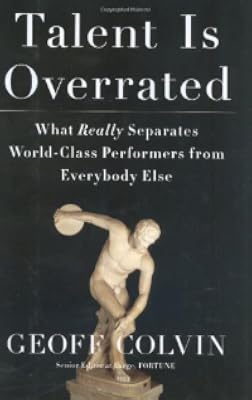
This is a fantastic read; perhaps the kind of book an engineer would write. Cal is direct in almost all his points and even while substantiating his points, he doesn't belabor the point. It is very much in stark contrast to the other books I have read from authors such as "Talent Is Overrated", "Grit", and "Outliers."
Anyone who is interested in learning about how people achieve success, should definitely read it. I think, human's have a natural fascination for a good story due to which given a choice between truth and a good story, they inevitably choose the "good story." Just like what happened in the case of "Pi," fiction (especially inspirational fiction) makes a much better selling material than plain old truth.
The book challenges show more the fundamental assumption that "following one's passion" yields success. Perhaps it is a classic case of confusing between cause and effect. Cal goes on to build his own theory of success. It is quite interesting and definitely worth a read. Unfortunately, as in most cases the answer is rather "complex" and definitely not "formulaic." However, I prefer his formulation to Steve Job's formulation - "follow your passion." As the saying goes - it is better to be vaguely right and than be precisely wrong! show less
Anyone who is interested in learning about how people achieve success, should definitely read it. I think, human's have a natural fascination for a good story due to which given a choice between truth and a good story, they inevitably choose the "good story." Just like what happened in the case of "Pi," fiction (especially inspirational fiction) makes a much better selling material than plain old truth.
The book challenges show more the fundamental assumption that "following one's passion" yields success. Perhaps it is a classic case of confusing between cause and effect. Cal goes on to build his own theory of success. It is quite interesting and definitely worth a read. Unfortunately, as in most cases the answer is rather "complex" and definitely not "formulaic." However, I prefer his formulation to Steve Job's formulation - "follow your passion." As the saying goes - it is better to be vaguely right and than be precisely wrong! show less
Members
- Recently Added By
Lists

Books Read in 2017
4,249 works; 129 members

Books & Films Referenced by Cal Newport's Deep Work
43 works; 1 member
Author Information

29+ Works 10,267 Members
Cal Newport is the author of How to Win at College and How to Become a Straight-A Student. He graduated from Dartmouth College and earned a Ph.D. from MIT. His writing has appeared in national publications, and he is the founder of Study Hacks, the Web's most popular student advice blog.
Work Relationships
Common Knowledge
- Canonical title
- So Good They Can't Ignore You
- Original publication date
- 2012-09
- Dedication
- To Julie
- First words
- 'Follow your passion' is dangerous advice.
- Last words
- (Click to show. Warning: May contain spoilers.)Life is good.
- Blurbers
- Godin, Seth; Hoffman, Reid; Kelly, Kevin; Pink, Daniel H.; Sivers, Derek
- Original language
- English
Classifications
Statistics
- Members
- 1,372
- Popularity
- 17,301
- Reviews
- 34
- Rating
- (3.91)
- Languages
- English, German, Italian, Spanish
- Media
- Paper, Audiobook, Ebook
- ISBNs
- 19
- ASINs
- 10