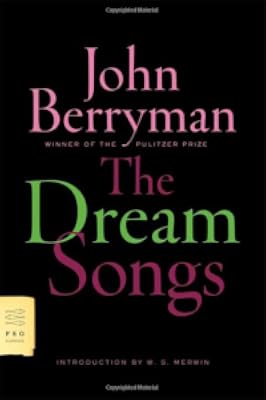
The Dream Songs
by John Berryman
On This Page
Description
The completeDream Songs-hypnotic, seductive, masterful-as thrilling to read now as they ever were John Berryman'sDream Songs are perhaps the funniest, saddest, most intricately wrought cycle of poems by an American in the twentieth century. They are also, more simply, the vibrantly sketched adventures of a uniquely American antihero named Henry. Henry falls in and out of love, and is in and out of the hospital; he sings of joy and desire, and of beings at odds with the world. He is lustful; show more he is depressed. And while Henry is breaking down and cracking up and patching himself together again, Berryman is doing the same thing to the English language, crafting electric verses that defy grammar but resound with an intuitive truth: "if he had a hundred years," Henry despairs in "Dream Song 29," "& more, & weeping, sleepless, in all them time / Henry could not make good." This volume collects both77 Dream Songs, which won Berryman the Pulitzer Prize in 1965, and their continuation,His Toy, His Dream, His Rest, which was awarded the National Book Award and the Bollingen Prize in 1969.The Dream Songs are witty and wild, an account of madness shot through with searing insight, winking word play, and moments of pure, soaring elation. This is a brilliantly sustained and profoundly moving performance that has not yet-and may never be-equaled. show lessTags
Recommendations











Member Reviews
My relationship with John Berryman’s Dream Songs, like the songs themselves, is murky, complicated, obscure in origin, and not easy to explain—not even to myself. One signpost of great art, it seems to me, is that the meaning of its greatness shifts in relation to the reader over time, and my appreciation of The Dream Songs has deepened and evolved—as I expect it will continue to for the rest of my life—in the two decades since it first came to my attention.
In my twenties I knew that Berryman was, like me, an alcoholic, and that he committed suicide in Minneapolis in 1972, and being at an age susceptible to the romantic myth of the doomed, hard-drinking mystic, the messy glamour of the dissolute—before I came to know (that is, show more in real terms, hard terms, blood terms) the cost of that myth—I was intrigued. I knew too that he was considered a brilliant and impenetrable poet, an impression that was confirmed by my first casual glance into an edition of 77 Dream Songs on the shelf of my boss’s office in Cambridge.
These were not like other poems: within their consistent 16-line armature they were turbulent, mad, feverish, cryptic, an unruly union of boppy jive-talk, and thorny quasi-Elizabethan diction. It was impossible to tell who was speaking, or to whom; poems ended in mid-syllable, bristled with random phrases in foreign languages, sported menacing-looking accent marks and Shakespearean contractions, were riddled with ampersands and ellipses. The whole thing was messy, hallucinatory, and impossible to resist; it was the Exile on Main Street of poetry, and I was hooked.
As the shadows over my own life lengthened, scattered phrases accrued talismanic power. “He stared at ruin. Ruin stared straight back,” begins number 45; then, “I’m too alone. I see no end” and “Lightning fell silent where the Devil knelt.” “Hell talkt my brain awake,” says Henry, the mysterious semi-protagonist, at one point, and it seemed as fit a phrase for my existence—insomniac, deeply unhappy—as any. Safely on the other side of life again at age 32, I was given for my birthday, by my parents, a very nearly mint-condition first edition of the complete cycle, the celebrated Farrar Straus hardcover from 1968, featuring Charles Skaggs’s bold white-pink-and-green typography. The interior design, which follows the template set by the brilliant Guy Fleming for the original 1964 edition of 77 Dream Songs, is austere and beautiful, with that slightly antique feel of openness and clarity that seems particular to book design of that era. (Someday I would like an expert in the history of typography to explain to me how this is so). I have it in front of me now, paging through it as I try to capture, clumsily, the strange beauty of this half-understood work, to anatomize its appeal.
The Dream Songs collectively is many things: a record of a consciousness, a song cycle, an ongoing formalist experiment, a journal of an imaginary insanity, a high-modernist word collage, and an elegy for a generation of poets. The work as a whole is death-haunted, with each successive passing of another poet or peer—Jarrell, Roethke, Schwartz, Williams—bringing a yearning elegy, grave and often touching, as the poet bends his soul towards the haven that they have found and that he will gain only through force of self-violence. As the songs pile up and the years pass the prosody becomes starker, cleaner, marginally more transparent, yet somehow purer in its despair: the world’s longest and most eloquent suicide note. There is also an engagingly quotidian quality to the work, as in a journal: occasional mentions of the outside world, of presidents, the Cold War, the Congo, Vietnam, peek through the whirling kaleidoscope of the poet / narrator’s brain, like a slideshow of the darkening sixties playing in an adjacent room. Other songs seem to hint acidly at the growing professional and academic demands of Berryman’s career. All of this is filtered through a blurry, argumentative stream of voices that is extremely difficult to decode, Berryman’s own note—Henry is “not the poet, not me”—being of limited assistance in the matter.
Better minds than mine have tried to identify a consistent schema of speakerly identification for the Songs, which seem to be narrated from a kind of shifting first-and-a-half-person, the half-person being the poet’s unseen companion, who addresses him as “Mr. Bones” in the rhythms of a not entirely convincing African-American patois, and who may be a schizophrenic counterpart of the narrator and/or Henry. What is to my mind undeniable about the poems is the sense of mystery, of the uncanny, of a shifting, fully inhabited interior consciousness, however opaque or inaccessible, that they convey. Not everyone agrees: the great postwar critic M. L. Rosenthal, for one, thought that The Dream Songs was a step backwards for Berryman, calling it “work we must forage (in) too much on our own.”
It’s an interesting word, “forage,” and apt, for to my mind, a mental “foraging” is in fact the primary experience of reading, especially work so dense and demanding as Berryman’s. And the fruits of my expeditions into the verbal thickets left behind by this brilliant, sad, unlucky, intense man, are a paradoxically heightened sense of freedom and gratitude, an attentiveness to the air and light around me, the twinkling of the city at night, a hunger for “tasting all the secret bits of life.”
From "The Last Book I Loved," The Rumpus / Storyboard, February 15, 2013 show less
In my twenties I knew that Berryman was, like me, an alcoholic, and that he committed suicide in Minneapolis in 1972, and being at an age susceptible to the romantic myth of the doomed, hard-drinking mystic, the messy glamour of the dissolute—before I came to know (that is, show more in real terms, hard terms, blood terms) the cost of that myth—I was intrigued. I knew too that he was considered a brilliant and impenetrable poet, an impression that was confirmed by my first casual glance into an edition of 77 Dream Songs on the shelf of my boss’s office in Cambridge.
These were not like other poems: within their consistent 16-line armature they were turbulent, mad, feverish, cryptic, an unruly union of boppy jive-talk, and thorny quasi-Elizabethan diction. It was impossible to tell who was speaking, or to whom; poems ended in mid-syllable, bristled with random phrases in foreign languages, sported menacing-looking accent marks and Shakespearean contractions, were riddled with ampersands and ellipses. The whole thing was messy, hallucinatory, and impossible to resist; it was the Exile on Main Street of poetry, and I was hooked.
As the shadows over my own life lengthened, scattered phrases accrued talismanic power. “He stared at ruin. Ruin stared straight back,” begins number 45; then, “I’m too alone. I see no end” and “Lightning fell silent where the Devil knelt.” “Hell talkt my brain awake,” says Henry, the mysterious semi-protagonist, at one point, and it seemed as fit a phrase for my existence—insomniac, deeply unhappy—as any. Safely on the other side of life again at age 32, I was given for my birthday, by my parents, a very nearly mint-condition first edition of the complete cycle, the celebrated Farrar Straus hardcover from 1968, featuring Charles Skaggs’s bold white-pink-and-green typography. The interior design, which follows the template set by the brilliant Guy Fleming for the original 1964 edition of 77 Dream Songs, is austere and beautiful, with that slightly antique feel of openness and clarity that seems particular to book design of that era. (Someday I would like an expert in the history of typography to explain to me how this is so). I have it in front of me now, paging through it as I try to capture, clumsily, the strange beauty of this half-understood work, to anatomize its appeal.
The Dream Songs collectively is many things: a record of a consciousness, a song cycle, an ongoing formalist experiment, a journal of an imaginary insanity, a high-modernist word collage, and an elegy for a generation of poets. The work as a whole is death-haunted, with each successive passing of another poet or peer—Jarrell, Roethke, Schwartz, Williams—bringing a yearning elegy, grave and often touching, as the poet bends his soul towards the haven that they have found and that he will gain only through force of self-violence. As the songs pile up and the years pass the prosody becomes starker, cleaner, marginally more transparent, yet somehow purer in its despair: the world’s longest and most eloquent suicide note. There is also an engagingly quotidian quality to the work, as in a journal: occasional mentions of the outside world, of presidents, the Cold War, the Congo, Vietnam, peek through the whirling kaleidoscope of the poet / narrator’s brain, like a slideshow of the darkening sixties playing in an adjacent room. Other songs seem to hint acidly at the growing professional and academic demands of Berryman’s career. All of this is filtered through a blurry, argumentative stream of voices that is extremely difficult to decode, Berryman’s own note—Henry is “not the poet, not me”—being of limited assistance in the matter.
Better minds than mine have tried to identify a consistent schema of speakerly identification for the Songs, which seem to be narrated from a kind of shifting first-and-a-half-person, the half-person being the poet’s unseen companion, who addresses him as “Mr. Bones” in the rhythms of a not entirely convincing African-American patois, and who may be a schizophrenic counterpart of the narrator and/or Henry. What is to my mind undeniable about the poems is the sense of mystery, of the uncanny, of a shifting, fully inhabited interior consciousness, however opaque or inaccessible, that they convey. Not everyone agrees: the great postwar critic M. L. Rosenthal, for one, thought that The Dream Songs was a step backwards for Berryman, calling it “work we must forage (in) too much on our own.”
It’s an interesting word, “forage,” and apt, for to my mind, a mental “foraging” is in fact the primary experience of reading, especially work so dense and demanding as Berryman’s. And the fruits of my expeditions into the verbal thickets left behind by this brilliant, sad, unlucky, intense man, are a paradoxically heightened sense of freedom and gratitude, an attentiveness to the air and light around me, the twinkling of the city at night, a hunger for “tasting all the secret bits of life.”
From "The Last Book I Loved," The Rumpus / Storyboard, February 15, 2013 show less
I have lived with these poems for years, and survived.
The thing that, for me, separates Berryman from the other "confessional" poets is his sense of humor. It is a black humor, certainly, a skull coughing and chuckling while chain smoking cigarettes, but it is a sense of humor nonetheless. Dark, dark, dark and funny.
Also noteworthy is the poet's twisted but seldom-erring ear. The syntax of these poems is often tortured, fractured, bent, but it is always meant to be that way.
I votes in my hole.
The thing that, for me, separates Berryman from the other "confessional" poets is his sense of humor. It is a black humor, certainly, a skull coughing and chuckling while chain smoking cigarettes, but it is a sense of humor nonetheless. Dark, dark, dark and funny.
Also noteworthy is the poet's twisted but seldom-erring ear. The syntax of these poems is often tortured, fractured, bent, but it is always meant to be that way.
I votes in my hole.
I already quoted the dream songs in one of my other reviews, which goes to show how much I adore them. The dream songs were iconic even back when there were only 77 of them, and they were personally influential for me - this was the first long poetic sequence I ever read where there were continuing characters, but no clear linear plot. the language is lively, the form is a contemporary play on the sonnet tradition, and the expressionistic connections from one song to the next do eventually begin to form a narrative - a dreamy narrative.
The Dream Songs is a monumental work of modern poetry. It has wide influence and is a monument of both its time in relation to the genre and of Berryman's own life and thought. Still, I would not call it perfect, though many would disagree with me. I think what draws me to that decision is its sheer mass, over three hundred individual poems. Many of these poems are jsut okay, if not outright boring. At the same time, a few handfuls of these poems are among the best I have ever read - evocative, musical, woeful, funny, piercing songs. You can't say, unlike with other collections, that it would have been better if Berryman cut a number of the poems. Too reduce this book by too much would risk making its narrative incoherent. One strength show more of the overall collection is we do get a great sense of poor, pitiful Henry, but some of the poems that make up that portrait are rather forgettable. This is not a perfect poetry collection, but it is still one from which any serious student of poetry will learn indispensable lessons in form and music and emotion and that needs to be read. show less
Berryman occupies a special place in my brain. He is quite simply one of the most startlingly original poets of the 20th century, and the fact that he isn't taught right up front in literature classes alongside T. S. Eliot and Sylvia Plath makes me terribly sad.
Berryman occupies a special place in my brain. He is quite simply one of the most startlingly original poets of the 20th century, and the fact that he isn't taught right up front in literature classes alongside T. S. Eliot and Sylvia Plath makes me terribly sad.
A handful of these poems are among my favourite poems ever but, as a whole, I find the collection uneven: many, the majority, just mean nothing to me. Even so, the dream song is a gorgeous format, and when they are good they are very very good.
Members
- Recently Added By
Author Information

36+ Works 2,771 Members
John Berryman's poetry has a depth and obscurity that discourages many readers while it entices critics. His major work, The Dream Songs (1969), forms a poetic notebook that captures the ephemera of mood and attitude of this most mercurial of poets. Born John Smith in McAlester, Oklahoma, in 1914 and educated at Columbia University and Clare show more College, Cambridge, he later taught at several universities. Berryman received the Shelley Memorial Award (1948), the Harriet Monroe Award (1957), the Loines Award for poetry of the National Institute of Arts and Letters (1964), and the fellowship of the Academy of American Poets (1966). In 1964 he won the Pulitzer Prize in poetry for 77 Dream Songs (1964). His short story "The Imaginary Jew" received the Kenyon-Doubleday Award and was listed in Best American Short Stories, (1946). He also wrote Stephen Crane (1950) and is the author of a novel, Recovery (1973). Often listed along with Sylvia Plath and Anne Sexton as a major confessional poet, he was as much concerned with literary artifice as he was with personal revelation. His works include The Freedom of the Poet, Henry's Fate & Other Poems, 1967-1972, Collected Poems 1937-1971, Berryman's Shakespeare, and Selected Poems. Berryman committed suicide in 1972. (Bowker Author Biography) show less
Work Relationships
Is abridged in
Common Knowledge
- People/Characters
- John Berryman
Classifications
Statistics
- Members
- 1,111
- Popularity
- 22,975
- Reviews
- 14
- Rating
- (4.15)
- Languages
- English, Swedish
- Media
- Paper, Ebook
- ISBNs
- 8
- ASINs
- 11