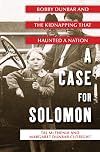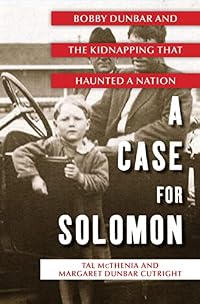
A Case for Solomon: Bobby Dunbar and the Kidnapping That Haunted a Nation
by Tal McThenia (Author), Margaret Dunbar Cutright (Author)
On This Page
Description
A Case for Solomon : Bobby Dunbar and the Kidnapping That Haunted a Nation chronicles one of the most celebrated--and most misunderstood--kidnapping cases in American history. In 1912, four-year-old Bobby Dunbar, the son of an upper-middle-class Louisiana family, went missing in the swamps. After an eight-month search that electrified the country and destroyed Bobby's parents, the boy was found, filthy and unrecognizable, in the pinewoods of southern Mississippi. A wandering piano tuner who show more had been shuttling the child throughout the region by wagon for months was arrested and charged with kidnapping--a crime that was punishable by death at the time. But when a destitute single mother came forward from North Carolina to claim the boy as her son, not Bobby Dunbar, the case became a high-pitched battle over custody--and identity--that divided the South. Amid an ever-thickening tangle of suspicion and doubt, two mothers and a father struggled to assert their rightful parenthood over the child, both to the public and to themselves. For two years, lawyers dissected and newspapers sensationalized every aspect of the story. Psychiatrists, physicians, criminologists, and private detectives debated the piano tuner's guilt and the boy's identity. And all the while the boy himself remained peculiarly guarded on the question of who he was. It took nearly a century, a curiosity that had been passed down through generations, and the science of DNA to discover the truth. -- Jacket, p. [2]. show lessTags
Recommendations













Member Reviews
A fascinating story of a missing child, a man accused of a kidnapping and the town that fought for a prominent family. When Bobby Dunbar went missing at four years old his picture was sent around the country. When a young boy who slightly resembled the missing boy is found with another man they are both taken back to the town where Bobby Dunbar went missing. The only problem is that Julia Anderson claims this young boy is her son. She had let the supposed "kidnapper" a relative of hers take her son with him while she got back on her feet. He held to this story the entire time he was incarcerated. Julia went to her grave knowing this was her son and that the Dunbars and won him in court.
This is a heartbreaking story that shows how show more people's outlook on the life of those who have and those who have not play a role in the justice and injustices of our court systems. This story is put together by the granddaughter of that young kidnapped child. This is a must read. It held me from beginning to end. Besides, you have to read it if you want to find out if he truly was the child of the Dunbars or Julia Anderson's child. show less
This is a heartbreaking story that shows how show more people's outlook on the life of those who have and those who have not play a role in the justice and injustices of our court systems. This story is put together by the granddaughter of that young kidnapped child. This is a must read. It held me from beginning to end. Besides, you have to read it if you want to find out if he truly was the child of the Dunbars or Julia Anderson's child. show less
The story of Bobby Dunbar is remarkable for many reasons and it is told sometimes brilliantly, and sometimes painfully slowly, in "A Case for Solomon."
The details here can be exceptionally tedious; it's as though the writer wants to make use of every single bit of research he unearthed (and his research is, indeed, impressive). The problem is that it makes for text that feels heavy, just one small step above an entry in an encyclopedia. Scenes that the reader is waiting for, that offer critical information about the story, are long and labored and become dreary instead of exciting. (Imagine watching a marathon and, in the last minutes having to see it in slow motion, and also hearing at the same time information about the kinds of show more shoes the runner is wearing, and where he bought his clothing, and his favorite foods.) The details about the role of the newspapers could make a book in themselves, and are rarely all that compelling.
Most people know the results of the DNA tests, so there are no great revelations here. But I still picked up this book because I wanted to know more about the family, and especially about the man who grew up as Bobby Dunbar.
I loved the beginning and the end, and many parts in the middle. If only this book had had a competent editor it could have been masterful. show less
The details here can be exceptionally tedious; it's as though the writer wants to make use of every single bit of research he unearthed (and his research is, indeed, impressive). The problem is that it makes for text that feels heavy, just one small step above an entry in an encyclopedia. Scenes that the reader is waiting for, that offer critical information about the story, are long and labored and become dreary instead of exciting. (Imagine watching a marathon and, in the last minutes having to see it in slow motion, and also hearing at the same time information about the kinds of show more shoes the runner is wearing, and where he bought his clothing, and his favorite foods.) The details about the role of the newspapers could make a book in themselves, and are rarely all that compelling.
Most people know the results of the DNA tests, so there are no great revelations here. But I still picked up this book because I wanted to know more about the family, and especially about the man who grew up as Bobby Dunbar.
I loved the beginning and the end, and many parts in the middle. If only this book had had a competent editor it could have been masterful. show less
This is one of those books that sticks with you for a while. I was horrified to learn the role the press played in this whole fiasco. We really have not learned from past mistakes. When Bobby Dunbar went missing, no stone was left unturned. Yet when a boy was found who was similar in looks, the press was there to “get the story”. I felt like they were willing to make the story fit a happy ending no matter what.
My sympathies went to Julia Anderson who had no resources due to her financial circumstances. I was pleased to learn the truth had been found but saddened by the pain everyone involved in this case suffered. The authors have done a tremendous amount of research and have successfully told the story in a way that carried the show more reader along, making them want to know what happened next.
We are given a look at the time period and how things worked for those who had and those had not. In this day and age we have the benefit of DNA testing. Yet I wonder how much the press would be able to skew the opinions of all parties involved. It is sad that so many lives have been destroyed. Yet I feel that a mystery was left unanswered in this story. I don’t know if anyone will ever solve that mystery. This is definitely worth the read. show less
My sympathies went to Julia Anderson who had no resources due to her financial circumstances. I was pleased to learn the truth had been found but saddened by the pain everyone involved in this case suffered. The authors have done a tremendous amount of research and have successfully told the story in a way that carried the show more reader along, making them want to know what happened next.
We are given a look at the time period and how things worked for those who had and those had not. In this day and age we have the benefit of DNA testing. Yet I wonder how much the press would be able to skew the opinions of all parties involved. It is sad that so many lives have been destroyed. Yet I feel that a mystery was left unanswered in this story. I don’t know if anyone will ever solve that mystery. This is definitely worth the read. show less
As someone who is intimately attached to this story (I am married to the grandson of the boy who is the focus of this book) I have to admit, the writing did nothing for me. I was aware there was a story about the blood of the man who is known as Bobby Dunbar. I was aware it was a huge piece of news at the time, becoming a national story. But I also knew that the blood running through the man's veins did not impact who he was as a husband or a father.
The writing of this book was stilted and dense. I found it tough to get through, as there were so many pieces of data that were incorporated into the narrative. Perhaps that makes it a stronger non-fiction book, delving into the nitty gritty of a story that rocked communities and families show more intimately. However, it also means that the audience for this book today, is small and intimate and will likely not reach a much wider piece of the population.
To be fair, I am generally a lover of fiction, where the theme is the key, not the evidence. Though, when I do reach for non-fiction, the thesis statement is something I generally look for, and I could not find it in the amassed pile of references here. Perhaps I didn't dig enough, or pay enough attention. I'll take some ownership of the disconnect between myself and the book. show less
The writing of this book was stilted and dense. I found it tough to get through, as there were so many pieces of data that were incorporated into the narrative. Perhaps that makes it a stronger non-fiction book, delving into the nitty gritty of a story that rocked communities and families show more intimately. However, it also means that the audience for this book today, is small and intimate and will likely not reach a much wider piece of the population.
To be fair, I am generally a lover of fiction, where the theme is the key, not the evidence. Though, when I do reach for non-fiction, the thesis statement is something I generally look for, and I could not find it in the amassed pile of references here. Perhaps I didn't dig enough, or pay enough attention. I'll take some ownership of the disconnect between myself and the book. show less
Ratings
Members
- Recently Added By
Lists

True Crime
216 works; 16 members
Author Information
Awards and Honors
Awards
Common Knowledge
- Canonical title
- A Case for Solomon: Bobby Dunbar and the Kidnapping That Haunted a Nation
- Original publication date
- 2012-08-14
- People/Characters
- Bobby Dunbar
Classifications
- Genres
- Nonfiction, General Nonfiction, History, Biography & Memoir, Politics and Government
- DDC/MDS
- 364.15 — Society, Government, and Culture Social problems and social services Crime Criminal offenses Offenses against the person
- LCC
- HV6603 .D86 .M35 — Social sciences Social pathology. Social and public welfare. Criminology Social pathology. Social and public welfare. Criminology Crimes and offenses
- BISAC
Statistics
- Members
- 88
- Popularity
- 362,647
- Reviews
- 4
- Rating
- (3.71)
- Languages
- English
- Media
- Paper, Ebook
- ISBNs
- 3
- ASINs
- 2