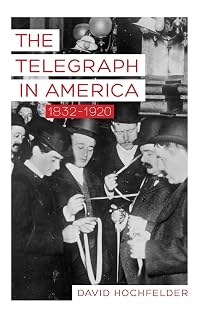
The Telegraph in America, 1832–1920 (Johns Hopkins Studies in the History of Technology)
by David Hochfelder
Johns Hopkins Studies in the History of Technology
32 Members (3.50)
On This Page
Description
Telegraphy in the nineteenth century approximated the Internet in the twenty-first century. The author, a historian and electrical engineer, offers readers a comprehensive history of this groundbreaking technology, which employs breaks in an electrical current to send code along miles of wire. This book examines the correlation between technological innovation and social change and shows how this transformative relationship helps us to understand and perhaps define modernity. The telegraph show more revolutionized the spread of information - speeding personal messages, news of public events, and details of stock fluctuations. During the Civil War, telegraphed intelligence and high-level directives gave the Union war effort a critical advantage. Afterward, the telegraph helped build and break fortunes and, along with the railroad, altered the way Americans thought about time and space. This book thus supplies readers with an introduction to the early stirrings of the information age. show lessTags
Recommendations
































Member Reviews
Members
- Recently Added By
Lists

Books in the Bibliography of The Alchemy of Us by Ainissa Ramirez
181 works; 1 member
Author Information
2 Works 33 Members
David Hochfelder is an associate professor of history at University at Albany, SUNY.
Series

Classifications
- Genres
- Nonfiction, History, Technology
- DDC/MDS
- 384.10973 — Society, government, & culture Commerce, communications & transportation regulations Communications Telegraph
- LCC
- TK5123 .H63 — Technology Electrical engineering. Electronics. Nuclear engineering Electrical engineering. Electronics. Nuclear Telecommunication
- BISAC
Statistics
- Members
- 32
- Popularity
- 881,034
- Rating
- (3.50)
- Languages
- English
- Media
- Paper, Ebook
- ISBNs
- 3
- ASINs
- 2