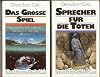
Ender's War
by Orson Scott Card
On This Page
Description
"In Ender's Game, you'll meet Andrew "Ender" Wiggin, an extraordinary boy picked to compete against other gifted children in a grueling soldier-training program for humanity's 100-year war against the alien Buggers. As the pressure mounts, Ender and his remarkable siblings hold the key to victory- but the cost may be more than any of them can bear. And in Speaker for the Dead, you'll see the bitter fruit borne by his last-ditch plan to win the war as a new alien race enters the fray. Can show more Ender's unique gifts prevent history from repeating itself?" -- Goodreads show lessTags
Recommendations






















Member Reviews
Ender's War:
The first entry into the Ender's Game series by Orson Scott Card was very good. I didn't really know what it was about, aside from reading the info in the front cover and seeing some of the previews of the movie, and so I knew it was about using children to fight a war with an invading alien, the buggers. Ender (his sister's childhood pronunciation of Andrew) was monitored early on to see if he could make it to Battle School. The instructors use every tactic in the book to see if he is the one who will lead their troops to victory. Pretty well done, but not very many developed female characters (his sister and the one female who made it to battle school).
Speaker for the Dead:
Great continuation to Ender's Game. I found it to show more be so very different from the first book, where Ender was a child forced to grow up quickly. In Speaker for the Dead, he's all grown up, and travels the universe to speak for the dead - to find out about someone who has died and present their life to those who knew him or her. It touches on similar issues from the first book - what do you do when you meet an alien species? Very well done. show less
The first entry into the Ender's Game series by Orson Scott Card was very good. I didn't really know what it was about, aside from reading the info in the front cover and seeing some of the previews of the movie, and so I knew it was about using children to fight a war with an invading alien, the buggers. Ender (his sister's childhood pronunciation of Andrew) was monitored early on to see if he could make it to Battle School. The instructors use every tactic in the book to see if he is the one who will lead their troops to victory. Pretty well done, but not very many developed female characters (his sister and the one female who made it to battle school).
Speaker for the Dead:
Great continuation to Ender's Game. I found it to show more be so very different from the first book, where Ender was a child forced to grow up quickly. In Speaker for the Dead, he's all grown up, and travels the universe to speak for the dead - to find out about someone who has died and present their life to those who knew him or her. It touches on similar issues from the first book - what do you do when you meet an alien species? Very well done. show less
One book - two novels.
The first is the Sci-fi seminal work Ender's Game. I read this novel many years ago and loved the Battle School scenes, in fact I loved this entire book, the characters, the plot, virtually everything about it. Rereading it again, the story shows it's age a bit, the ending which seemed cool to me as a kid, seems forced now, a bit unrealistic that the battles were actually real and not a game and not noticed doesn't seem possible. And, the relationships between siblings seem very one dimensional. Still, the Battle School is way cool and the concepts it introduces still rock.
The second book is a much quieter story, in essence a murder mystery story involving a second non-human race. I found this story equally show more fascinating but in a totally different way. It explores the what makes us human theme, it tosses in pain and grief, it talks about culture and yearning, and is generally a very interesting read.
Both, highly recommended, for totally separate reasons. show less
The first is the Sci-fi seminal work Ender's Game. I read this novel many years ago and loved the Battle School scenes, in fact I loved this entire book, the characters, the plot, virtually everything about it. Rereading it again, the story shows it's age a bit, the ending which seemed cool to me as a kid, seems forced now, a bit unrealistic that the battles were actually real and not a game and not noticed doesn't seem possible. And, the relationships between siblings seem very one dimensional. Still, the Battle School is way cool and the concepts it introduces still rock.
The second book is a much quieter story, in essence a murder mystery story involving a second non-human race. I found this story equally show more fascinating but in a totally different way. It explores the what makes us human theme, it tosses in pain and grief, it talks about culture and yearning, and is generally a very interesting read.
Both, highly recommended, for totally separate reasons. show less
Ender's Game is a complicated book. It's mostly about how to deal with bullying, but with many other threads. Published in 1985, it anticipates universally networked computers, global discussion networks, and complex computer games. It looks at shaping a person into a weapon, and has at its core the shifting battle games that make that possible. And then it has quite a long epilogue with a sad and hopeful conclusion.
хор,твердая,672
Members
- Recently Added By
Lists

Pleasant Surprises: Books That Exceeded Our Expectations
418 works; 143 members

Books With the Most Memorable Titles
478 works; 158 members
Author Information

575+ Works 213,896 Members
Orson Scott Byron Walley Card, was born in 1951 and studied theater at Brigham Young University. He received his B.A. in 1975 and his M.A. in English in 1981. He wrote plays during that time, including Stone Tables (1973) and the musical, Father, Mother, Mother and Mom (1974). A Mormon, Scott served a two-year mission in Brazil before starting show more work as a journalist in Utah. He also designed games at Lucas Film Games, 1989-92. He is best known for his science fiction novels, including the popular Ender series. Well known titles include A Planet Called Treason (1979), Treasure Box (1996), and Heartfire (1998). He has also written the guide called How to Write Science Fiction and Fantasy (1990). His novel Ender's Game and its sequel Speaker for the Dead, both won Hugo and Nebula awards, making Card the only author to win both prizes in consecutive years. His titles Shadows in Flight, Ruins and Ender's Game made The New York Times Best Seller List. He is also the author of The First Formic War Series, which includes the titles Earth Unaware, Earth Afire, and Earth Awakens. (Bowker Author Biography) show less
Awards and Honors
Series
Belongs to Publisher Series
Bastei Science Fiction-Special (24155)
Bastei Lübbe Taschenbuch (24155)
Work Relationships
Contains
Common Knowledge
- Canonical title*
- Ender
- Original title
- Ender's Game; Speaker for the dead
- Original publication date
- 1986
- People/Characters
- Ender Wiggin (Andrew Wiggin)
- First words
- "I've watched through his eyes, I've listened through his ears, and I tell you he's the one."
- Last words
- (Click to show. Warning: May contain spoilers.)The sunlight on her back, the breeze against her wings, the water cool under her feet, her eggs warming and maturing in the flesh of the cabra: Life, so long waited for, and not until today could she be sure that she would be, not the last of her tribe, but the first.
- Original language*
- Englisch
- Disambiguation notice
- This work includes books (some with varying titles) containing two novels - Ender's Game and Speaker for the Dead. It should not be combined with either novel singly.
*Some information comes from Common Knowledge in other languages. Click "Edit" for more information.
Classifications
Statistics
- Members
- 449
- Popularity
- 68,087
- Reviews
- 7
- Rating
- (4.30)
- Languages
- English, German, Russian
- Media
- Paper
- ISBNs
- 4
- ASINs
- 9