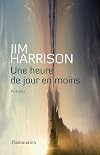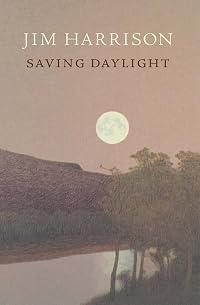
Saving Daylight
by Jim Harrison
On This Page
Description
""Jim Harrison is a writer with immortality in him."" --The Times (London)Tags
Recommendations















Member Reviews
The late Jim Harrison is perhaps Reed City's most famous son, having lived here during his formative years, between the ages of four and fourteen. So when I found this pristine signed copy of SAVING DAYLIGHT (2007) in the local thrift store, of course I had to buy it. I read through it this afternoon and must admit that many (most?) of these poems left me mystified, or at least puzzled. But I did enjoy some of them. Like the extended "Livingston Suite," which memorializes a young boy drowned in the river that runs through the Montana town. The poet does not love town living, but it brings back his boyhood -
"In Livingston I'm back home in Reed City / over fifty years ago when trains were steam but the cows / and alleys were the same, the show more friendly town mongrels / I said hello to, one who walked with me an hour / before turning home when we crossed his street."
It's obvious why I liked this. Or, from "After the War," remembering his early years in Reed City, surrounded by siblings and veteran uncles -
"During Wold War II my brother John / and I would holler 'bombs over Tokyo' / when we pooped. A different kind of war."
Many of the poems here attest to a profound love for the many dogs Harrison has shared his life with, a preoccupation with aging and death, and a mostly irreverent attitude toward religion, as in "Incomprehension" -
"The church says God is a spy / who keeps track of how we misuse our genitals. He always yawns / at the beginning of work."
I know I'm cherry-picking here, but I'm forced to stick with the ones I thought I kinda understood, or the lines that made me laugh. There are also a few nods and lines to or about his poet friends Ted Kooser and Dan Gerber. But I'm gonna quit while I'm ahead. Jim Harrison left us six years ago but his written work - and there is a LOT - will be with us for a long time. RIP, Jim. You've made Reed City proud. Very highly recommended especially for poetry lovers.
- Tim Bazzett, author of the REED CITY BOY trilogy show less
"In Livingston I'm back home in Reed City / over fifty years ago when trains were steam but the cows / and alleys were the same, the show more friendly town mongrels / I said hello to, one who walked with me an hour / before turning home when we crossed his street."
It's obvious why I liked this. Or, from "After the War," remembering his early years in Reed City, surrounded by siblings and veteran uncles -
"During Wold War II my brother John / and I would holler 'bombs over Tokyo' / when we pooped. A different kind of war."
Many of the poems here attest to a profound love for the many dogs Harrison has shared his life with, a preoccupation with aging and death, and a mostly irreverent attitude toward religion, as in "Incomprehension" -
"The church says God is a spy / who keeps track of how we misuse our genitals. He always yawns / at the beginning of work."
I know I'm cherry-picking here, but I'm forced to stick with the ones I thought I kinda understood, or the lines that made me laugh. There are also a few nods and lines to or about his poet friends Ted Kooser and Dan Gerber. But I'm gonna quit while I'm ahead. Jim Harrison left us six years ago but his written work - and there is a LOT - will be with us for a long time. RIP, Jim. You've made Reed City proud. Very highly recommended especially for poetry lovers.
- Tim Bazzett, author of the REED CITY BOY trilogy show less
the poem this book opened with ("water") floored me. it was a great start for what is overall a really good collection of poems. there are a few in here that just blew me away, and fewer that i didn't like at all. mostly it's nice language and cadence, and poems about life, nature, mortality. (by the end i'd gotten attached to his dog rose, just by how often she was mentioned.) this is my first jim harrison and i'm glad i read it.
"Divide your death by your life and you get
a circle, though I'm not so good at math." (from "Adding it Up")
my favorites are all short, so:
Water
Before I was born I was water.
I thought of this sitting on a blue
chair surrounded by pink, red, white
hollyhocks in the yard in front
of my green studio. There are show more conclusions
to be drawn but I can't do it anymore.
Born man, child man, singing man,
dancing man, loving man, old man,
dying man. This is a round river
and we are her fish who become water.
The Bear
When my propane ran out
when I was gone and the food
thawed in the freezer I grieved
over the five pounds of melted squid,
but then a big gaunt bear arrived
and feasted on the garbage, a few tentacles
left in the grass, purplish white worms.
O bear, now that you've tasted the ocean
I hope your dreamlife contains the whales
I've seen, that one in the Humboldt current
basking on the surface who seemed to watch
the seabirds wheeling around her head.
Angry Women
Women in peignoirs are floating around
the landscape well out of eyesight
let alone reach. They are as palpable
as the ghost of my dog Rose whom I see
on long walks, especially when exhausted
and my half-blind eyes are blurred by cold wind
or sleet or snow. The women we've mistreated
never forgive us nor should they, thus their ghostly
energies thrive at dawn and twilight in this vast
country where any of the mind's movies can be played
against this rumpled wide-screened landscape.
Our souls are travelers. You can tell when your own
is gone, and then these bleak, improbable
visits from others, their dry tears because you were
never what you weren't, so that the world
becomes only what it is, the unforgiving flow
of an unfathomable river. Still they wanted you otherwise,
closer to their dream child, just as you imagined
fair maidens tight to you as decals to guide
you toward certainties. The new pup, uncrippled by ideals,
leaps against the fence, leaps at the mountains beyond. show less
"Divide your death by your life and you get
a circle, though I'm not so good at math." (from "Adding it Up")
my favorites are all short, so:
Water
Before I was born I was water.
I thought of this sitting on a blue
chair surrounded by pink, red, white
hollyhocks in the yard in front
of my green studio. There are show more conclusions
to be drawn but I can't do it anymore.
Born man, child man, singing man,
dancing man, loving man, old man,
dying man. This is a round river
and we are her fish who become water.
The Bear
When my propane ran out
when I was gone and the food
thawed in the freezer I grieved
over the five pounds of melted squid,
but then a big gaunt bear arrived
and feasted on the garbage, a few tentacles
left in the grass, purplish white worms.
O bear, now that you've tasted the ocean
I hope your dreamlife contains the whales
I've seen, that one in the Humboldt current
basking on the surface who seemed to watch
the seabirds wheeling around her head.
Angry Women
Women in peignoirs are floating around
the landscape well out of eyesight
let alone reach. They are as palpable
as the ghost of my dog Rose whom I see
on long walks, especially when exhausted
and my half-blind eyes are blurred by cold wind
or sleet or snow. The women we've mistreated
never forgive us nor should they, thus their ghostly
energies thrive at dawn and twilight in this vast
country where any of the mind's movies can be played
against this rumpled wide-screened landscape.
Our souls are travelers. You can tell when your own
is gone, and then these bleak, improbable
visits from others, their dry tears because you were
never what you weren't, so that the world
becomes only what it is, the unforgiving flow
of an unfathomable river. Still they wanted you otherwise,
closer to their dream child, just as you imagined
fair maidens tight to you as decals to guide
you toward certainties. The new pup, uncrippled by ideals,
leaps against the fence, leaps at the mountains beyond. show less
JH in his sixties as he saw mortality nearing but not yet its face. Dogs, woods, mountains and deserts. The word shaman is used too losely for writers but not for JH. I don't always agree but I respect and need his interpretation of the world. He is truly missed.
First half of this colleciton was beautiful, prosaic, filled with themes of compassion and connection. the latter third was a bit depressing - many references to aging, debt, death. Preferred the first part.
Ratings
Members
- Recently Added By
Author Information

81+ Works 11,877 Members
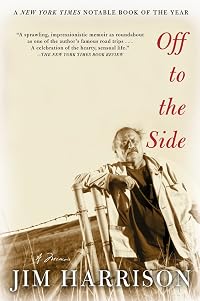
James Thomas Harrison was born on December 11, 1937 in Grayling, Michigan. After receiving a B.A. in comparative literature from Michigan State University in 1960 and a M.A. in comparative literature from the same school in 1964, he briefly taught English at the State University of New York at Stony Brook. During his lifetime, he wrote 14 show more collections of poetry, 21 volumes of fiction, two books of essays, a memoir, and a children's book. His collections of poetry included Plain Song, The Theory and Practice of Rivers, Songs of Unreason, and Dead Man's Float. He received a Guggenheim fellowship for his poetry in 1969. His essays on food, much of which first appeared in Esquire, was collected in the 2001 book, The Raw and the Cooked. His memoir, Off to the Side, was published in 2002. His first novel, Wolf, was published in 1971. His other works of fiction included A Good Day to Die, Farmer, The Road Home, Julip, and The Ancient Minstrel. His novel, Legends of the Fall, was adapted into a feature film starring Anthony Hopkins and Brad Pitt. Harrison wrote the screenplay for the movie. His novel, Dalva, was adapted as a made-for-television movie starring Rod Steiger and Farrah Fawcett. He died on March 26, 2016 at the age of 78. (Bowker Author Biography) show less
Awards and Honors
Notable Lists
Common Knowledge
- Original publication date
- 2006
Classifications
Statistics
- Members
- 108
- Popularity
- 301,121
- Reviews
- 4
- Rating
- (4.32)
- Languages
- English, French
- Media
- Paper, Ebook
- ISBNs
- 5
- ASINs
- 1