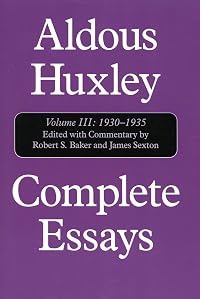
Complete Essays of Aldous Huxley, Vol. 3: 1930-1935
by Aldous Huxley  , Robert S. Baker (Editor), James Sexton (Editor)
Complete Essays of Aldous Huxley (volume 3)
36 Members (4.33)
On This Page
Description
This third volume of a projected six reinforces Huxley's stature as one of the most acute and informed observers of the social and ideological trends of the years between the world wars. It contains the important collection of essays "Music at Night" as well as the majority of Huxley's journalistic writing for the Hearst newspapers in the United States and for a variety of British periodicals such as Nash's Pall Mall Magazine, the Evening Standard, and Time and Tide. Much of the attraction show more of the Hearst essays lies in their vivid period detail: references to the raucous voices of Nazi broadcasters, speeches by Roosevelt and Stalin, Soviet five-year plans, and the effects of the Great Depression combine to provide a rich context for Huxley's increasingly active role in organized pacifism and his sense of standing on the threshold of a new era. The essays of "Music at Night" define this trend as "the New Romanticism," a celebration of Enlightenment modernity and an excessive faith in instrumental reason and applied science. Huxley was both intrigued by and suspicious of state planning and centralized bureaucratic authority. The essays in Volume III (and the volume to follow) register his growing ambivalence about the role of technocracy and science in an era of experimentation in the concentration of executive and legislative power. At their best, Huxley's essays stand among the finest examples of the genre in modern literature. "He was among the few writers who...played with ideas so freely, so gaily, with such virtuosity, that the responsive reader...was dazzled and excited."--Isaiah Berlin. show lessTags
Recommendations


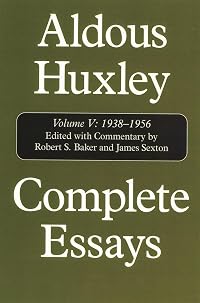




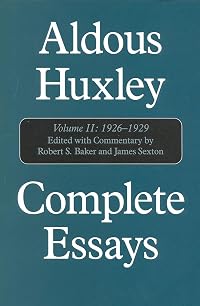









Member Reviews
Members
- Recently Added By
Author Information

287+ Works 104,861 Members
Aldous Huxley was born on July 26, 1894, in Surrey, England, into a distinguished scientific and literary family; his grandfather was the noted scientist and writer, T.H. Huxley. Following an eye illness at age 16 that resulted in near-blindness, Huxley abandoned hope of a career in medicine and turned instead to literature, attending Oxford show more University and graduating with honors. While at Oxford, he published two volumes of poetry. Crome Yellow, his first novel, was published in 1927 followed by Antic Hay, Those Barren Leaves, and Point Counter Point. His most famous novel, Brave New World, published in 1932, is a science fiction classic about a futuristic society controlled by technology. In all, Huxley produced 47 works during his long career, In 1947, Huxley moved with his family to southern California. During the 1950s, he experimented with mescaline and LSD. Doors of Perception and Heaven and Hell, both works of nonfiction, were based on his experiences while taking mescaline under supervision. In 1959, Aldous Huxley received the Award of Merit for the Novel from the American Academy of Arts and Letters. He died on November 22, 1963. (Bowker Author Biography) show less
Aldous Huxley has a Legacy Library. Legacy libraries are the personal libraries of famous readers, entered by LibraryThing members from the Legacy Libraries group.
Series

Work Relationships
Common Knowledge
- Canonical title
- Complete Essays of Aldous Huxley, Vol. 3: 1930-1935
Classifications
Statistics
- Members
- 36
- Popularity
- 796,784
- Rating
- (4.33)
- Languages
- English
- Media
- Paper
- ISBNs
- 1
- ASINs
- 1