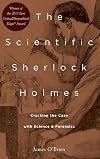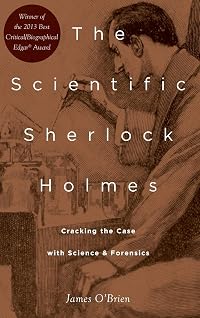
The Scientific Sherlock Holmes
by James O'Brien
On This Page
Description
Arthur Conan Doyle's enduringly popular Sherlock Holmes has his own undeniable place in the public eye. Holmes is often seen applying concepts of some branch of science in his work, discussing scientific matters with Watson, or is involved in situations where the applicability of the formal sciences is apparent. 'The Scientific Sherlock Holmes' connects Holmes' vegetable poisons with concepts in botany, his use of fingerprinting with forensic science and carbon monoxide poisoning and show more hemoglobin tests with concepts in chemistry, thus integrating the Holmes stories with all branches of science. show lessTags
Recommendations

















Member Reviews
Holmes devotees know that the great detective is a very accomplished scientist. In this book, O'Brien discusses the advances in forensic science being made at the time when Holmes was active, and assesses Holmes's abilities in chemistry and other sciences. He also provides context with real-life cases that use some of the new-fangled forensic techniques.
As you may gather from the subtitle, Cracking the Case, a lot of the discussion comes rife with spoilers. I had a feeling that would happen, but I read on anyway and tried to read the spoilery bits as fast as possible. If you are not terribly concerned with spoilers, then you will probably find this quite interesting. In the chapter on chemistry, for example, O'Brien tackles Isaac show more Asimov's assertion that Holmes was a "blundering" chemist, addressing each of Asimov's complaints and giving Holmes a fairer hearing.
Another interesting point was made about the canon in general: most of the "favourite" stories, as voted on time and time again by fans, come from the first half of the canon, when Doyle was more active as a man of science. Once his interest in spiritualism kicked in, the stories became less scientific and thus less interesting. That hadn't occurred to me but it certainly seems plausible.
Overall this is an interesting read if you've already read all of the Holmes stories or are not overly concerned about spoilers. show less
As you may gather from the subtitle, Cracking the Case, a lot of the discussion comes rife with spoilers. I had a feeling that would happen, but I read on anyway and tried to read the spoilery bits as fast as possible. If you are not terribly concerned with spoilers, then you will probably find this quite interesting. In the chapter on chemistry, for example, O'Brien tackles Isaac show more Asimov's assertion that Holmes was a "blundering" chemist, addressing each of Asimov's complaints and giving Holmes a fairer hearing.
Another interesting point was made about the canon in general: most of the "favourite" stories, as voted on time and time again by fans, come from the first half of the canon, when Doyle was more active as a man of science. Once his interest in spiritualism kicked in, the stories became less scientific and thus less interesting. That hadn't occurred to me but it certainly seems plausible.
Overall this is an interesting read if you've already read all of the Holmes stories or are not overly concerned about spoilers. show less
When I think of Holmes, I think of a scientific method of deduction. I think of a human version of a CSI lab before there were CSI labs, able to observe and interpret the smallest grains or threads of evidence and effortlessly build a case against the evil evildoer. I admit, I haven't read the canon lately, so I have to take the author's word for it when numbers are cited – the frequency of occasions when Holmes used a magnifying glass or a microscope, or dabbled in chemistry. Which I have no problem doing – it's obvious that Mr. O'Brien was thorough in his tallies. He's thorough in every aspect of the book. Which, in a way, is why it did not rate more than three stars.
Let me 'splain.
This book reminded me a little of one of the show more Shakespeare biographies I've encountered lately, which tries to bake a cake with about a half a cup of batter. The author presents the little information that exists from a different angle, and basically fills in the rest with art and artifice – like using a styrofoam layer for that cake. With The Scientific Sherlock Holmes, the idea is a good one: see, this is how Sherlock Holmes used science in his investigations. The practice, though, brings in the styrofoam. There are fifty-six short stories and four novels ("long stories") in the canon, and when all is said and done there isn't much more batter to work with here than for a Shakespeare bio.
The book is broken into sections relating to the different sciences, and each one augments the information derived from the Holmes canon with anecdotes from reality, and discussion of where Doyle obtained his information. The section on fingerprinting, for example, is a nice little history of the science, including its earliest appearance in fiction in Mark Twain's Pudd'nhead Wilson. The section on astronomy – dealing more with Moriarty than with Holmes – brings in an acquaintance of Doyle's who was the likely source for the references. The section on handwriting analysis goes into some detail about the Lindbergh kidnapping, among others, and that on footprints (which was a little disappointing; I didn't realize footprint evidence had been so thoroughly discredited) went into the OJ Simpson trial (which was surprising).
Another way in which the little available material was puffed up to fill the 208 pages was simple repetition. Some of the same points were made (in nearly the same phrasing) two or more times. In a longer work reiteration can be helpful, but this was fairly brief (and illustrations, an appendix, bibliography, and index took up a fair amount of space). (The appendix is concerned with the totally off-topic but wildly weird and interesting "Doyle conspiracies" – I had no idea that he was blamed for everything from an archaeological hoax to, God bless us, the Jack the Ripper killings. There's a certain irony to the latter given that the most recent Holmes I've read was [book:Dust and Shadow].)
The exploration of science in the Holmes stories was fun and interesting, but where it would have made for an excellent longish article, it simply was not enough to fill a book.
This was a Netgalley advance copy, read with thanks. show less
Let me 'splain.
This book reminded me a little of one of the show more Shakespeare biographies I've encountered lately, which tries to bake a cake with about a half a cup of batter. The author presents the little information that exists from a different angle, and basically fills in the rest with art and artifice – like using a styrofoam layer for that cake. With The Scientific Sherlock Holmes, the idea is a good one: see, this is how Sherlock Holmes used science in his investigations. The practice, though, brings in the styrofoam. There are fifty-six short stories and four novels ("long stories") in the canon, and when all is said and done there isn't much more batter to work with here than for a Shakespeare bio.
The book is broken into sections relating to the different sciences, and each one augments the information derived from the Holmes canon with anecdotes from reality, and discussion of where Doyle obtained his information. The section on fingerprinting, for example, is a nice little history of the science, including its earliest appearance in fiction in Mark Twain's Pudd'nhead Wilson. The section on astronomy – dealing more with Moriarty than with Holmes – brings in an acquaintance of Doyle's who was the likely source for the references. The section on handwriting analysis goes into some detail about the Lindbergh kidnapping, among others, and that on footprints (which was a little disappointing; I didn't realize footprint evidence had been so thoroughly discredited) went into the OJ Simpson trial (which was surprising).
Another way in which the little available material was puffed up to fill the 208 pages was simple repetition. Some of the same points were made (in nearly the same phrasing) two or more times. In a longer work reiteration can be helpful, but this was fairly brief (and illustrations, an appendix, bibliography, and index took up a fair amount of space). (The appendix is concerned with the totally off-topic but wildly weird and interesting "Doyle conspiracies" – I had no idea that he was blamed for everything from an archaeological hoax to, God bless us, the Jack the Ripper killings. There's a certain irony to the latter given that the most recent Holmes I've read was [book:Dust and Shadow].)
The exploration of science in the Holmes stories was fun and interesting, but where it would have made for an excellent longish article, it simply was not enough to fill a book.
This was a Netgalley advance copy, read with thanks. show less
For all Sherlockians out there this is a great account of the scientific Sherlock Holmes
Ratings
Members
- Recently Added By
Lists

Edgar Award
418 works; 15 members
Author Information

1 Work 81 Members
Awards and Honors
Awards
Common Knowledge
- Canonical title
- The Scientific Sherlock Holmes
- Original title
- The Scientific Sherlock Holmes
- Original publication date
- 2013
- People/Characters
- Sherlock Holmes; John H. Watson
- Important places
- London, England, UK
Classifications
- Genres
- Nonfiction, Science & Nature, General Nonfiction, Literature Studies and Criticism
- DDC/MDS
- 363.25 — Society, government, & culture Social problems and social services Public Safety - Police, Crime Investigation Police services Criminal investigation & forensics
- LCC
- HV8073 .O36 — Social sciences Social pathology. Social and public welfare. Criminology Social pathology. Social and public welfare. Criminal justice administration Police. Detectves. Constabulary Police duty. Methods of protection Investigation of crimes. Examination
- BISAC
Statistics
- Members
- 79
- Popularity
- 401,199
- Reviews
- 3
- Rating
- (3.00)
- Languages
- English
- Media
- Paper, Audiobook, Ebook
- ISBNs
- 5
- ASINs
- 2