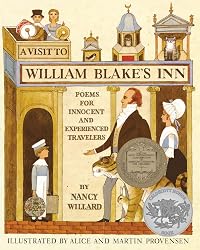
A Visit to William Blake's Inn: Poems for Innocent and Experienced Travelers
by Nancy Willard
On This Page
Description
A collection of poems describing the curious menagerie of guests who arrive at William Blake's inn.Tags
Recommendations



Member Reviews
I was pleasantly surprised by the whimsical poetic take on William Blake and his poetry that Nancy Willard achieved in A Visit to William Blake's Inn. While the book captured the essence of William Blake's Songs of Innocence and Experience, "Tyger, Tyger, Burning bright...", Willard magically enhanced them for a child's introduction to those works with playful beasts, the poet as the master of majestic inn, and easily accessible poetry in four line stanzas with rhyming couplets.
For example:
Two mighty dragons brew and bake
and many are the loaves they've burned
and are the spits they've turned
and many those who stop and break
their joyful bread with William Blake.
The musical quality of Nancy Willard's poetry is delightful to read aloud show more and the illustrations that usually encompass the full two page layout are detailed water color line drawings which capture the dress and architecture of the romantic period. The book is rather long, forty-five pages, but Willard broke up individuals poems under pseudo (perhaps) chapter titles, thus giving the reader the ability to stop after one or at least to break up the book into shorter reading sessions.
What I find so interesting about this book and would use in the classroom, especially a high school one, is the way in which she was able to take a nearly two hundred year old, sometimes very complicated to understand poetry, and put them into a new format. The assignment: To take a poem (and everyone would have the same poem) and have to create a poem in response. The response could by translating the poem into modern english or rap, or creating a conversational response as Ralegh did to Marlowe's The Passionate Shepherd to his love. The assignment would not only force the students to examine the poem closely, it would also hopefully give them a sense that they were in control of it and thus alleviating any fear they have to reading or examining poems. Nancy Willard's A Visit to William Blake's Inn could stand as a wonderful example of one way to create a response - by making an assigned poem into a children's poem. show less
For example:
Two mighty dragons brew and bake
and many are the loaves they've burned
and are the spits they've turned
and many those who stop and break
their joyful bread with William Blake.
The musical quality of Nancy Willard's poetry is delightful to read aloud show more and the illustrations that usually encompass the full two page layout are detailed water color line drawings which capture the dress and architecture of the romantic period. The book is rather long, forty-five pages, but Willard broke up individuals poems under pseudo (perhaps) chapter titles, thus giving the reader the ability to stop after one or at least to break up the book into shorter reading sessions.
What I find so interesting about this book and would use in the classroom, especially a high school one, is the way in which she was able to take a nearly two hundred year old, sometimes very complicated to understand poetry, and put them into a new format. The assignment: To take a poem (and everyone would have the same poem) and have to create a poem in response. The response could by translating the poem into modern english or rap, or creating a conversational response as Ralegh did to Marlowe's The Passionate Shepherd to his love. The assignment would not only force the students to examine the poem closely, it would also hopefully give them a sense that they were in control of it and thus alleviating any fear they have to reading or examining poems. Nancy Willard's A Visit to William Blake's Inn could stand as a wonderful example of one way to create a response - by making an assigned poem into a children's poem. show less
Willard somehow manages to capture the ideal of William Blake without directly borrowing anything specific from his poems, that I could discern. (I didn't have Blake's Songs of Innocence and Experience at my elbow, and probably should have.) Some reviewers indicate the poems are revisions of Blake's, others they are merely inspired by Blake's own. Cursory review indicates there are tigers and sunflowers in Blake poems, need to confirm anything more specific than that.
Reminiscent of Master Snickup's Cloak in that the immediate impression of weight or innovation can't be pinned down to anything in particular, but still I'm left thinking this is something pretty special. Though with Snickup, it was primarily the art work, and with Willard show more it's both her poetry and the Provensen's artwork.
Willard brings in whimsical animal characters, who interact and speak with people, but again, the effect is not so much Pooh or Seuss or Peter Pan ... more a Mona Lisa smile than a laugh or snicker. As of a world-weary adult reminding themselves of the importance of magic, and imagination. For example, a Tiger features throughout, with Tyger, tyger burning bright quoted in the forward, but nothing more is done to link them, apart from keeping the Tiger's antics from becoming overly quaint or cutesy.
Written longer ago than first I thought: 1981, winning Caldecott and Newbery awards for 1982. Perhaps recently reprinted as it surfaced more than once in the last year for me. show less
Reminiscent of Master Snickup's Cloak in that the immediate impression of weight or innovation can't be pinned down to anything in particular, but still I'm left thinking this is something pretty special. Though with Snickup, it was primarily the art work, and with Willard show more it's both her poetry and the Provensen's artwork.
Willard brings in whimsical animal characters, who interact and speak with people, but again, the effect is not so much Pooh or Seuss or Peter Pan ... more a Mona Lisa smile than a laugh or snicker. As of a world-weary adult reminding themselves of the importance of magic, and imagination. For example, a Tiger features throughout, with Tyger, tyger burning bright quoted in the forward, but nothing more is done to link them, apart from keeping the Tiger's antics from becoming overly quaint or cutesy.
Written longer ago than first I thought: 1981, winning Caldecott and Newbery awards for 1982. Perhaps recently reprinted as it surfaced more than once in the last year for me. show less
It is rare to win both the Newberry Medal Award and a Caldecott Honor Award for the same book.
Well worth the accolades, this book is lushly illustrated with a silly manner that keeps the readers attention while smiling at the creativity. In addition, well-written poems in the style of William Blake hold the readers interest. HIGHLY RECOMMENDED.
Well worth the accolades, this book is lushly illustrated with a silly manner that keeps the readers attention while smiling at the creativity. In addition, well-written poems in the style of William Blake hold the readers interest. HIGHLY RECOMMENDED.
This is a collection of poetry written in the style (somewhat) of William Blake.Travelers join together at William Blake's Inn and silliness ensues. Beautiful poems couple with gorgeous illustrations to make a great picture book. As a fan of William Blake, this was a hit!
As a fan of traditional English literature, I really wanted to like this award winning picture book. And there are a lot of fun little details, especially in the charming illustrations (which won a Caldecott Honor). But, I'm not quite sure why the poetry in this book won a Newbery Medal. The world of an 18th century English inn is not going to be familiar or clearly understandable to most young readers. The vocabulary is quite advanced in places, which is fine for older readers who are familiar with Blake's 18th century poetry, but not for really for modern grade schoolers. If this book were already in an elementary library, it could probably stay there. But I certainly wouldn't add it to a collection, unless it were for older readers show more to use as a comparison to Blake's writing itself. show less
I love the idea of this book, but I found the actual poems inaccessible. I could see a younger child enjoying the dreaminess of the pictures, but the poems themselves have difficult syntax and strange premises - too complex to be enjoyed by an older child.
I confess, William Blake’s Inn is a book I wish my two oldest children (age eight and five) read more often. The Provensens’s art is absolutely gorgeous, playful, and warm. Willard’s poetry is playful and warm as well, and the childhood inspiration she drew upon when composing the poems imbue them with sincerity and quality. I admit the book’s plot is thin. Willard’s poems are inserted into the framework of a tale about a boy who is picked-up and taken for a stay at William Blake’s inn. The boy’s adventures and that characters he meets are revealed in Willard’s clever verses and the Provensens’s atmospheric illustrations. However, the story is lacking. It may be that Willard’s poems are too long to keep a child’s show more attention, or that their content channels too much of the esoteric from Blake’s own romantic work. William Blake’s Inn is suitable for children age six and up. show less
Members
- Recently Added By
Lists

Caldecott Honor Books
296 works; 23 members

Newbery Medal Winners - By Year
105 works; 7 members

Books Read in 2021
5,361 works; 114 members

Medieval History
19 works; 1 member
Author Information

Nancy Willard was born in Ann Arbor, Michigan on June 26, 1936. She received a bachelor's degree in 1958 and a Ph.D in 1963 from the University of Michigan and a master's degree from Stanford University. She taught at Vassar College in the English department from 1965 until 2012. She published more than 70 books during her lifetime including show more collections of poetry, children's books, collections of short stories, novels, essays, and criticism. In 1982, she received the Newbery Medal for A Visit to William Blake's Inn. She died from natural causes on February 19, 2017 at the age of 80. (Bowker Author Biography) show less
All Editions
Awards and Honors
Awards
Common Knowledge
- Original publication date
- 1981-09-08
- People/Characters
- William Blake
- Epigraph
- "Will you come?" said the Sun.
"Soon," said the Moon.
"How far?" said the Star.
"I'm there," said the Air. - Dedication
- For Ralph, who built the inn,
And for Eric, who loves Blake - First words
- Introduction: I was seven and starting my second week in bed with the measles when I made the acquaintance of William Blake.
This inn belongs to William Blake
and many are the beasts he's tamed
and many are the stars he's named
and many those who stop and take
their joyful rest with William Blake. - Last words
- (Click to show. Warning: May contain spoilers.)Blake's Advice to Travelers: He whose face gives no light will never become a star.
- Original language
- English
Classifications
Statistics
- Members
- 1,838
- Popularity
- 11,887
- Reviews
- 48
- Rating
- (3.80)
- Languages
- Chinese, English
- Media
- Paper, Audiobook, Ebook
- ISBNs
- 17
- ASINs
- 15