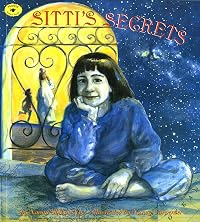
Sitti's Secrets
by Naomi Shihab Nye
On This Page
Description
A young girl describes a visit to see her grandmother in a Palestinian village on the West Bank.Tags
Recommendations







Member Reviews
When Mona and her father travel back to his childhood home in Palestine - no specific location is mentioned, but given the rural setting, and lack of crowding, I'm going to assume it is in the West Bank, rather than the Gaza Strip - the young American girl finds herself warmly welcomed into her extended family, forming a particularly strong bond with her Sitti, or grandmother. As she and Sitti bake together, find a way to communicate, despite the language barrier, and share some private moments, Mona begins to sense her deep connection to the older woman, and to feel that she has been let in on a secret. This connectedness will stay with her, even when she returns to her home in America, "on the other side of the world."
A lovely show more evocation of family, and a gentle exploration of the importance of cultural roots, Sitti's Secrets is one of the few picture-books I have encountered, depicting a Palestinian or Palestinian-American child, and - in addition to its own inherent merit as a story - is very welcome, for that reason. I'm glad that the Picture Book Club to which I belong chose it as an alternate selection, for our March "Outstanding Women" theme, as I might not have picked it up, otherwise.
That said, like some other readers, I was rather uncomfortable with the insertion, late in the story, of Mona's letter to the President, assuring him that if he (and other Americans) knew her Sitti, they would like her. This discomfort did not arise from any feeling that children's books should not address political themes - clearly, they often do, and often quite effectively. Nor did I object to the obvious subtext of the letter - that Arabs in general, and Palestinians in particular, have sometimes been demonized here in America; and that American policy has often been biased in favor of Israel, - because I feel that this subtext is truthful.
No, what I object to, with regards to Mona's letter, is its abrupt intrusion into a narrative that does not prepare the young reader for it. No mention is made, in Sitti's Secrets, of the difficulties of Palestinian life under Israeli occupation. No mention is made of American foreign policy, or of American perceptions, with regard to the region. So the letter feels out of place - addressing something that the young reader may, or may not, be aware of. I feel that Nye should either have made her narrative more overtly political, in order to explain the letter, or she should have been satisfied with a story whose focus was familial.
In any case, Sitti's Secrets is still a very worthwhile book, providing a much-needed portrait of Palestinians as human beings, just like you, me, and (presumably) the children reading it. The beautiful illustrations by Nancy Carpenter add to the sense of wonder and discovery. All in all, with the obvious exception of the letter, I recommend it! show less
A lovely show more evocation of family, and a gentle exploration of the importance of cultural roots, Sitti's Secrets is one of the few picture-books I have encountered, depicting a Palestinian or Palestinian-American child, and - in addition to its own inherent merit as a story - is very welcome, for that reason. I'm glad that the Picture Book Club to which I belong chose it as an alternate selection, for our March "Outstanding Women" theme, as I might not have picked it up, otherwise.
That said, like some other readers, I was rather uncomfortable with the insertion, late in the story, of Mona's letter to the President, assuring him that if he (and other Americans) knew her Sitti, they would like her. This discomfort did not arise from any feeling that children's books should not address political themes - clearly, they often do, and often quite effectively. Nor did I object to the obvious subtext of the letter - that Arabs in general, and Palestinians in particular, have sometimes been demonized here in America; and that American policy has often been biased in favor of Israel, - because I feel that this subtext is truthful.
No, what I object to, with regards to Mona's letter, is its abrupt intrusion into a narrative that does not prepare the young reader for it. No mention is made, in Sitti's Secrets, of the difficulties of Palestinian life under Israeli occupation. No mention is made of American foreign policy, or of American perceptions, with regard to the region. So the letter feels out of place - addressing something that the young reader may, or may not, be aware of. I feel that Nye should either have made her narrative more overtly political, in order to explain the letter, or she should have been satisfied with a story whose focus was familial.
In any case, Sitti's Secrets is still a very worthwhile book, providing a much-needed portrait of Palestinians as human beings, just like you, me, and (presumably) the children reading it. The beautiful illustrations by Nancy Carpenter add to the sense of wonder and discovery. All in all, with the obvious exception of the letter, I recommend it! show less
I thought this was a beautifully written and illustrated book, and I liked it a lot. The illustrations brought the characters to life and made imagining them in real life and their experiences easy. The book was written in first person from the perspective of Nona the main character in the book who goes to visit her grandma (Sitti) in Palestine. The author does a good job of comparing and contrasting Palestine and the United States along with Nona's daily life and Sitti's daily life. The language in this book was very smooth and easy to follow making it a good choice for any student to read or have it be read to them by an adult or older kid. I think the main message in this book is that distance can not eliminate the love that someone show more has for someone else and that even across the world people are still people and we're all the same on the inside. This was a beautiful story and I think it's a good way for children to learn about a different culture in a different part of the world. show less
Sitti’s Secrets is a lovely story about Mona, an Arab-American girl, visiting her grandmother for the first time in Palestine. In lyrical language Mona describes first the distance between herself and her grandmother (“between us are fishes and cities and buses and fields and presidents and clotheslines and trucks and stopsigns and signs that say DO NOT ENTER”,) and then the closeness that she experiences once she meets Sitti. Sitti has bird tattoos on her hands, long hair under her hijab and a clear love for her granddaughter. She shows Mona how to make bread in the old way and calls her habibi, Arabic for “darling.” At the end of the trip Mona has gained not only her connection to Sitti, who is a kindred spirit despite their show more language gap, but a passionate sense that Palestinians and all people have rights and should be treated with fairness. Mona writes to the President saying “I vote for peace. My grandmother votes with me.” Her conviction is political in a sense but also personal and spiritual. She grows up during the visit and her naturally creative and lyrical voice muses at the book’s end “Sometimes I think the world is a huge body tumbling in space, all curled up like a child sleeping. People are far apart but connected.”
Naomi Shihab Nye is likely the best known Arab-American author for children. Sitti appears again in her award-winning teen novel Habibi. As in Sitti’s Secrets Nye comes out strongly in favor of friendship across cultural lines and an end to ethnic violence. As Lisa Suhair Majaj writes in her article “Arab-American Literature: Origins and Developments,” “The gift of heritage, Nye makes clear, is also a warning: notions of “true” identity are too easily reified into the hard lines of absolutes that lead to bloodshed. What matters, she suggests, is not one’s ethnic identity so much as the care and concern one human extends to another.” This is an excellent book for librarians to suggest to teachers looking for books to address war and pacifism to children in second to sixth grade. The art is gorgeous and complements the lyrical text well. Indeed the book is so sensual and whimsical that younger readers may not grasp the larger issues it hints at, which is why it is ideal for classroom or one-on one discussions. Libraries should make an effort to purchase and retain this title as Arab-Americans in general and Palestinian-Americans even more so are wildly underrepresented in public and school library collections. Although this is often shelved with picture book collections it is a good choice to recommend to readers transitioning into chapter books who are ready for some emotionally complexity but still want pictures and a short text. This is also a good addition to any discussions of, book talks about (or displays featuring) Nye’s other work including Habibi and Going, Going Gone.
Nye, Naomi Shahib. Sitti’s Secrets. Ill. by Nancy Carpenter. New York, NY: Simon and Schuster, 1997. Print
Suhair Majaj, Lisa. "Arab-American Literature: Origins and Developments." American Studies Journal 52. 2008 Web. Mar 14, 2010 show less
Naomi Shihab Nye is likely the best known Arab-American author for children. Sitti appears again in her award-winning teen novel Habibi. As in Sitti’s Secrets Nye comes out strongly in favor of friendship across cultural lines and an end to ethnic violence. As Lisa Suhair Majaj writes in her article “Arab-American Literature: Origins and Developments,” “The gift of heritage, Nye makes clear, is also a warning: notions of “true” identity are too easily reified into the hard lines of absolutes that lead to bloodshed. What matters, she suggests, is not one’s ethnic identity so much as the care and concern one human extends to another.” This is an excellent book for librarians to suggest to teachers looking for books to address war and pacifism to children in second to sixth grade. The art is gorgeous and complements the lyrical text well. Indeed the book is so sensual and whimsical that younger readers may not grasp the larger issues it hints at, which is why it is ideal for classroom or one-on one discussions. Libraries should make an effort to purchase and retain this title as Arab-Americans in general and Palestinian-Americans even more so are wildly underrepresented in public and school library collections. Although this is often shelved with picture book collections it is a good choice to recommend to readers transitioning into chapter books who are ready for some emotionally complexity but still want pictures and a short text. This is also a good addition to any discussions of, book talks about (or displays featuring) Nye’s other work including Habibi and Going, Going Gone.
Nye, Naomi Shahib. Sitti’s Secrets. Ill. by Nancy Carpenter. New York, NY: Simon and Schuster, 1997. Print
Suhair Majaj, Lisa. "Arab-American Literature: Origins and Developments." American Studies Journal 52. 2008 Web. Mar 14, 2010 show less
I liked this book because I think that there are a lot of children who have family living in different parts of the world and it’s a great way for them to talk about it and see how much it can enrich their lives. Sitti lives in the US and her Grandmother is Arabic and lives on the other side of the world. It is also good because it shows that you don’t have to have a language in common to be able to communicate, Sitti and her grandmother use gestures to talk like rubbing their tummy if their hungry. The book is also good because it helps open children’s eyes to individuals rather that stereotyping an entire race. At the end of the book Sitti says that she votes for peace because anybody who knew her Grandmother like she did show more couldn’t hate her. show less
I enjoyed Naomi Sihab Nye’s story “Sitti’s Secrets” because she uses rich descriptions to describe the relationship between the young girl and her grandmother. Nye describes Sitti’s voice as having “danced as high as the whistles of birds. Her voice giggled and whoosed like the wind going around corners. She had a thousand rivers in her voice”. She also describes how although Habibi does not speak the same language as Sitti and her other family members she still enjoys spending time with them, and understands that they too enjoy her company by saying “we played marbles together in their courtyard. Their marbles were blue and green and spun through the dust like planets. We didn’t need words to play marbles”. The show more overall theme of this story is that love can be expressed, felt, and communicated without words. It shows that love is found in the way one interacts with others, not in what they say. show less
Sitti's Secrets is a book that I enjoyed reading immensely for multiple reasons. The story was very engaging, the illustrations captured the world and how Mona viewed it in a beautiful way, and the book expressed what it is like to be apart of two very different cultures. In the book there are many translations and views into Mona's two very different worlds: her life at home and then the time she spent with her Sitti (grandmother) in Palestine. One aspect I really enjoyed about the story in this book was that although Mona could not speak the same language as her Sitti, they still had a very strong connection and relationship. I also enjoyed the illustrations and how the illustrator embedded landscapes, buildings, and globes into the show more pictures. The illustrations showed what Mona was referring to when she talked about everything that was between her and her Sitti in Palestine. This book sends out the message that language is not necessary to have a deep bond with someone far away and that peace can still be abundant even in times of turmoil. show less
I really enjoyed reading this book about middle eastern culture from a child’s perspective. When I turned to the first page of this book, the illustrations really stood out to me. I was surprised at the abstract nature, and how different faces, textures, and colors all blended so interestingly on the pages. I began reading about the little girl, Mona, who was thinking about her grandmother, Sitti, who lives across the world, and soon realized that the pictures were overlapping to show differences in their two worlds. An example of this is seen on the first page where the author writes, “between us are fish and cities and busses and fields,” and the pages show Mona swinging on a swing during the daytime, and the tip of her sky is show more half an ocean and half a city. Another part of the book that I found interesting was the way Mona described her visit with her Sitti when she went to visit her across the world, somewhere in the Middle East. She says, “ we talked through my father as if he were a telephone” which I thought was a good way to describe how a translator worked to a child, as well as the language barriers that exist between different countries.
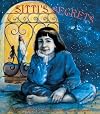
This book’s main purpose was to show different aspects of culture through pictures and storytelling. The illustrations show men picking lentils in a field, different types of food, Arabic words, and other aspects of the Middle Eastern cultures.
After pages and pages of Mona’s beautiful storytelling about her visit with her Grandmother across the world, she has to leave her Sitti’s home and go back to America where she lives. When she returns home, Mona turns on the news and notes that she felt worried about what was going on in the world. In a note to the President of the United States, Mona writes: “Mr. President, I wish you luck on your very hard job. I vote for peace. My Grandmaa votes with me.” I thought this was extremely compelling, because none of the book talked about war. The author waited until the end to mention that there is not peace between the Middle East and the United States. It also will lead children to question what Mona is talking about that she saw on the news, and how anyone would think that the beautiful caring grandmother they had just read about could be in trouble. The author also left her own note at the end of the book, stating “If Grandmas ran the world, I don’t think we’d have any wars” which I thought was not only true, but a nice way to end her book. show less
This book’s main purpose was to show different aspects of culture through pictures and storytelling. The illustrations show men picking lentils in a field, different types of food, Arabic words, and other aspects of the Middle Eastern cultures.
After pages and pages of Mona’s beautiful storytelling about her visit with her Grandmother across the world, she has to leave her Sitti’s home and go back to America where she lives. When she returns home, Mona turns on the news and notes that she felt worried about what was going on in the world. In a note to the President of the United States, Mona writes: “Mr. President, I wish you luck on your very hard job. I vote for peace. My Grandmaa votes with me.” I thought this was extremely compelling, because none of the book talked about war. The author waited until the end to mention that there is not peace between the Middle East and the United States. It also will lead children to question what Mona is talking about that she saw on the news, and how anyone would think that the beautiful caring grandmother they had just read about could be in trouble. The author also left her own note at the end of the book, stating “If Grandmas ran the world, I don’t think we’d have any wars” which I thought was not only true, but a nice way to end her book. show less
Members
- Recently Added By
Lists

One Picture Book Per Country
206 works; 1 member
Author Information

62+ Works 6,659 Members
Naomi Shihab Nye has received a Guggenheim Fellowship, the Witter Bynner Fellowship from the Library of Congress, the I. B. Lavan Award from the Academy of American Poets, and four Pushcart Prizes, as well as numerous honors for her books for younger readers. She lives in San Antonio, Texas
All Editions
Awards and Honors
Common Knowledge
- Canonical title
- Sitti's Secrets
- Important places
- Palestine
Classifications
Statistics
- Members
- 512
- Popularity
- 58,723
- Reviews
- 27
- Rating
- (4.11)
- Languages
- English
- Media
- Paper
- ISBNs
- 10
- UPCs
- 1
- ASINs
- 2