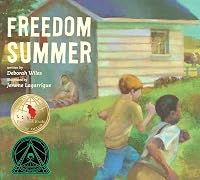
Freedom Summer
by Deborah Wiles
On This Page
Description
In 1964, Joe is pleased that a new law will allow his best friend John Henry, who is colored, to share the town pool and other public places with him, but he is dismayed to find that prejudice still exists.Tags
Recommendations
















Member Reviews
Best friends Joe and John Henry enjoy many of the usual pleasures of boyhood together one hot summer - swimming in Fiddler's Creek (in their birthday suits!), savoring the ice pops from Mr. Mason's General Store - but the realities of segregated life in 1964 Mississippi intrude, keeping them from doing everything they would like, and from being too open about their friendship. When they learn that a new law requires their town to permit everyone - black and white - to use public facilities like the swimming pool, they are excited at the prospect of swimming in those crystal-clear waters together, for the very first time. But when they arrive at the pool on the fateful morning in question, they discover that the town, determined to show more resist integration, has filled it with hot tar, rather than allow blacks to swim. The law may have changed, but the people still had a long way to go...
Based upon author Deborah Wiles' memories of growing up in the South during the tumultuous Civil Rights era, Freedom Summer is a poignant exploration of friendship across racial lines, narrated by a young white boy (Joe) who, although content to have a black boy (John Henry) as a boon companion, has never really questioned the "way things are." It is only when change seems possible, and then impossible, that Joe truly considers how their friendship (and their town) might look to John Henry. I appreciated the perspective offered here on an important moment in our history, and the insight given, through the story, into the lives of ordinary young kids during extraordinary times. I was particularly impressed by the fact that the author chose to realistically depict "what happened next," highlighting the fact that things didn't immediately change, after the passage of the Civil Rights Act of 1964 - there was (and still is) a long way to go.
With an engaging tale of friendship amidst the senseless wrongs of racism and segregation, and immensely appealing artwork by Jerome Lagarrigue, Freedom Summer is an outstanding work of historical fiction for the younger, picture-book set! Highly recommended to anyone looking for children's stories set during the Civil Rights era, or featuring interracial friendship. It could, perhaps, be paired with Jacqueline Woodson's The Other Side, which presents the story of a friendship between a young black girl and her white neighbor in this same period. show less
Based upon author Deborah Wiles' memories of growing up in the South during the tumultuous Civil Rights era, Freedom Summer is a poignant exploration of friendship across racial lines, narrated by a young white boy (Joe) who, although content to have a black boy (John Henry) as a boon companion, has never really questioned the "way things are." It is only when change seems possible, and then impossible, that Joe truly considers how their friendship (and their town) might look to John Henry. I appreciated the perspective offered here on an important moment in our history, and the insight given, through the story, into the lives of ordinary young kids during extraordinary times. I was particularly impressed by the fact that the author chose to realistically depict "what happened next," highlighting the fact that things didn't immediately change, after the passage of the Civil Rights Act of 1964 - there was (and still is) a long way to go.
With an engaging tale of friendship amidst the senseless wrongs of racism and segregation, and immensely appealing artwork by Jerome Lagarrigue, Freedom Summer is an outstanding work of historical fiction for the younger, picture-book set! Highly recommended to anyone looking for children's stories set during the Civil Rights era, or featuring interracial friendship. It could, perhaps, be paired with Jacqueline Woodson's The Other Side, which presents the story of a friendship between a young black girl and her white neighbor in this same period. show less
This is a very evocative book about racism and hatred. Here's this boy, excited to play in the pool for the first time - and he can't. The city was so upset about integration that they filled the pool with concrete rather than let black people swim there. Terrible.
This book is realistic, and we can always use more books about history. It's well-written, I like the artwork.
But...
See, now, I have to ask this. Here's this book about integration, about hatred, about racism. It features a white boy and his black best friend. Best friend's big brother makes an appearance, too. The best friend is the one who feels heartbroken, he's the one who's suffering here...
So why is the white kid the narrator?
Is this story of friendship, and of hatred, show more really his story to tell? Why couldn't John Henry have told his own story? show less
This book is realistic, and we can always use more books about history. It's well-written, I like the artwork.
But...
See, now, I have to ask this. Here's this book about integration, about hatred, about racism. It features a white boy and his black best friend. Best friend's big brother makes an appearance, too. The best friend is the one who feels heartbroken, he's the one who's suffering here...
So why is the white kid the narrator?
Is this story of friendship, and of hatred, show more really his story to tell? Why couldn't John Henry have told his own story? show less
I absolutely loved this book. The story really showed that children don't start out having these hurtful opinions, but instead learn out them from the adults around them. The friendship in this book is really powerful showing a good support system. The illustrations in my opinion were beautiful and very detailed.
While the writing in this story is a bit young, the topic is more mature. A black boy is friends with a white boy during the "freedom summer" when the integration law was passed. The boys know they are not treated equally in town but are still friends despite that. The morning comes when the black boy will finally be able to swim in the town pool with his white friend, only to discover that the town has filled in the pool rather than allow integration. They have a very real and frank discussion about what that means and how it makes each boy feel. There is an author's note at the end talking about how while this specific story was made up, this type of thing happened recently. When I read this book to a class of 5th grade students they show more had some excellent and very enlightened things to contribute to the discussion. show less
Freedom Summer shows the challenges and adversity of two young boys that are best friends despite societal expectations. The story is uncomfortable yet comforting, as you follow Young Joe, a privileged white boy, and John Henry, the son of the cook in Young Joe's home. Deborah Wiles takes you on Joe's journey of understanding his privilege and creating hope for John Henry through friendship, encouragement, and humility. I think this is a text that could easily be incorporated in a classroom, especially with our current social climate. The story teaches acceptance and emphasizes the innocence of a child while introducing sensitive subjects in an appropriate manner for young readers.
This has some wonderful imagery, for example: "we shoot marbles in the dirt until we're too hot to be alive" and "workers tie planks to their shoes and stomp on the blacktop to make it smooth." The drawings are smudged, and feel like memory. They also provide an "everyman" feeling. The vagueness of the people's faces means it could be you, your cousin, your brother who is experiencing institutional racism in the Summer of 1964.
In the summer of 1964, civil rights workers in Mississippi organized “Freedom Summer,” a movement to register black Americans to vote. It was a time of great racial violence and change. This story is told from the perspectives of kids. John Henry is a young African American boy who is best friends with Joe, who is white. There are many areas of town however that John Henry is restricted from going. Instead of using his white privilege and meeting up with John Henry later, as he used to, Joe decides he will only see the town the way John Henry is allowed to see it.
This is a great story with nice illustrations that has won multiple awards. I see it as an excellent book to teach white kids about our past and about making ethical choices.
This is a great story with nice illustrations that has won multiple awards. I see it as an excellent book to teach white kids about our past and about making ethical choices.
Members
- Recently Added By
Author Information

20+ Works 7,037 Members
All Editions
Awards and Honors
Awards
Classifications
Statistics
- Members
- 1,348
- Popularity
- 17,746
- Reviews
- 96
- Rating
- (4.49)
- Languages
- English
- Media
- Paper
- ISBNs
- 12
- ASINs
- 2