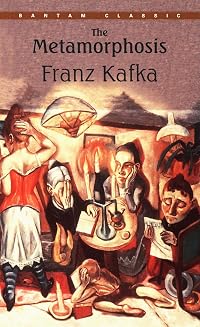
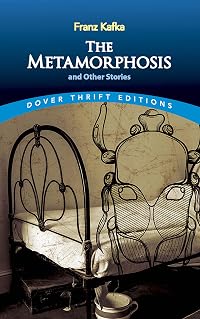
Metamorphosis [Bantam Classic]
by Franz Kafka 
On This Page
Description
The Metamorphosis begins almost comically. A man wakes up to find he has turned into an insect. But the claustrophobic, dirty room and the increasingly distressed narrator soon turn this into a tale of slow horror. Most horrifying of all is his family's reaction to his metamorphosis and their final solution to the problem..
Tags
Recommendations










Member Reviews
I know exactly how Grete feels. I have a bug for a brother, too. =_=
Writers from Prague tend to leave indelible impressions on my mind. I'll admit it, I have a pro-Prague bias, I love all things European with the intimacy only a foreigner can achieve. Kafka and Kundera, they are inevitably infused with some of the magic of Prague. Their works are steeped in nuance, they play with overtones and instil their words with ambiguity. All stories are so inherently beautiful in their own right, the act of writing reviews often consist of little more than the cherry-picking of a few choice adjectives, and private, fragmentary reflections on the impotency of words that stubbornly refuse to convey to others the very emotions they provoke in us. show more The job of the modern writer, then, is to capture that elusive, transient feeling with their words, to bottle it and sell it. Kafka sells despair, but a subtle form of hopelessness that uses the theme of alienation from the rest of the world to express itself. Leaves you just as, if not more, utterly devastated by the end. show less
Writers from Prague tend to leave indelible impressions on my mind. I'll admit it, I have a pro-Prague bias, I love all things European with the intimacy only a foreigner can achieve. Kafka and Kundera, they are inevitably infused with some of the magic of Prague. Their works are steeped in nuance, they play with overtones and instil their words with ambiguity. All stories are so inherently beautiful in their own right, the act of writing reviews often consist of little more than the cherry-picking of a few choice adjectives, and private, fragmentary reflections on the impotency of words that stubbornly refuse to convey to others the very emotions they provoke in us. show more The job of the modern writer, then, is to capture that elusive, transient feeling with their words, to bottle it and sell it. Kafka sells despair, but a subtle form of hopelessness that uses the theme of alienation from the rest of the world to express itself. Leaves you just as, if not more, utterly devastated by the end. show less
“As Gregor Samsa awoke one morning from uneasy dreams he found himself transformed in his bed into a gigantic insect.”
This very effective opening sentence entirely encapsulates everything I knew about this story prior to reading it. I remember as a teenager watching a few minutes of Steven Berkoff’s televised adaptation and shortly changing the channel for some greener posture. I remember there was this bloke contorting on the floor pretending to be an insect and I just did not want to know any more.
Before I read The Metamorphosis had no idea what to expect, I thought perhaps some PKD weirdness, something surreal, probably with some kind of message. The weirdness is definitely there (though not in PKD style) and Gregor’s show more cavalier reaction to his transformation is quite surreal. What I did not expect though was how sad, poignant and tragic this story is. In spite of being amply bizarre, the strangeness of the situation almost seems to be beside the point. After waking up to find that he has morphed into a horrible giant insect overnight Gregor seems to take it all in stride. Not one to waste any time WTF-ing Gregor rallies like a champ and simply gets on with his insectile life. He worries more about how his situation will affect his family’s welfare than how horrifying his predicament is. What a guy. Gregory lives in a shabby apartment with his parents and a younger sister. Initially they are all sympathetic of his condition, but as time goes by and their financial position deteriorates their patience and sympathy begin to evaporate.
I don't want to elaborate any more on the plot as it is a short story (novella). Throughout the story Gregor retains his goodness, even through the gradual loss of his humanity. The opposite seems to be the case for his family. His sense of alienation and isolation is very palpable (especially as I was reading the story in a very quiet environment). What befalls Gregor is so tragic [a:Thomas Hardy|15905|Thomas Hardy|https://d.gr-assets.com/authors/1189902685p2/15905.jpg] probably wishes he had thought of it. Even the “happy ending” makes me sad. Of course the entire thing can be interpreted as an allegory, there is a school of thought that it is all in Gregor’s mind and he has simply gone completely cuckoo one fine morning (working in textile will do that to you). As a sci-fi nerd I reject this hypothesis and choose to believe that the poor fellow does metamorphose during the night. Probably due to a stray cosmic ray from another dimension, or just a demented Dalek having a laugh at his expense. In any event this is a story that will stay with me for the rest of my life.
Note: Thanks to Glenn for recommending this book to me. show less
This very effective opening sentence entirely encapsulates everything I knew about this story prior to reading it. I remember as a teenager watching a few minutes of Steven Berkoff’s televised adaptation and shortly changing the channel for some greener posture. I remember there was this bloke contorting on the floor pretending to be an insect and I just did not want to know any more.
Before I read The Metamorphosis had no idea what to expect, I thought perhaps some PKD weirdness, something surreal, probably with some kind of message. The weirdness is definitely there (though not in PKD style) and Gregor’s show more cavalier reaction to his transformation is quite surreal. What I did not expect though was how sad, poignant and tragic this story is. In spite of being amply bizarre, the strangeness of the situation almost seems to be beside the point. After waking up to find that he has morphed into a horrible giant insect overnight Gregor seems to take it all in stride. Not one to waste any time WTF-ing Gregor rallies like a champ and simply gets on with his insectile life. He worries more about how his situation will affect his family’s welfare than how horrifying his predicament is. What a guy. Gregory lives in a shabby apartment with his parents and a younger sister. Initially they are all sympathetic of his condition, but as time goes by and their financial position deteriorates their patience and sympathy begin to evaporate.
I don't want to elaborate any more on the plot as it is a short story (novella). Throughout the story Gregor retains his goodness, even through the gradual loss of his humanity. The opposite seems to be the case for his family. His sense of alienation and isolation is very palpable (especially as I was reading the story in a very quiet environment). What befalls Gregor is so tragic [a:Thomas Hardy|15905|Thomas Hardy|https://d.gr-assets.com/authors/1189902685p2/15905.jpg] probably wishes he had thought of it. Even the “happy ending” makes me sad. Of course the entire thing can be interpreted as an allegory, there is a school of thought that it is all in Gregor’s mind and he has simply gone completely cuckoo one fine morning (working in textile will do that to you). As a sci-fi nerd I reject this hypothesis and choose to believe that the poor fellow does metamorphose during the night. Probably due to a stray cosmic ray from another dimension, or just a demented Dalek having a laugh at his expense. In any event this is a story that will stay with me for the rest of my life.
Note: Thanks to Glenn for recommending this book to me. show less
Personally, I fucking hate these Kafka-esque setups. There's no reason given for the guy's turning into a bug. None whatsoever. The story begins with him waking up in the shape of a giant bug. Of course his family is grossed out and freaked out. The story goes on, he becomes more and more miserable.
Nothing happy about this book. It would have been better if some reason had been given, but Kafka wasn't very good at doing that, was he? Not gonna lie, I feel that kind of plot cliche/device is a terrible one and other authors need to stop using it.
Some people interpret this as a metaphor on people with disabilities because that's how many of them were treated by their families. This book was published in 1915, so during WWI and yeah, there show more were men coming home from the warfront with missing limbs, eyes, having paralysis and etc and yanno, that would have been a more effective means of storytelling than choosing the metaphor of something that is near-universally reviled.
I know people will disagree with me and decry my opinion and all that but it is what it is - I'm all for books with people with disabilities, but sometimes an idea is just not delivered well and I think this book is one of them. It wouldn't be the first or last time I read a book that failed to deliver, but oh well. show less
Nothing happy about this book. It would have been better if some reason had been given, but Kafka wasn't very good at doing that, was he? Not gonna lie, I feel that kind of plot cliche/device is a terrible one and other authors need to stop using it.
Some people interpret this as a metaphor on people with disabilities because that's how many of them were treated by their families. This book was published in 1915, so during WWI and yeah, there show more were men coming home from the warfront with missing limbs, eyes, having paralysis and etc and yanno, that would have been a more effective means of storytelling than choosing the metaphor of something that is near-universally reviled.
I know people will disagree with me and decry my opinion and all that but it is what it is - I'm all for books with people with disabilities, but sometimes an idea is just not delivered well and I think this book is one of them. It wouldn't be the first or last time I read a book that failed to deliver, but oh well. show less
"One morning, as Gregor Samsa was waking up from anxious dreams, he discovered that in bed he had been changed into a monstrous verminous bug." Thus runs the Johnston translation of one of the most famous opening lines in modern literature, the doorway to a strange tale of man inexplicably turned into an insect.
Grounded as it is on a conviction that life is indeed a tale told by an idiot, Kafka's short absurdist masterpiece yields as many interpretations as there are readers. Samsa's transformation is, of course, never explained. One day he's the precarious sole support of his family, and the next he's an oversized bug. Why? Who knows? Why does anything happen in this theater of the absurd we call life?
For me, what rose to the surface show more was the plight of those (like Samsa and his family) who exist just barely above absolute destitution. When the meaningless obtrudes — an accident, a disability, and illness — the struggle to survive becomes so consuming that no one has time or energy to care why it happened.
Our breadwinner is suddenly a scuttering insect requiring care and attention? So what? Perhaps the middle or upper classes have leisure to philosophize about this, but our existence is already so ridiculous that we can only take the ridiculous in stride while trying to keep body and soul together. When you have nothing, being transformed into vermin is the least of your problems. show less
Grounded as it is on a conviction that life is indeed a tale told by an idiot, Kafka's short absurdist masterpiece yields as many interpretations as there are readers. Samsa's transformation is, of course, never explained. One day he's the precarious sole support of his family, and the next he's an oversized bug. Why? Who knows? Why does anything happen in this theater of the absurd we call life?
For me, what rose to the surface show more was the plight of those (like Samsa and his family) who exist just barely above absolute destitution. When the meaningless obtrudes — an accident, a disability, and illness — the struggle to survive becomes so consuming that no one has time or energy to care why it happened.
Our breadwinner is suddenly a scuttering insect requiring care and attention? So what? Perhaps the middle or upper classes have leisure to philosophize about this, but our existence is already so ridiculous that we can only take the ridiculous in stride while trying to keep body and soul together. When you have nothing, being transformed into vermin is the least of your problems. show less
Have you ever had a day where something supremely strange happens and, in the context of the day, you just sigh and think, "You know what? This might as well happen."
The entirety of The Metamorphosis feels like that sort of day. It's surreal and hyper-real at once, a strange mix of absurdity and reality, being inside the protagonist's head and yet being totally detached from the events. So weird you're separated from the weirdness, so absurd you can only shrug and say, "Sure, why not," and go along with it.
It's not stream-of-consciousness, not really, but there's still the feeling of watching as the thoughts of a man float languidly past you. Normally, this would irk me, but Kafka's writing has a pacifying, dreamlike, almost sedative show more quality that made me totally okay with just surfing along on top of Gregor's thoughts.
If anybody tells you this novella is about a man transforming into a cockroach, they are wrong. First, this event literally happens in the first sentence of the book. Second, there's no transformation- Gregor just wakes up to find he's changed form. And third, it is never specified what exactly Gregor's changed into. Cockroach, dung beetle, leaf bug, he could even be a ladybug- all Kafka calls him is the vague word "vermin"- though he is most definitely an insect of some sort. Lastly, this isn't what the book is about, at least no more than Life of Pi is about a tiger or To Kill a Mockingbird is about killing a literal mockingbird. This book is about everything that happens after Gregor wakes up as an insect- namely, his family's response.
Is the vermin a metaphor for something? Probably. Definitely probably. What's it a metaphor for? I couldn't even tell you. Some abstract existential concept, I'm sure- one that would gall me to have to write an essay on.
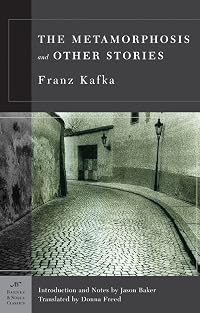
That brings me to this particular edition, and while I will say that the translation is quite good, the "Explanatory Notes on the Text" are horrid. They explain nothing, and in fact they're the sort of intellectual argument and counterargument and counter-counterargument and overdissection that makes me want to vomit. If, however, you'd like to pick apart the possible origins of the protagonist's surname or the German prefixes of the original title, this may be right up your alley:
Kill me please.
I've read people's reviews calling The Metamorphosis "delightful," "horrifying," "depressing," and a thousand other things like that, and I couldn't disagree more. I felt nothing, but something tells me that's what I was supposed to feel. I was detached, as if watching the events unfold a million miles away, moored there by Kafka's vague, flowy, calming writing. This might be the book with the least emotion I've ever read- it elicited no feeling whatsoever from me, and I was as mildly interested in an "Oh, huh, would you look at that," sort of sense as Gregor was when he looked down one morning and saw that he had several tiny legs and an exoskeleton.
And, just as a side note: the entire time I was reading this, I could not stop thinking about this scene from Harry Potter and the Half-Blood Prince:
THE PINCERS.
Read for the 2016 Popsugar Reading Challenge: "A book that's under 150 pages." show less
The entirety of The Metamorphosis feels like that sort of day. It's surreal and hyper-real at once, a strange mix of absurdity and reality, being inside the protagonist's head and yet being totally detached from the events. So weird you're separated from the weirdness, so absurd you can only shrug and say, "Sure, why not," and go along with it.
It's not stream-of-consciousness, not really, but there's still the feeling of watching as the thoughts of a man float languidly past you. Normally, this would irk me, but Kafka's writing has a pacifying, dreamlike, almost sedative show more quality that made me totally okay with just surfing along on top of Gregor's thoughts.
If anybody tells you this novella is about a man transforming into a cockroach, they are wrong. First, this event literally happens in the first sentence of the book. Second, there's no transformation- Gregor just wakes up to find he's changed form. And third, it is never specified what exactly Gregor's changed into. Cockroach, dung beetle, leaf bug, he could even be a ladybug- all Kafka calls him is the vague word "vermin"- though he is most definitely an insect of some sort. Lastly, this isn't what the book is about, at least no more than Life of Pi is about a tiger or To Kill a Mockingbird is about killing a literal mockingbird. This book is about everything that happens after Gregor wakes up as an insect- namely, his family's response.
Is the vermin a metaphor for something? Probably. Definitely probably. What's it a metaphor for? I couldn't even tell you. Some abstract existential concept, I'm sure- one that would gall me to have to write an essay on.
That brings me to this particular edition, and while I will say that the translation is quite good, the "Explanatory Notes on the Text" are horrid. They explain nothing, and in fact they're the sort of intellectual argument and counterargument and counter-counterargument and overdissection that makes me want to vomit. If, however, you'd like to pick apart the possible origins of the protagonist's surname or the German prefixes of the original title, this may be right up your alley:
Pongs stresses "the terrifying character of an 'Un.' It is the linguistic form of negation, which goes back to a dialectical process of separation" (263). See further Hasselblatt (193). Pongs notes earlier than Weinberg the highly charged etymological background of "ungeheures Ungeziefer." He comments: "The concentrated energy of Kafka's language... appears to be the only indication that Gregor is inwardly more deeply moved in his unconscious than his baldly registering language suggests" (263).
Kill me please.
I've read people's reviews calling The Metamorphosis "delightful," "horrifying," "depressing," and a thousand other things like that, and I couldn't disagree more. I felt nothing, but something tells me that's what I was supposed to feel. I was detached, as if watching the events unfold a million miles away, moored there by Kafka's vague, flowy, calming writing. This might be the book with the least emotion I've ever read- it elicited no feeling whatsoever from me, and I was as mildly interested in an "Oh, huh, would you look at that," sort of sense as Gregor was when he looked down one morning and saw that he had several tiny legs and an exoskeleton.
And, just as a side note: the entire time I was reading this, I could not stop thinking about this scene from Harry Potter and the Half-Blood Prince:
THE PINCERS.
Read for the 2016 Popsugar Reading Challenge: "A book that's under 150 pages." show less
It is a strange and weird novel that I devoured in a single day, following the unexplained metamorphosis of a man into a bug. He is at first shown a little bit of sympathy and care, but as time passed, he is no more than a disgusting vermin that had to be eradicated. What is ironic is that although we know he still loved his family, especially his sister, he couldn't voice them out, and his family, as we later find out, view him as merely a means by which to pay off their debts. He is already isolated from the start.
It is a disturbingly real commentary on the human condition: through Gregor's metamorphosis, Kafka reveals we were already bugs, already reduced to our function, our utility, our economic value.
P/S: It reminds me of an show more occasion in which hordes of cockroaches swarmed out from the drain beneath my house, the writhing mass of it, and we smash, spray poison, crush them until we smell of cockroaches. show less
It is a disturbingly real commentary on the human condition: through Gregor's metamorphosis, Kafka reveals we were already bugs, already reduced to our function, our utility, our economic value.
P/S: It reminds me of an show more occasion in which hordes of cockroaches swarmed out from the drain beneath my house, the writhing mass of it, and we smash, spray poison, crush them until we smell of cockroaches. show less
Boy oh Boy, did I struggle with this. So I went to the internet searching for clarification and discovered there are as many interpretations of this book as there are legs on Gregor's new buggish body. I find it fascinating that people have been reading and discussing this book for 100 years and no one seems to have completely figured it out yet. Is it about the alienation of modern life? The Role of the individual in the family? Who can say with any degree of confidence? So this book was a conundrum for me but it has piqued my interest in Kafka. I'm not through with him yet. He had enough influence on me to leave me in a dark funk at the end of this book without really even knowing why. That intrigues me. Maybe I'll try The Trial next.
Members
- Recently Added By
Lists

Magic Realism
371 works; 52 members

Best Satire
188 works; 28 members

Existentialism
90 works; 11 members

Books Read in 2013
1,630 works; 51 members

The College Board: 101 Great Books Recommended for College-Bound Readers
111 works; 7 members

Books Read in 2024
4,623 works; 126 members

Books That Made Us Cry
278 works; 145 members

el
1,139 works; 1 member
Philosophical Fiction
97 works; 27 members
20th Century Literature
1,161 works; 54 members

Best of World Literature
434 works; 51 members
Author Information

1,502+ Works 103,675 Members
Franz Kafka -- July 3, 1883 - June 3, 1924 Franz Kafka was born to middle-class Jewish parents in Prague, Czechoslovakia on July 3, 1883. He received a law degree at the University of Prague. After performing an obligatory year of unpaid service as law clerk for the civil and criminal courts, he obtained a position in the workman's compensation show more division of the Austrian government. Always neurotic, insecure, and filled with a sense of inadequacy, his writing is a search for personal fulfillment and understanding. He wrote very slowly and deliberately, publishing very little in his lifetime. At his death he asked a close friend to burn his remaining manuscripts, but the friend refused the request. Instead the friend arranged for publication Kafka's longer stories, which have since brought him worldwide fame and have influenced many contemporary writers. His works include The Metamorphosis, The Castle, The Trial, and Amerika. Kafka was diagnosed with tuberculosis (TB) in August 1917. As his disease progressed, his throat became affected by the TB and he could not eat regularly because it was painful. He died from starvation in a sanatorium in Kierling, near Vienna, after admitting himself for treatment there on April 10, 1924. He died on June 3 at the age of 40. (Bowker Author Biography) show less
Franz Kafka has a Legacy Library. Legacy libraries are the personal libraries of famous readers, entered by LibraryThing members from the Legacy Libraries group.
All Editions
Some Editions
Series
Belongs to Publisher Series
Work Relationships
Contains
Common Knowledge
- Canonical title
- Metamorphosis [Bantam Classic]
- Original title
- Die Verwandlung
- Alternate titles
- The Metamorphosis
- Original publication date
- 1972-03
- People/Characters
- Gregor Samsa
- Dedication
- I am indebted to Allen Mandelbaum for proposing this book, and to Gregory Armstrong, its exemplary editor.
I wish to thank Ralph Freedman, Barney Milstein, and Ruth Hein for making valuable improvements to the translation.... (show all)
The Reference Division of the Princeton University Library helped me compile the bibliography. - First words
- One morning, when Gregor Samsa woke from troubled dreams, he found himself transformed in his bed into a horrible vermin.
- Last words
- (Click to show. Warning: May contain spoilers.)And, as if in confirmation of their new dreams and good intentions, as soon as they reached their destination Grete was the first to get up and stretch out her young body.
- Canonical DDC/MDS
- 833.912
- Canonical LCC
- PT2621.A26
- Disambiguation notice
- The Bantam Classics edition contains additional content, essays and commentary on The Metamorphosis. Do not add/combine with the other editons.
Classifications
- Genres
- Fiction and Literature, General Fiction
- DDC/MDS
- 833.912 — Literature & rhetoric German & related literatures German fiction 1900- 1900-1990 1900-1945
- LCC
- PT2621 .A26 — Language and Literature German, Dutch and Scandinavian literatures German literature Individual authors or works 1860/70-1960
- BISAC
Statistics
- Members
- 6,021
- Popularity
- 2,112
- Reviews
- 87
- Rating
- (3.80)
- Languages
- 9 — Czech, English, Finnish, French, German, Hindi, Japanese, Farsi/Persian, Russian
- Media
- Paper, Audiobook, Ebook
- ISBNs
- 197
- UPCs
- 2
- ASINs
- 15