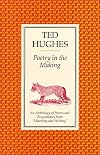
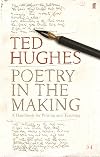
Poetry in the Making
by Ted Hughes
On This Page
Description
Drawn from Ted Hughes's celebrated programs for the BBC's "Listening and Writing" series, Poetry in the Making is a fresh, student-friendly discussion of what Hughes calls "imaginative writing." Offering generous citations from the work of several English-speaking, mostly modern or contemporary poets - including Hopkins, Dickinson, Eliot, Larkin, Plath, and himself - Hughes provides a useful and readable primer on "the kind of [poetry] writing children can do without becoming false to show more themselves." Like Kenneth Koch's classic Wishes, Lies, and Dreams, Poetry in the Making presents new ideas on how children and other beginners might best compose their own poems while also presenting candid, and more general, insights that all students and scholars of the art or craft of verse will find inspiring. And although these pieces were primarily intended to help students improve their creative writingn abilities, they are also an effective introduction to Hughes's own work and the influences other writers have had on him. Hughes, who was Poet Laureate to Queen Elizabeth II at the time of his death 1998, casually and colorfully discusses how he came to write, what inspires him (and why), and the difficulties that he (and other writers) confront when writing. show lessTags
Recommendations









Member Reviews
This slim paperback collects a series of radio talks English poet Ted Hughes gave for the BBC Schools Service in the 1960s. That fact evokes a time when you could expect a class of ten-to-fourteen-year-olds to pay attention to a radio in the classroom. No powerpoint, no video, no smartboard. “Wireless” meant something else in those days.
So the technology of delivery is outdated. But what about the content? It holds up well. Hughes has thought intelligently about what to present in just nine lessons that will set pupils off on the adventure of creating their own poems and stories. He does this without condescending to his listeners.
Hughes illustrates his points with a selection of poems, both his own and those of other poets. For show more publication, he supplemented the talks with notes for classroom teachers and additional verses.
The book closes with a short chapter in which Hughes tackles the challenge of correlating experience with words. The difficulty of finding just the right word is evident, but the other half of the equation presents a challenge, as well. We are barely aware of all that our senses take in; in what sense is that experience? (In an earlier chapter, he asks how many of us, appearing in court, would want to have our case decided by a jury that recalled no more of the evidence than we do of last week’s lessons). Hughes counters this by speculating that a sense called psychometry may be something we all have, not just the few for whom it is documented. This final chapter is not numbered, as the others are, which leads me to think it was not one of the broadcast talks. Possibly a wise decision; I didn’t notice this anomaly at first and found myself wondering what 10-to-14-year-olds, sitting at their desks as the words came out of a wooden box, would have made of it.
I think this book would still be valuable for anyone tasked with introducing poetry to children, or for adults who want to bootstrap themselves into the matter of reading and writing poems. show less
So the technology of delivery is outdated. But what about the content? It holds up well. Hughes has thought intelligently about what to present in just nine lessons that will set pupils off on the adventure of creating their own poems and stories. He does this without condescending to his listeners.
Hughes illustrates his points with a selection of poems, both his own and those of other poets. For show more publication, he supplemented the talks with notes for classroom teachers and additional verses.
The book closes with a short chapter in which Hughes tackles the challenge of correlating experience with words. The difficulty of finding just the right word is evident, but the other half of the equation presents a challenge, as well. We are barely aware of all that our senses take in; in what sense is that experience? (In an earlier chapter, he asks how many of us, appearing in court, would want to have our case decided by a jury that recalled no more of the evidence than we do of last week’s lessons). Hughes counters this by speculating that a sense called psychometry may be something we all have, not just the few for whom it is documented. This final chapter is not numbered, as the others are, which leads me to think it was not one of the broadcast talks. Possibly a wise decision; I didn’t notice this anomaly at first and found myself wondering what 10-to-14-year-olds, sitting at their desks as the words came out of a wooden box, would have made of it.
I think this book would still be valuable for anyone tasked with introducing poetry to children, or for adults who want to bootstrap themselves into the matter of reading and writing poems. show less
wonderful animal poems. plus essays.
Ratings
Members
- Recently Added By
Author Information

151+ Works 13,904 Members
Ted Hughes was born on August 17, 1930 in England and attended Cambridge University, where he became interested in anthropology and folklore. These interests would have a profound effect on his poetry. In 1956, Hughes married famed poet Sylvia Plath. He taught at the University of Massachusetts at Amherst from 1957 until 1959, and he stopped show more writing altogether for several years after Plath's suicide in 1963. Hughes's poetry is highly marked by harsh and savage language and depictions, emphasizing the animal quality of life. He soon developed a creature called Crow who appeared in several volumes of poetry including A Crow Hymn and Crow Wakes. A creature of mythic proportions, Crow symbolizes the victim, the outcast, and a witness to life and destruction. Hughes's other works also created controversy because of their style, manner, and matter, but he has won numerous honors, including the Somerset Maugham Award in 1960, and the Queen's Medal for Poetry in 1974. His greatest honor came in 1984, when he was named Poet Laureate of England. Ted Hughes died in 1998. (Bowker Author Biography) show less
Common Knowledge
- Canonical title
- Poetry in the Making
Classifications
- Genres
- Poetry, Literature Studies and Criticism, Fiction and Literature
- DDC/MDS
- 808.1 — Literature & rhetoric Literature, rhetoric & criticism Rhetoric and collections of literary texts from more than two literatures Rhetoric of poetry
- LCC
- PR1225 .H8 — Language and Literature English English Literature Collections of English literature
- BISAC
Statistics
- Members
- 179
- Popularity
- 183,358
- Reviews
- 2
- Rating
- (3.62)
- Languages
- English, Portuguese
- Media
- Paper
- ISBNs
- 5
- ASINs
- 4