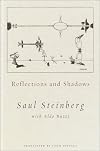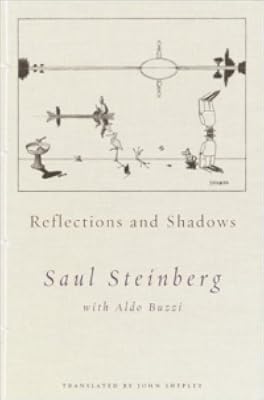
Reflections and Shadows
by Saul Steinberg, Aldo Buzzi (Author)
On This Page
Description
As The New Yorker's genius cartoonist, Saul Steinberg was universally admired for his playful and profound images of the life and times of his adopted homeland, the USA. In Reflections and Shadows, the artist evokes an equally enchanting portrait of his own life, conjuring images from his childhood in poverty-stricken Romania, his artistic education in Milan and his first taste of freedom and opportunity, in Washington and New York. Written in collaboration with his close friend, the author show more Aldo Buzzi, Reflections and Shadows offers a wonderful insight into the life and work of one of the twentieth century's great talents. show lessTags
Recommendations

























Member Reviews
Published after his death in 1999, this is a meditation based on a series of interviews of Steinberg by Buzzi. Beginning with his childhood and youth in Romania, through his wartime experience in Italy and his maturity in the United States, Steinberg muses with an acute visual sense, appropriate for an artist. The book is illustrated with his drawings.
His ideas about influences on art are insightful. as he describes early photographers “inspired by the paintings of Delacroix and Ingres”, to his thorught that Bacon “clearly derives from the Polaroid”. I was intrigued by his suggestion that the use of industrial paints in American art occurred because of poor artists used cold-water flats as studios, “and to make them livable show more they had to scrape and paint the walls, doors and windows, and floors . . . and this led them to work on a large scale, to use industrial paints, such as gold or silver on radiators, new materials”. His description of the New York City taxi cab of the ‘40’s as created out of Cubist elements, of the automobile influenced by Constructivism, Cubism, and “Fernandlégerism” makes one look at cars in a whole new light.
The title, Reflections and Shadows, comes from a section in which he discusses how what one sees in reverse in a reflection (in a mirror, in water) or shadow is often better - sharper, more intense - than the original. “If ou look only at the reflection, and not at the reflecting part, you see a gratuitous reality that exists for you alone. For fun I throw a stone into the upside-down landscape, and seeing that the lower part moves I almost expect the upper part to move too.”
If I quoted all my favorite parts of this book, I’d be typing almost the entire thing, so you’ll have to go read it for yourself! show less
His ideas about influences on art are insightful. as he describes early photographers “inspired by the paintings of Delacroix and Ingres”, to his thorught that Bacon “clearly derives from the Polaroid”. I was intrigued by his suggestion that the use of industrial paints in American art occurred because of poor artists used cold-water flats as studios, “and to make them livable show more they had to scrape and paint the walls, doors and windows, and floors . . . and this led them to work on a large scale, to use industrial paints, such as gold or silver on radiators, new materials”. His description of the New York City taxi cab of the ‘40’s as created out of Cubist elements, of the automobile influenced by Constructivism, Cubism, and “Fernandlégerism” makes one look at cars in a whole new light.
The title, Reflections and Shadows, comes from a section in which he discusses how what one sees in reverse in a reflection (in a mirror, in water) or shadow is often better - sharper, more intense - than the original. “If ou look only at the reflection, and not at the reflecting part, you see a gratuitous reality that exists for you alone. For fun I throw a stone into the upside-down landscape, and seeing that the lower part moves I almost expect the upper part to move too.”
If I quoted all my favorite parts of this book, I’d be typing almost the entire thing, so you’ll have to go read it for yourself! show less
4 stelle sentimentali. Io amo Steinberg e sono rimasta folgorata dalla Squarzola (la follia architettonica di Buzzi).
Queste 70 pagine scritte larghe sono riflessioni e appunti di Steinberg che inquadrano ulteriormente il personaggio. Adesso sono in fremente attesa che mi arrivi l'epistolario.
Queste 70 pagine scritte larghe sono riflessioni e appunti di Steinberg che inquadrano ulteriormente il personaggio. Adesso sono in fremente attesa che mi arrivi l'epistolario.
Ratings
Members
- Recently Added By
Author Information

78+ Works 823 Members
Romanian Saul Steinberg is best known for his drawings in The New Yorker. He has won various awards for his drawings and watercolors. He is the author of several books of drawings, including The Passport, and The New World. He died in 1999. (Bowker Author Biography)
Aldo Buzzi trained as an architect in Milan, where he now lives. He worked in the Italian cinema for many years and then as a publisher.
Classifications
Statistics
- Members
- 50
- Popularity
- 605,265
- Reviews
- 2
- Rating
- (3.43)
- Languages
- 5 — English, French, German, Italian, Portuguese (Portugal)
- Media
- Paper
- ISBNs
- 6