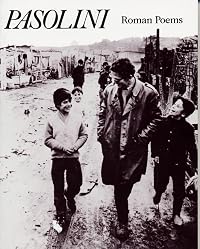
Roman Poems (City Lights Pocket Poets Series) (Italian Edition)
by Pier Paolo Pasolini
On This Page
Description
The Italian film-maker Pier Paolo Pasolini was first and always a poet--the most important civil poet, according to Alberto Moravia, in Italy in the second half of this century. His poems were at once deeply personal and passionately engaged in the political turmoil of his country. In 1949, after his homosexuality led the Italian Communist Party to expel him on charges of "moral and political unworthiness," Pasolini fled to Rome. This selection of poems from his early impoverished days onthe show more outskirts of Rome to his last (with a backward longing glance at his native Friuli) is at the center of his poetic and filmic vision of modern Italian life as an Inferno. "From all these refusals, we know what Pasolini stood against--political ideologies of all kinds, the complacency inherent in the established social order, the corruption of the institutions of church and state. If Pasolini could be said to have stood for anything it was for the struggles of Italy's working class--both the rural peasants and those barracked in the urban slums at the edges of Italian cities--whose humanity he evoked with great eloquence and nuance. But it ishis refusals that animate his legacy with an incandescent rage, a passionate and profound fury that did not, as Zigaina suggests, cry out for death--but for just the opposite." --Nathaniel Rich,The New York Review of Books Pier Paolo Pasolini was born in 1922 in Bologna. In addition to the films for which he is world famous, he wrote novels, poetry, and social and cultural criticism, and was an accomplished painter. He was murdered in 1975 at Ostia, near Rome. show lessTags
Recommendations











Member Reviews
In the introduction to this small, bilingual paperback (poems are side by side in both Italian and English), Alberto Moravia paints the controversial film maker as "first and always a poet" and calls him "the major Italian poet of the second half of this century" (20th).
There are 27 poems, mostly collected from other compilations published under Pasolini. He covers sex (Sesso, consolazione della miseria), social status (Il desidero di richezza del sottoproletario romano), anger (la rabbia), and the beauty of Rome (Verso le terme di Caracalla), as well as a wide panoply of subjects.
As with other Italian poetry, I find the original language versions to be quite evocative compared to the English translations. However, I personally find show more Italian to be such a beautiful spoken language, one could recite the directions for assembling a commode in Italian and the sound would be poetic.
Given that this is a nifty little pocket sized bilingual translation, it can be quite useful for wooing a potential lover. Memorize but one poem in both languages and you'll have them eating out of your hand. show less
There are 27 poems, mostly collected from other compilations published under Pasolini. He covers sex (Sesso, consolazione della miseria), social status (Il desidero di richezza del sottoproletario romano), anger (la rabbia), and the beauty of Rome (Verso le terme di Caracalla), as well as a wide panoply of subjects.
As with other Italian poetry, I find the original language versions to be quite evocative compared to the English translations. However, I personally find show more Italian to be such a beautiful spoken language, one could recite the directions for assembling a commode in Italian and the sound would be poetic.
Given that this is a nifty little pocket sized bilingual translation, it can be quite useful for wooing a potential lover. Memorize but one poem in both languages and you'll have them eating out of your hand. show less
Ratings
Members
- Recently Added By
Author Information

349+ Works 6,056 Members
Born in Bologna, Pasolini spent most of his childhood at his mother's birthplace in Friuli, where he learned the local dialect that he used in his first, last, and best poetry. He became a teacher in a local Communist party chapter, but was accused of blatant immorality in 1949, fired from his job, and expelled from the party. With his mother, he show more went to Rome, spending much time in the slums, mastering the Roman dialect. His novel Ragazzi di Vita (1955), based on his Roman street experience, established him as the leading neorealistic writer of the day. His second neorealistic novel, A Violent Life (1959), brought him greater success. Before long, however, he rejected neorealism and began to live for art's sake. Thereafter, except for what he called his "cat-like" nocturnal prowling for homosexual sex or love, Pasolini "did not lose a moment," as Cecelia Ross aptly said, "in his efforts to lay new directions for literature as well as for theater and television." He poured all his talents and energies into his major films, starting with The Gospel According to St. Matthew (1964), which sustains the mood of Bach's music, and running through The Hawks and the Sparrows (1966), Oedipus Rex (1967), Pigsty, Medea (1970), and a trilogy made up of The Decameron (1970), Canterbury Tales (1971), and Arabian Nights (1974). Throughout his works, Pasolini explored the culture and language of the outcasts living in the shabby Roman periphery. Shortly before he died, Pasolini published a revised and enlarged edition of his dialect poems, La nuova gioventu (The New Youth) (1975). Pasolini was murdered by being run over several times with his own car, dying on 2 November 1975 on the beach at Ostia, near Rome. Pasolini was buried in Casarsa. (Bowker Author Biography) show less
Series
Belongs to Publisher Series
Classifications
- Genres
- Poetry, Fiction and Literature
- DDC/MDS
- 851.914 — Literature & rhetoric Italian, Romanian & related literatures Italian poetry 1900- 1900-1999 1945-1999
- LCC
- PQ4835 .A48 .A23 — Language and Literature French, Italian, Spanish and Portuguese literatures Italian literature Individual authors, 1900-1960
- BISAC
Statistics
- Members
- 156
- Popularity
- 210,526
- Reviews
- 1
- Rating
- (4.33)
- Languages
- English, Italian
- Media
- Paper
- ISBNs
- 2