On This Page
Description
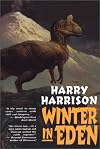
The dinosaurs continue to challenge humans for mastery of Earth in this follow-up to West of Eden. Only now, a new Ice Age is on its way and the dinosaurs are facing extinction. They need to reconquer human territory. Kerrick, a hunter, launches a quest to rally a final defence for humankind.Tags
Recommendations





















Member Reviews
Harrison continues the tale of a war between Stone Age humans and the Yilanè, intelligent descendants of dinosaurs which, in this world, were not wiped out by a cometary impact.
This second book in the series is centered on what, for us, would be the Atlantic Ocean and the theme of discovery. The villain of the series, the Yilanè Vaintè, is now discredited after the destruction of the race’s first transoceanic colony. She was leader of the city, and the blowback of her genocidal war on human and one in particular, her former captive and hero of the story, Kerrick, led to that result. She convinces the leadership of another city to help her renew her attacks against the humans in the western hemisphere of Earth – necessary because show more an encroaching ice age is driving the Yilanè out of their Eurasian and African homes. (Harrison gives Kerrick a prologue in the book which adequately summaries the events of the first book, but I’d recommend reading West of Eden anyway.)
For his part, Kerrick hopes to put the ruins of the Yilanè city to some use. He also becomes quite attached and concerned with two Yilanè males. Like him, they were prisoners of Vaintè, and, like all males of that race, confined to a harem existence. Their discoveries and their hard-won self-confidence and knowledge, their exultation in the freedom of the world beyond the harem walls, is a major charm of this novel.
Harrison introduces an Eskimo-like race of human (though they have vestigial tails) nomads called the Paramutan which figure in the adventures of Kerrick and the wife and son he is separated from. It is their knowledge and exploration of the northern part of the ocean that will become important in the plot and another confrontation between Kerrick and Vaintè. Also crossing the sea, in the other direction, are the exiled Daugthers of Death, a pacifistic sect that holds all life sacred and that are regarded as dangerous subversives in all Yilanè cities. Aided by a legendary, crank, caustic scientist who also has been banished, they discover this world’s version of South America. Harrison, with this, gives us an engaging plot where the otherworldly concern with religious contemplation clashes with the practical commands and wishes of that scientist.
Harrison also, in the Yilanè-human war, shows the innovation each side undertakes. The Yilanè develop new weapons and defenses using their supremely sophisticated genetic engineering. Humans rely on their specie’s knack for deception and trickery.
All in all, a worthy effort that, even though it’s a middle book in a trilogy, manages to almost feel complete on its own. As with the first novel, at least in hardcover, Bill Sanderson provides many line drawings that vividly illustrate Harrison’s world and, especially, creatures. Also, as with the first book, there is an appendix on the languages and background of this world. With the introduction of the Paramutan, it differs somewhat from the appendix in West of Eden. show less
This second book in the series is centered on what, for us, would be the Atlantic Ocean and the theme of discovery. The villain of the series, the Yilanè Vaintè, is now discredited after the destruction of the race’s first transoceanic colony. She was leader of the city, and the blowback of her genocidal war on human and one in particular, her former captive and hero of the story, Kerrick, led to that result. She convinces the leadership of another city to help her renew her attacks against the humans in the western hemisphere of Earth – necessary because show more an encroaching ice age is driving the Yilanè out of their Eurasian and African homes. (Harrison gives Kerrick a prologue in the book which adequately summaries the events of the first book, but I’d recommend reading West of Eden anyway.)
For his part, Kerrick hopes to put the ruins of the Yilanè city to some use. He also becomes quite attached and concerned with two Yilanè males. Like him, they were prisoners of Vaintè, and, like all males of that race, confined to a harem existence. Their discoveries and their hard-won self-confidence and knowledge, their exultation in the freedom of the world beyond the harem walls, is a major charm of this novel.
Harrison introduces an Eskimo-like race of human (though they have vestigial tails) nomads called the Paramutan which figure in the adventures of Kerrick and the wife and son he is separated from. It is their knowledge and exploration of the northern part of the ocean that will become important in the plot and another confrontation between Kerrick and Vaintè. Also crossing the sea, in the other direction, are the exiled Daugthers of Death, a pacifistic sect that holds all life sacred and that are regarded as dangerous subversives in all Yilanè cities. Aided by a legendary, crank, caustic scientist who also has been banished, they discover this world’s version of South America. Harrison, with this, gives us an engaging plot where the otherworldly concern with religious contemplation clashes with the practical commands and wishes of that scientist.
Harrison also, in the Yilanè-human war, shows the innovation each side undertakes. The Yilanè develop new weapons and defenses using their supremely sophisticated genetic engineering. Humans rely on their specie’s knack for deception and trickery.
All in all, a worthy effort that, even though it’s a middle book in a trilogy, manages to almost feel complete on its own. As with the first novel, at least in hardcover, Bill Sanderson provides many line drawings that vividly illustrate Harrison’s world and, especially, creatures. Also, as with the first book, there is an appendix on the languages and background of this world. With the introduction of the Paramutan, it differs somewhat from the appendix in West of Eden. show less
This could perhaps be considered alternate history - what if the dinosaurs did not go extinct? The Yilane (murgus to humans) co-exist with Stone Age humans on Earth. Normally this co-existence is peaceful, as there is plenty of room for both species. As an Ice Age approaches, the murgus must find warmer places to live, and that puts them in competition with the humans. Led by Kerrick, an escaped murgu slave, the humans fight back. Well written, good plot and good ideas, this is an excellent book.
In the second book of the Eden trilogy we can follow the human-reptile (Yilané) war which a bit turns into a provate revenge between Kerrick and Vainté. A great story in an impressively detailed world. Who needs more?
I did not like this second book as much as the first. It was cut up into too many small pieces with very short paragraphs and sometimes no real linkage to the story's main plot. I suppose it is just setting the basis for the final book.
The last 30+ pages bother me... Why should I learn Yilanè writing when there is none in the novel itself? Why should I learn pronunciation? The dictionary is full of words in Margu that are never used in the story and when I had a Yilanè word that I wanted the meaning of... it was not in that dictionary.
I might read the last of the series but I won't seriously look for it.
The last 30+ pages bother me... Why should I learn Yilanè writing when there is none in the novel itself? Why should I learn pronunciation? The dictionary is full of words in Margu that are never used in the story and when I had a Yilanè word that I wanted the meaning of... it was not in that dictionary.
I might read the last of the series but I won't seriously look for it.
An inevitable sequel, this time delving more deeply into Vilaine Society, and a bit on how the intelligent lizards developed. Just not as much fun and much nearer Harrison's usual level.
An amusing what - if.
What if the dinosaurs had NOT died out, but man had still risen?
Can two intelligent species find a way to share a world?
What if the dinosaurs had NOT died out, but man had still risen?
Can two intelligent species find a way to share a world?
Members
- Recently Added By
Lists

Best Fantasy Novels
821 works; 357 members
Author Information

438+ Works 44,226 Members
Harry Harrison was born Henry Maxwell Dempsey on March 12, 1925 in Stamford, Connecticut. He was drafted into the U. S. Air Corps in 1943 and became a sharpshooter, a military policeman, a gunnery instructor, and a specialist in the prototypes of computer-guided bomb-sights and gun turrets. After being discharged, he graduated from Hunter College show more with a degree in art. By the end of the 1940s, he was running a small studio that specialized in selling illustrations to comics and science-fiction magazines. He then moved on to editing some of the magazines. As the market for comics began to shrink, he started writing for science-fiction magazines. He wrote short science fiction stories and novels including Deathworld, Captive Universe, Montezuma's Revenge, Star Smashers of the Galaxy Rangers, Stonehenge, West of Eden, Stars and Stripes Forever. He also wrote the Stainless Steel Rat series and the Bill, the Galactic Hero series. His novel Make Room! Make Room! Was the inspiration for the movie Soylent Green. He also wrote under the pseudonyms Hank Dempsey, Felix Boyd, Wade Kaempfert, Cameron Hall, Philip St. John, and Leslie Charteris. He died on August 15, 2012 at the age of 87. (Bowker Author Biography) show less
Some Editions
Series

Belongs to Publisher Series
Work Relationships
Is contained in
Has as a commentary on the text
Common Knowledge
- Canonical title*
- Winter in Eden
- Original title
- Winter in Eden
- Original publication date
- 1986-09
- People/Characters
- Kerrick; Lanefenuu; Vainte
- First words
- Proloog: Het leven is niet langer gemakkelijk.
Prolog: Life is no longer easy.
Hoofdstuk 1: De storm liep ten einde en trok naar zee.
Chapter 1:
The storm was ending, blowing out to sea. - Last words
- (Click to show. Warning: May contain spoilers.)Ze draaide zich weer om en liep langs het strand, een kaarsrecht spoor van voetstappen in het zand achterlatend, langzaam maar zeker de invallende duisternis tegemoet.
(Click to show. Warning: May contain spoilers.)She turned and walked along the beach, leaving a straight trail of footsteps on the sand, walking slowly and steadily into the falling dusk. - Original language
- English
- Canonical DDC/MDS
- 823.08768
*Some information comes from Common Knowledge in other languages. Click "Edit" for more information.
Classifications
- Genres
- Science Fiction, Fiction and Literature
- DDC/MDS
- 823.08768 — Literature & rhetoric English & Old English literatures English fiction By type Genre fiction Adventure fiction Speculative fiction Alternate history
- LCC
- PS3558 .A667 .W53 — Language and Literature American literature American literature Individual authors 1961-
- BISAC
Statistics
- Members
- 968
- Popularity
- 27,058
- Reviews
- 8
- Rating
- (3.68)
- Languages
- 10 — Czech, Dutch, English, Finnish, German, Hungarian, Italian, Lithuanian, Russian, Spanish
- Media
- Paper, Audiobook, Ebook
- ISBNs
- 20
- ASINs
- 16