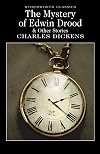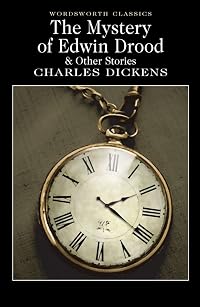
The Mystery of Edwin Drood and Other Stories
by Charles Dickens
On This Page
Description
With an Introduction and Notes by Peter Preston, University of Nottingham. Illustrations by S.L. Fildes and Hablot K. Browne (Phiz). Dickens's final novel, left unfinished at his death, is a tale of mystery whose fast-paced action takes place in an ancient cathedral city and in some of the darkest places in nineteenth-century London. Drugs, sexual obsession, colonial adventuring and puzzles about identity are among the novel's themes. At the centre of the plot lie the baffling disappearance show more of Edwin Drood and the many explanations of his whereabouts. A sombre and menacing atmosphere, a fascinating range of characters and Dickens's usual superb command of language combine to make this an exciting and tantalising story. Also included in this volume are a number of unjustly neglected stories and sketches, with subjects as different as murder and guilt and childhood romance. This unusual selection illustrates Dickens's immense creativity and versatility. AUTHOR Charles John Huffam Dickens FRSA (7 February 1812 - 9 June 1870), pen-name "Boz", was the most popular English novelist of the Victorian era and one of the most popular of all time. He created some of literature's most memorable characters. His novels and short stories have never gone out of print. A concern with what he saw as the pressing need for social reform is a theme that runs throughout his work. Much of his work first appeared in periodicals and magazines in serialised form, a favoured way of publishing fiction at the time. Dickens, unlike others who would complete entire novels before serial publication commenced, often wrote his in parts, in the order in which they were meant to appear. The practice lent his stories a particular rhythm, punctuated by one cliff-hanger after another to keep the public eager for the next instalment. show lessTags
Recommendations














Member Reviews
In cloisteresque Cloisterham, John 'Jack' Jasper lives with his ward and nephew, Mister Edwin Drood, and teaches music to Drood's own betrothed-the beguiling Rosa. Meanwhile, arriving at Cloisterham, the Landless twins, Neville and Helena of exotic advantage, cause a disruption to the quiet and monotonous lives of those in this Cathedral City.
Charles Dickens died before he could finish this novel. He wrote twenty-three chapters, each one carefully planned and written before giving it to be published in serial format, as were all his others. The Mystery of Edwin Drood is indeed probably the greatest mystery of all, and we as readers and fans of Dickens must accept the fact.
It's a hard fact to accept, however. I cannot fully understand show more this feeling within me; not one I've felt after finishing (in-as-much as one can finish this book) any book, or at least very few books. There is the obvious adoration for such a talented and captivating writer; there is the subdued anger that often Dickens can write so magnificently about nothing; there is the dismay at the knowledge that I knew it was unfinished when I went in; and of course there is the embarrassment of feeling let down despite of that fact.
What more can I say? It is Dickens. Do not start with this if you are new to him: but do not end with it, either. It may have been his last, but do not let it be yours. show less
Charles Dickens died before he could finish this novel. He wrote twenty-three chapters, each one carefully planned and written before giving it to be published in serial format, as were all his others. The Mystery of Edwin Drood is indeed probably the greatest mystery of all, and we as readers and fans of Dickens must accept the fact.
It's a hard fact to accept, however. I cannot fully understand show more this feeling within me; not one I've felt after finishing (in-as-much as one can finish this book) any book, or at least very few books. There is the obvious adoration for such a talented and captivating writer; there is the subdued anger that often Dickens can write so magnificently about nothing; there is the dismay at the knowledge that I knew it was unfinished when I went in; and of course there is the embarrassment of feeling let down despite of that fact.
What more can I say? It is Dickens. Do not start with this if you are new to him: but do not end with it, either. It may have been his last, but do not let it be yours. show less
A mixed and interesting collection of shorter stories (MED reviewed separately):
Master Humphrey's Clock - engaging and heart warming for the most part, though I found the Weller parts tiresome because of the vernacular of their speech.
Hunted Down - an interesting little mystery with several twists.
Holiday Romance - a very amusing story told by four children, showing their view of the world and of adults.
George Silverman's Explanation - a story of a man shaped by the influences of the grinding poverty of his childhood and his adolescent experiences of religious poverty. Becomes a bit less hard-edged as it goes on into his life as a tutor, though.
Master Humphrey's Clock - engaging and heart warming for the most part, though I found the Weller parts tiresome because of the vernacular of their speech.
Hunted Down - an interesting little mystery with several twists.
Holiday Romance - a very amusing story told by four children, showing their view of the world and of adults.
George Silverman's Explanation - a story of a man shaped by the influences of the grinding poverty of his childhood and his adolescent experiences of religious poverty. Becomes a bit less hard-edged as it goes on into his life as a tutor, though.
Ratings
Members
- Recently Added By
Author Information

2,578+ Works 313,139 Members
Charles Dickens, perhaps the best British novelist of the Victorian era, was born in Portsmouth, Hampshire, England on February 7, 1812. His happy early childhood was interrupted when his father was sent to debtors' prison, and young Dickens had to go to work in a factory at age twelve. Later, he took jobs as an office boy and journalist before show more publishing essays and stories in the 1830s. His first novel, The Pickwick Papers, made him a famous and popular author at the age of twenty-five. Subsequent works were published serially in periodicals and cemented his reputation as a master of colorful characterization, and as a harsh critic of social evils and corrupt institutions. His many books include Oliver Twist, David Copperfield, Bleak House, Great Expectations, Little Dorrit, A Christmas Carol, and A Tale of Two Cities. Dickens married Catherine Hogarth in 1836, and the couple had nine children before separating in 1858 when he began a long affair with Ellen Ternan, a young actress. Despite the scandal, Dickens remained a public figure, appearing often to read his fiction. He died in 1870, leaving his final novel, The Mystery of Edwin Drood, unfinished. (Bowker Author Biography) show less
Some Editions
Series
Belongs to Publisher Series
Work Relationships
Contains
Common Knowledge
- Canonical title
- The Mystery of Edwin Drood and Other Stories
- Original title
- The Mystery of Edwin Drood and other stories
- Disambiguation notice
- Contains five stories. see description for exact titles.
Classifications
Statistics
- Members
- 185
- Popularity
- 176,489
- Reviews
- 2
- Rating
- (4.00)
- Languages
- English
- Media
- Paper, Ebook
- ISBNs
- 2
- ASINs
- 3