On This Page
Description
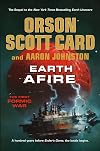
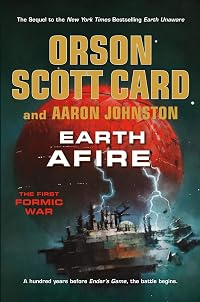
One hundred years before Ender's Game, the aliens arrived on Earth with fire and death. This is the story of the First Formic War. Victor Delgado beat the alien ship to Earth, but just barely. Not soon enough to convince skeptical governments that there was a threat. They didn't believe that until space stations and ships and colonies went up in sudden flame. And when that happened, only Mazer Rackham and the Mobile Operations Police could move fast enough to meet the threat.Tags
Recommendations
Member Reviews
This review is written with a GPL 4.0 license and the rights contained therein shall supersede all TOS by any and all websites in regards to copying and sharing without proper authorization and permissions. Crossposted at WordPress, Blogspot, & Librarything by Bookstooge’s Exalted Permission
Title: Earth Afire
Series: Enderverse: First Formic War #2
Authors: Orson Card & Aaron Johnston
Rating: 4 of 5 Stars
Genre: SF
Pages: 373
Words: 148K
Synopsis:
From Wikipedia.org
A century before the events of Ender's Game, an alien spaceship enters the solar system and soon makes known its hostile intentions by destroying harmless human ships. Then, it wipes out a ragtag fleet of asteroid miners who have banded together in a desperate attempt to stop it. show more All of the adult male members of Victor Delgado's extended clan die in the battle. The survivors are unable to transmit a warning, so Victor volunteers for a near-suicidal mission to try to reach Earth in a tiny, hastily converted unmanned cargo ship. He makes it to the Moon, but is unable to get the authorities to take him seriously. Thus, humanity is totally unprepared when the First Formic War starts.
The invader sends three enormous landing craft to southeast China. The Formics emerge and use gas to defoliate the area and kill everyone. Despite suffering stupendous losses, the suspicious Chinese government refuses outside help.
Before the landing, Mazer Rackham had been training the Chinese military on a new transport aircraft, the HERC, in exchange for training on their new invention, drill sledges that can tunnel quickly underground. During the Formic invasion, he saves Bingwen, a very intelligent eight-year-old Chinese boy, but is then shot down. Bingwen saves his life, with the remote help of Mazer's romantic interest, Kim. Bingwen and Mazer then set off to destroy the nearest Formic lander.
The Mobile Operations Police (MOP), a small but elite international force, enters China (without official authorization). The MOPs save Bingwen and Mazer from a Formic attack. The lander is heavily shielded, but it does not extend underground. Mazer manages to find some drill sledges and HERCs to transport them close to the lander. MOP Captain Wit O'Toole obtains a tactical nuclear weapon from anonymous Chinese who do not agree with their government's stance on foreign assistance. They destroy the lander, but then Captain Shenzu arrives and places Mazer under arrest.
Meanwhile, Victor and Imala (a Customs Agent assigned to Victor upon his unauthorized arrival) manage to drift close to the Formic ship, using a disguised ship provided by Lem Jukes (the only son of the richest man alive) to avoid being destroyed. Victor breaks into the alien ship through a gun port.
My Thoughts:
I enjoyed the first book, Earth Unaware, so much that I broke my usual way of reading and dived immediately into this the second book in the First Formic War trilogy. This was another really good entry but for whatever reason I didn't enjoy it quite as much, hence the halfstar knocked off.
Part of it is that the Lem and his father Ukko Jukes thing got tiresome. Lem lives and breathes everything through the lens of thinking his father is out to test him. He's paranoid about it, to the point where it got on my nerves. Then Ukko will go and do something to justify everything Lem has thought. That was just as frustrating, if not more so, to read about.
A lot of the action takes place in China. I rather enjoyed these sections and found the boy Bingwen to be an Ender-prototype. He was smart and intelligent and didn't act like a baby. While many of the adults around him were panicking he was trying to figure out ways to fix whatever the problem was. He was not a superhuman, but Card definitely has a thing for writing very intelligent young people (Ender or Rigg from the Pathfinder trilogy). Bingwen also brought a very human touch to the story. His adventures as an 8year old getting beat up, trying to take special tests to get ahead and then his parents dying, taking care of his aged grandfather, it was all SO human. Mazer Rackham is the military look, Victor and Imala are the political look and Bingwen is the purely everyman look.
I liked how all the threads were woven together in this story. There were no obvious demarcations between Card and Johnston, to the point where I wonder if Johnston did most of the writing with Card supplying the ideas. It doesn't really matter though, as it was a good tight story.
★★★★☆ show less
Title: Earth Afire
Series: Enderverse: First Formic War #2
Authors: Orson Card & Aaron Johnston
Rating: 4 of 5 Stars
Genre: SF
Pages: 373
Words: 148K
Synopsis:
From Wikipedia.org
A century before the events of Ender's Game, an alien spaceship enters the solar system and soon makes known its hostile intentions by destroying harmless human ships. Then, it wipes out a ragtag fleet of asteroid miners who have banded together in a desperate attempt to stop it. show more All of the adult male members of Victor Delgado's extended clan die in the battle. The survivors are unable to transmit a warning, so Victor volunteers for a near-suicidal mission to try to reach Earth in a tiny, hastily converted unmanned cargo ship. He makes it to the Moon, but is unable to get the authorities to take him seriously. Thus, humanity is totally unprepared when the First Formic War starts.
The invader sends three enormous landing craft to southeast China. The Formics emerge and use gas to defoliate the area and kill everyone. Despite suffering stupendous losses, the suspicious Chinese government refuses outside help.
Before the landing, Mazer Rackham had been training the Chinese military on a new transport aircraft, the HERC, in exchange for training on their new invention, drill sledges that can tunnel quickly underground. During the Formic invasion, he saves Bingwen, a very intelligent eight-year-old Chinese boy, but is then shot down. Bingwen saves his life, with the remote help of Mazer's romantic interest, Kim. Bingwen and Mazer then set off to destroy the nearest Formic lander.
The Mobile Operations Police (MOP), a small but elite international force, enters China (without official authorization). The MOPs save Bingwen and Mazer from a Formic attack. The lander is heavily shielded, but it does not extend underground. Mazer manages to find some drill sledges and HERCs to transport them close to the lander. MOP Captain Wit O'Toole obtains a tactical nuclear weapon from anonymous Chinese who do not agree with their government's stance on foreign assistance. They destroy the lander, but then Captain Shenzu arrives and places Mazer under arrest.
Meanwhile, Victor and Imala (a Customs Agent assigned to Victor upon his unauthorized arrival) manage to drift close to the Formic ship, using a disguised ship provided by Lem Jukes (the only son of the richest man alive) to avoid being destroyed. Victor breaks into the alien ship through a gun port.
My Thoughts:
I enjoyed the first book, Earth Unaware, so much that I broke my usual way of reading and dived immediately into this the second book in the First Formic War trilogy. This was another really good entry but for whatever reason I didn't enjoy it quite as much, hence the halfstar knocked off.
Part of it is that the Lem and his father Ukko Jukes thing got tiresome. Lem lives and breathes everything through the lens of thinking his father is out to test him. He's paranoid about it, to the point where it got on my nerves. Then Ukko will go and do something to justify everything Lem has thought. That was just as frustrating, if not more so, to read about.
A lot of the action takes place in China. I rather enjoyed these sections and found the boy Bingwen to be an Ender-prototype. He was smart and intelligent and didn't act like a baby. While many of the adults around him were panicking he was trying to figure out ways to fix whatever the problem was. He was not a superhuman, but Card definitely has a thing for writing very intelligent young people (Ender or Rigg from the Pathfinder trilogy). Bingwen also brought a very human touch to the story. His adventures as an 8year old getting beat up, trying to take special tests to get ahead and then his parents dying, taking care of his aged grandfather, it was all SO human. Mazer Rackham is the military look, Victor and Imala are the political look and Bingwen is the purely everyman look.
I liked how all the threads were woven together in this story. There were no obvious demarcations between Card and Johnston, to the point where I wonder if Johnston did most of the writing with Card supplying the ideas. It doesn't really matter though, as it was a good tight story.
★★★★☆ show less
I (typically) really enjoy Orson Scott Card's work. I did not enjoy this book. It was work to get through. I see now as I am writing a review that it was written jointly with some fellow named Aaron Johnston... well... that might explain it. This is not typical Card, other than the focus on the boy-genius who can save the world (a usual Card protagonist).... the story is whiny, the characters non-distinct and the plot... really doesn't go anywhere. It is also a full-on cliff hanger (assuming you can make it to the end of the book, it is definitely a struggle to do so, and there is no reward that makes it worth the slog).
The narration is not very good either - they alternate readers, but not based on characters or plot, just randomly. show more One of them places emphasis at very odd points. Overall, very disappointing - story was boring AND it had an abrupt ending. (I know I previously called it a cliff hanger, but that would imply there was some suspense that would make you buy the next one... there is no suspense, the story just stops mid-stroke and there is no resolution) - I guess you have to buy the next book to see how it ends, but usually I expect books (even those trying to develop cliff hanger suspense) to have a beginning, a middle and an end. This had a middle. show less
The narration is not very good either - they alternate readers, but not based on characters or plot, just randomly. show more One of them places emphasis at very odd points. Overall, very disappointing - story was boring AND it had an abrupt ending. (I know I previously called it a cliff hanger, but that would imply there was some suspense that would make you buy the next one... there is no suspense, the story just stops mid-stroke and there is no resolution) - I guess you have to buy the next book to see how it ends, but usually I expect books (even those trying to develop cliff hanger suspense) to have a beginning, a middle and an end. This had a middle. show less
I chose a three star rating for this book because, honestly, I can't decide if I enjoyed it or not. On the pro-side: the plot is interesting enough and there are just enough main characters that you don't get sick of them but not so many that you need a glossary to keep track of who's who. The technology is just advanced enough that you believe this is happening in the future, but not so advanced that it feels out of reach. On the con side: The character of Bingwen makes absolutely no sense. In no universe should this child be permitted to follow a soldier into battle. On top of that, he lectures Mazer in dialogue that feels completely unrealistic for even a hyper-precocious young child. Also, the frequent emphasis on traditional gender show more roles among the mining/scavenging characters feels out of place to me. The book's characters harp on how people living in deep space can't just replace things and everyone has to pitch in to ensure survival...but as soon as there's trouble the women are herded onto another ship with all of the children and captain's are expressing shock when another ship turns out to be led by a woman. It just doesn't seem to make sense in their all for one ethos to have certain activities so rigidly separated by gender.
So, I will probably read the third book to see how things end, but I'm definitely hoping the dialogue gets better if nothing else. show less
So, I will probably read the third book to see how things end, but I'm definitely hoping the dialogue gets better if nothing else. show less
Ender's Game - Orson Scott Card
A reread for me.
My first first was in my twenties, and I can remember the thrill that went through me at the end. This time, I wasn't surprised, but so many new things struck me.
Card is much better at single novels. Though Ender's Game did turn out to be a series, at the beginning (I believe) it was a solo novel. It was tight, contained, had an even pacing, and didn't stray over into the religious bent - which he is wont to do in the series. At least the ones I have tried. The tension built up. You knew that there was expected to be a war, but you didn't know if the novel was going to deal with it. At least I wasn't wondering 'where is this war going to be.. The second novel?' with my first read ever so show more long ago.
The bugger queen. In my mind I had expanded the part that the computer game had taken with the bugger queen. In retrospect, I had been thinking about that portion of the novel for years, and built it up myself. Which is interesting that an author made such an impression with such a little part. That one part made so much of the novel make sense by looking back and realizing what horrors that had the protagonist went through.. For no reason. The actuality of war was put out neatly by several paragraphs, without any condemnation in the words, they were simply given to the reader to make of what they will. In some ways it was more horrific than if Card had told us what we should feel.
It is also interesting that Card used the computer in another novel (a single novel, I might add) to do a similar job. In Lost Boys the protagonist plays with his "friends" on the computer when he retreats from real life bullies.
The only thing that bothered me this time was Ender, and most of the 'kids', talked like adults. And expressed things like adults. Beyond what you would expect even super intelligent kids to do. I often had to remind myself that he was only 6 when he went to the battleschool, and 10-11 when he commanded the fleet. All the kids were young. Beyond them calling each other names, I kept needing to remind myself that they weren't even (for the most part) 16. It really didn't affect my enjoyment, but..
It was really enjoyable to reread Ender's Game again. The ending wasn't a surprise, yet managed to carry the frisson of the adults watching. Waiting. Praying. And then.. Ender wasn't given the happy ending that you might have hoped. Perhaps there was a need to finish the story? It is a different Ender. A future time. Ender's Game, still, leaves the reader with a fulfilled read. Even if it wasn't quite what had been expected. show less
A reread for me.
My first first was in my twenties, and I can remember the thrill that went through me at the end. This time, I wasn't surprised, but so many new things struck me.
Card is much better at single novels. Though Ender's Game did turn out to be a series, at the beginning (I believe) it was a solo novel. It was tight, contained, had an even pacing, and didn't stray over into the religious bent - which he is wont to do in the series. At least the ones I have tried. The tension built up. You knew that there was expected to be a war, but you didn't know if the novel was going to deal with it. At least I wasn't wondering 'where is this war going to be.. The second novel?' with my first read ever so show more long ago.
The bugger queen. In my mind I had expanded the part that the computer game had taken with the bugger queen. In retrospect, I had been thinking about that portion of the novel for years, and built it up myself. Which is interesting that an author made such an impression with such a little part. That one part made so much of the novel make sense by looking back and realizing what horrors that had the protagonist went through.. For no reason. The actuality of war was put out neatly by several paragraphs, without any condemnation in the words, they were simply given to the reader to make of what they will. In some ways it was more horrific than if Card had told us what we should feel.
It is also interesting that Card used the computer in another novel (a single novel, I might add) to do a similar job. In Lost Boys the protagonist plays with his "friends" on the computer when he retreats from real life bullies.
The only thing that bothered me this time was Ender, and most of the 'kids', talked like adults. And expressed things like adults. Beyond what you would expect even super intelligent kids to do. I often had to remind myself that he was only 6 when he went to the battleschool, and 10-11 when he commanded the fleet. All the kids were young. Beyond them calling each other names, I kept needing to remind myself that they weren't even (for the most part) 16. It really didn't affect my enjoyment, but..
It was really enjoyable to reread Ender's Game again. The ending wasn't a surprise, yet managed to carry the frisson of the adults watching. Waiting. Praying. And then.. Ender wasn't given the happy ending that you might have hoped. Perhaps there was a need to finish the story? It is a different Ender. A future time. Ender's Game, still, leaves the reader with a fulfilled read. Even if it wasn't quite what had been expected. show less
This is review of the series as a whole. I held off on reading this series because it was co-authored. But when I started listening to it, Card's voice shines through immediately. Fans of the Ender's Shadow series will enjoy this too. My favorite character in this series is Lem Jukes, son of the world's richest man. He might be a rich, entitled scumbag who act atrociously, there more depth to his character. The second two books also go into the background of Mazer Rackham, Ender's Mentor/Torturer from the first book which is interesting.
Book 2 in the First Formic War Trilogy. As such, if you haven't read the first book, then just move along and go read the first one.
This continues where the first book left off. Victor, the deep space miner sent on a suicide trip back from the belt to the moon to notify humanity of the alien threat. He makes it, only to be met with skepticism; "Aliens, what alien?" Mazer Rackham is leading a New Zealand special forces team that is testing a new military vehicle that runs off of a new gravity drive. As he and his team are sent to train the Chinese military, the Formics arrive and attack Earth, in China (what are the chances). Then the crap hits the fan.
Pretty standard David vs. Golith battles. A ragtag group of humans against a vastly show more superior alien army. Card is definitely tailoring things ultimately land where they are supposed to in the later Ender series, morally, politically and technologically. Most signification, I think, is that Mazer befriends and protects a young Chinese boy. This boy's thoughts and feelings telegraph the idea of children being willing and able to fight.
A good series so far, I look forward to finishing it. (And staring on the Second Formic War trilogy, that just started up.)
8/10
S: 6/26/16 - F: 7/15/16 (20 Days) show less
This continues where the first book left off. Victor, the deep space miner sent on a suicide trip back from the belt to the moon to notify humanity of the alien threat. He makes it, only to be met with skepticism; "Aliens, what alien?" Mazer Rackham is leading a New Zealand special forces team that is testing a new military vehicle that runs off of a new gravity drive. As he and his team are sent to train the Chinese military, the Formics arrive and attack Earth, in China (what are the chances). Then the crap hits the fan.
Pretty standard David vs. Golith battles. A ragtag group of humans against a vastly show more superior alien army. Card is definitely tailoring things ultimately land where they are supposed to in the later Ender series, morally, politically and technologically. Most signification, I think, is that Mazer befriends and protects a young Chinese boy. This boy's thoughts and feelings telegraph the idea of children being willing and able to fight.
A good series so far, I look forward to finishing it. (And staring on the Second Formic War trilogy, that just started up.)
8/10
S: 6/26/16 - F: 7/15/16 (20 Days) show less
Earth Afire :First Formic War Series Book 2. This is second book in the series that tells the story of the initial invasion of Earth by ant like creatures called the Formic's. I have not read Ender’s Game in over 30 years and not kept up with the follow on novels. I am coming at this as essentially a newbie. I had a great deal of fun reading this book. Its pacing kept me interested. I cared for the characters. I particularly enjoyed the fact that this was not an American centered story. The characters come from all over the Earth and space. The story takes place in space and in China. It follows the lives of the main families in Earth Unaware, the first book in the series. The events that happen to them have a realistic feel. Its show more depiction of what a space based culture will be was believable. It does a good job of showing the horrors of war while not being graphic.
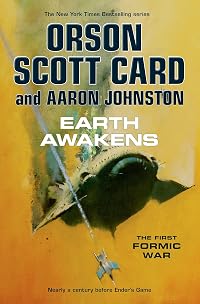
This story like a second act in a 3 act play does not stand well on its own. It literally ends in the middle of a major plot development. You will have to the third book in the trilogy to get the whole story. Fortunately the last book in the series Earth Awakens is available. show less
Members
- Recently Added By
Author Information

575+ Works 214,662 Members
Orson Scott Byron Walley Card, was born in 1951 and studied theater at Brigham Young University. He received his B.A. in 1975 and his M.A. in English in 1981. He wrote plays during that time, including Stone Tables (1973) and the musical, Father, Mother, Mother and Mom (1974). A Mormon, Scott served a two-year mission in Brazil before starting show more work as a journalist in Utah. He also designed games at Lucas Film Games, 1989-92. He is best known for his science fiction novels, including the popular Ender series. Well known titles include A Planet Called Treason (1979), Treasure Box (1996), and Heartfire (1998). He has also written the guide called How to Write Science Fiction and Fantasy (1990). His novel Ender's Game and its sequel Speaker for the Dead, both won Hugo and Nebula awards, making Card the only author to win both prizes in consecutive years. His titles Shadows in Flight, Ruins and Ender's Game made The New York Times Best Seller List. He is also the author of The First Formic War Series, which includes the titles Earth Unaware, Earth Afire, and Earth Awakens. (Bowker Author Biography) show less

36+ Works 5,161 Members
Some Editions
Awards and Honors
Series


Belongs to Publisher Series
Work Relationships
Common Knowledge
- Canonical title
- Earth Afire
- Original title
- Earth Afire
- Original publication date
- 2013-06-04
- People/Characters
- Victor Delgado; Imala Bootstamp; Ukko Jukes; Lem Jukes; Bingwen; Wit O'Toole (show all 9); Mazer Rackham; Patrick Chubs; Rena Delgado
- Important places
- Guongzhou Province, China; Luna (Moon)
- Original language*
- inglés
*Some information comes from Common Knowledge in other languages. Click "Edit" for more information.
Classifications
Statistics
- Members
- 980
- Popularity
- 27,018
- Reviews
- 26
- Rating
- (3.74)
- Languages
- English, French, Polish, Spanish
- Media
- Paper, Audiobook, Ebook
- ISBNs
- 14
- ASINs
- 10