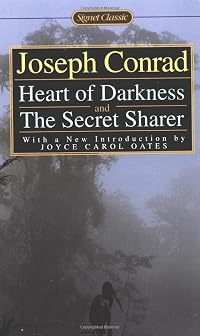
Heart of Darkness and The Secret Sharer
by Joseph Conrad
On This Page
Description
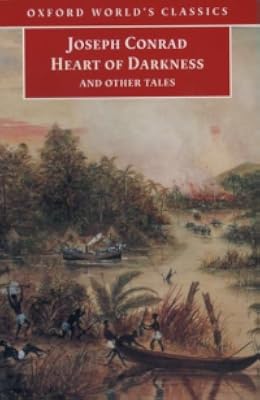
Heart Of Darkness. The story of the civilized, enlightened Mr. Kurtz who embarks on a harrowing "night journey" into the savage heart of Africa, only to find his dark and evil soul. The Secret Sharer. The saga of a young, inexperienced skipper forced to decide the fate of a fugitive sailor who killed a man in self-defense. As he faces his first moral test the skipper discovers a terrifying truth — and comes face to face with the secret itself. Heart Of Darkness and The Secret Sharer draw show more on actual events and people that Conrad met or heard about during his many far-flung travels. In portraying men whose incredible journeys on land and at sea are also symbolic voyages into their own mysterious depths, these two masterful works give credence to Conrad's acclaim as a major psychological writer. show lessTags
Recommendations

















Member Reviews
These two novellas of Joseph Conrad demonstrate his vivid writing style, rich use of symbolism, and commanding prose which, despite the dark themes, often borders on poetry. “The Secret Sharer,” concerning a conflicted young sea captain torn between the duty to his ship and loyalty to a rescued officer who has murdered a mutinous shipmate, is the easier read of the two. The narrator captain sees the fugitive as his double, another side of himself, and identifies with him from the outset, though the associative elements beyond the physical similarities are difficult to discern. “Heart of Darkness,” based on a frightening episode in Conrad’s life, explores the dark recesses of the human heart and soul, and the depravity which show more results from endless greed. Conrad alludes to this being the universal timelessness of such savagery, stretching from primitive times to today and beyond: “The mind of a man is capable of everything because everything is in it, all the past as well as all the future.” There is a hypnotic quality to Conrad’s writing, which operates on several levels. These stories demand a second reading, and perhaps even a third to fully appreciate. They seem to linger in the mind. show less
I found a copy of this book in a bathroom on the Josh C Stennis while deployed on a westpac in 2004 and I can say that it is a higher grade of reading material then you typically find in places like that - this book absolutely stunned me because of the language. There is no a single word that isn't perfectly placed. In 12 words Conrad says as much as i could in a page. And as I understand it the dude only learned English late in life and produced this masterpiece? I had never read writing like this before - somehow perfect technical efficiency and also an evocative poem simultaneously. The themes of this book are my absolute favorites - madness, desperation, and faith. For a long time I called this my favorite book.
This book is on so many "must-read" lists that I thought perhaps there was something wrong when I really didn't like the book. Then, I learned that my book club unanimously hated it. Yes, there is some value to reading the book, but don't start unless you are ready for a slog.
I like symbols and metaphors which is probably what I find so intriguing about Heart of Darkness. Every character (even the women who have minor parts but I would argue are major influences and drivers of the plot) as well as the setting can be read as symbolic for the social issues Conrad is trying to address. I agree that it is not easy to read because it is so rich with imagery and internal musings, and yet I would read it again and suspect I would find something new to like about it or that I missed before. The novella has a lot of layers and is an important example of social criticism that is still relevant today.
To be completely honest, the rating is more like this:
Heart of Darkness: * *
The Secret Sharer: ****
The Secret Sharer was really good. Relateable (if you don't take everything in a completely literal sense) and predictable, but good none the less. The ending wasn't quite what I expected (even after a friend spoiled it for me), but I can see why it is a favorite among high school English teachers. Conrad includes quite a bit of symbolism that teachers can use to attempt to get their students to see themselves in the pages. Whether the kids actually will or not, I can't say, but it's there if they look just beyond what's written on the page.
As for Heart of Darkness, my main complaint was the narrator. He was excessively verbose, making it show more painfully easy for the reader to lose interest every few pages. On top of all that, he took forever to get to the main point of the story. Again, I can see how high school English teachers would like using something like this because it basically spells out the imagery and symbolism for you with very little effort however, if they have to make an abridged version of the Iliad and/or Odyssey for teenagers, there's no way they will have the patience to get through this in the time allotted for class. Heck, the only reason I finished it was that I refuse to let books defeat me by not finishing them once I've started them.
Overall, given the choice, I'd only recommend The Secret Sharer. It is not worth the time or the effort, however minimal it may be, to finish Heart of Darkness. show less
Heart of Darkness: * *
The Secret Sharer: ****
The Secret Sharer was really good. Relateable (if you don't take everything in a completely literal sense) and predictable, but good none the less. The ending wasn't quite what I expected (even after a friend spoiled it for me), but I can see why it is a favorite among high school English teachers. Conrad includes quite a bit of symbolism that teachers can use to attempt to get their students to see themselves in the pages. Whether the kids actually will or not, I can't say, but it's there if they look just beyond what's written on the page.
As for Heart of Darkness, my main complaint was the narrator. He was excessively verbose, making it show more painfully easy for the reader to lose interest every few pages. On top of all that, he took forever to get to the main point of the story. Again, I can see how high school English teachers would like using something like this because it basically spells out the imagery and symbolism for you with very little effort however, if they have to make an abridged version of the Iliad and/or Odyssey for teenagers, there's no way they will have the patience to get through this in the time allotted for class. Heck, the only reason I finished it was that I refuse to let books defeat me by not finishing them once I've started them.
Overall, given the choice, I'd only recommend The Secret Sharer. It is not worth the time or the effort, however minimal it may be, to finish Heart of Darkness. show less
It's been quite a while since I've read this book. Upon reading it again, I realize my memories of its events were somewhat inaccurate so it was nice to approach it with older eyes. What strikes me most this time around, moreso than when I read it the first time (which was more about contemplating Kurtz's evil) is the stark racism, which isn't necessarily surprising given the time and culture in which it was written, but unnerving all the same. The book went faster this time around, and the evil didn't seem quite so breath-taking as it once did. While I used to find Marlow's long-awaited encounter with Kurtz the best part of the story
(and it still is pretty tense), I now find Marlow's final encounter with the "Intended" the most show more fascinating--that roiling anger of humoring someone when you consider to be sole the possessor of "true" knowledge. Good stuff. (PS--I acutally haven't read The Secret Sharer yet...bad English major!!) show less
(and it still is pretty tense), I now find Marlow's final encounter with the "Intended" the most show more fascinating--that roiling anger of humoring someone when you consider to be sole the possessor of "true" knowledge. Good stuff. (PS--I acutally haven't read The Secret Sharer yet...bad English major!!) show less
Joseph Conrad is an author that I had never read before, but I have watched Apocalypse Now. In that sense, I am familiar with the basic story of Heart of Darkness. I mean, you just explore the inner darkness present in all human beings. In that sense, this book is made up of two stories that do just that. The book is shorter than I thought it would be, I did not realize that it was a novella. Since the book is two stories in one and includes an introduction and an afterword, it is a bit misleading in the length of the stories.
The introduction is by Joyce Carol Oates, an author that I have heard of but never really got into. In college, I had to read one of her short stories, but I just remember the gist of the story. Some guy who turns show more out to be the Devil preys on this girl who wants to be seen as attractive or something. She wears ballet slippers and giggles a lot. Other than that, I can’t recall that much.
Anyway, both of the stories are enthralling explorations into the darkness of the human psyche, but there isn’t really a lot more I can say about this one. I never had to read this one in school but I probably would have liked it back then. The Euro-centrism is strong in this book, where the native people are called savages and other things. It was a different time, so it is fine. I hate when people censor or bowdlerize stories for their own Politically Correct interests.
The first story in the book is The Secret Sharer. I haven’t heard anything about this one at all. I am not really a Conrad completionist or a Scholar to any stretch of the imagination. Some guy is the Captain of a Ship that goes around the Gulf of Siam, with Siam being the old name for Thailand I think. He finds some guy that serves as his darker self. The story is only about fifty pages in length. I think it was included due to the fact that it also investigates the darkness in the human soul.
Heart of Darkness discusses the tale of a man named Marlow who journeys into the heart of the jungle by way of the Congo River. He is looking for a man named Kurtz because the company he works for wants him. It is very atmospheric and well-done throughout the book. It is quite dense and impressive considering English was not Conrad’s first or even second language.
In any case, the book was really good. It didn’t drag on for too long, but it wasn’t too short either. show less
The introduction is by Joyce Carol Oates, an author that I have heard of but never really got into. In college, I had to read one of her short stories, but I just remember the gist of the story. Some guy who turns show more out to be the Devil preys on this girl who wants to be seen as attractive or something. She wears ballet slippers and giggles a lot. Other than that, I can’t recall that much.
Anyway, both of the stories are enthralling explorations into the darkness of the human psyche, but there isn’t really a lot more I can say about this one. I never had to read this one in school but I probably would have liked it back then. The Euro-centrism is strong in this book, where the native people are called savages and other things. It was a different time, so it is fine. I hate when people censor or bowdlerize stories for their own Politically Correct interests.
The first story in the book is The Secret Sharer. I haven’t heard anything about this one at all. I am not really a Conrad completionist or a Scholar to any stretch of the imagination. Some guy is the Captain of a Ship that goes around the Gulf of Siam, with Siam being the old name for Thailand I think. He finds some guy that serves as his darker self. The story is only about fifty pages in length. I think it was included due to the fact that it also investigates the darkness in the human soul.
Heart of Darkness discusses the tale of a man named Marlow who journeys into the heart of the jungle by way of the Congo River. He is looking for a man named Kurtz because the company he works for wants him. It is very atmospheric and well-done throughout the book. It is quite dense and impressive considering English was not Conrad’s first or even second language.
In any case, the book was really good. It didn’t drag on for too long, but it wasn’t too short either. show less
Members
- Recently Added By
Lists

1001 Books You Must Read Before You Die
1,448 works; 1,134 members

20th Century Literature
1,161 works; 55 members

Books Featured on Gilmore Girls
307 works; 21 members

Out of Copyright
244 works; 14 members

Rory Gilmore Book Club
193 works; 5 members

Books Read in 2026
2,044 works; 68 members
Author Information

727+ Works 91,161 Members
Joseph Conrad is recognized as one of the 20th century's greatest English language novelists. He was born Jozef Konrad Nalecz Korzeniowski on December 3, 1857, in the Polish Ukraine. His father, a writer and translator, was from Polish nobility, but political activity against Russian oppression led to his exile. Conrad was orphaned at a young age show more and subsequently raised by his uncle. At 17 he went to sea, an experience that shaped the bleak view of human nature which he expressed in his fiction. In such works as Lord Jim (1900), Youth (1902), and Nostromo (1904), Conrad depicts individuals thrust by circumstances beyond their control into moral and emotional dilemmas. His novel Heart of Darkness (1902), perhaps his best known and most influential work, narrates a literal journey to the center of the African jungle. This novel inspired the acclaimed motion picture Apocalypse Now. After the publication of his first novel, Almayer's Folly (1895), Conrad gave up the sea. He produced thirteen novels, two volumes of memoirs, and twenty-eight short stories. He died on August 3, 1924, in England. (Bowker Author Biography) show less
Some Editions
Series
Belongs to Publisher Series
Work Relationships
Is contained in
Contains
Has as a student's study guide
Common Knowledge
- Canonical title
- Heart of Darkness and The Secret Sharer
- Original title
- Heart of Darkness & the Secret Sharer
- Original publication date
- 1899
- People/Characters
- Charles Marlow; Kurtz; The Captain
- Important places
- London, England, UK; Congo River, Africa; Belgian Congo
- First words
- On my right hand there were lines of fishing stakes resembling a mysterious system of half-submerged bamboo fences, incomprehensible in its division of the domain of tropical fishes, and crazy of aspect as if abandoned foreve... (show all)r by some nomad tribe of fishermen now gone to the other end of the ocean; for there was no sign of human habitation as far as the eye could reach.
The Nellie, a cruising yawl, swung to her anchor without a flutter of the sails and was at rest. - Last words
- (Click to show. Warning: May contain spoilers.)The offing was barred by a black bank of clouds and the tranquil waterway leading to the uttermost ends of the earth flowed sombre under an overcast sky -- seemed to lead into the heart of an immense darkness.
Classifications
Statistics
- Members
- 5,131
- Popularity
- 2,695
- Reviews
- 45
- Rating
- (3.73)
- Languages
- Czech, Dutch, English, German
- Media
- Paper, Audiobook, Ebook
- ISBNs
- 62
- UPCs
- 3
- ASINs
- 52