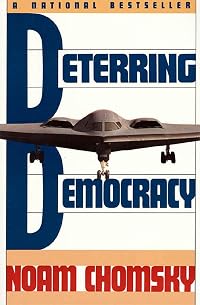
Deterring Democracy
by Noam Chomsky
On This Page
Description
"From World War II until the 1980s, the United States reigned supreme as both the economic and the military leader of the world. The major shifts in global politics that came about with the dismantling of the Eastern bloc have left the United States unchallenged as the preeminent military power, but American economic might has declined drastically in the face of competition, first from Germany and Japan ad more recently from newly prosperous countries elsewhere. In Deterring Democracy, the show more impassioned dissident intellectual Noam Chomsky points to the potentially catastrophic consequences of this new imbalance. Chomsky reveals a world in which the United States exploits its advantage ruthlessly to enforce its national interests--and in the process destroys weaker nations. The new world order (in which the New World give the orders) has arrived."--Publisher's description. show lessTags
Recommendations








Member Reviews
It is almost twenty years since Noam Chomsky published Deterring Democracy. Its contemporary context is an important starting point in the understanding of its position since most of the material seeks to analyse and contextualise United States foreign policy in the post-War years to the early nineties. In 1991 the United States under George Bush was embroiled in the First Gulf War. I must stress the word “first”, since this gives a clue to the book’s eventual prescience.
Also in 1991, a dim and distant past when the new millennium was not yet a talking point, a bi-polar world, whose permanence and assumed conflict provided the framework for all political analysis, was already being transformed. The Soviet Union had already ceased show more to be, but the years of Yeltsin’s IMF poverty lay ahead, as did those of Putin’s new pragmatic if demagogic prosperity.
Regimes of all political stances came and went in Central and South America. But all of them were classified as good or evil by the Manichean filter of the age. Occasionally, a convenience of political pragmatism offered re-branding, as in the case of Jamaica, where Michael Manley, a leader once undermined as a leftist was reinstated with eternal backing after Edward Seaga’s neo-liberal experiment predictably burnt out. Chomsky’s record of Manley’s second era being that of his violin phase is extremely succinct. He was put up by the left, but played by the right.
Descriptions of prevailing issues in Nicaragua, El Salvador and Guatemala figure large, of course. But Chomsky also visits the Dominican Republic, the Philippines and Europe to illustrate his central point. And it is a point that he makes and re-makes, a point that he still makes today. His analysis, simply put, is that an alliance of elite interests involving legislators, the powerful and those who own and control big business drives the US foreign policy agenda. The elite’s sole aim is to preserve and further its own power, influence and prosperity. The fact that it does not always speak with a consistent voice is merely evidence that within the group there remains competition. Indeed, the group is neither particularly stable nor permanent. It is rather a loose alliance of interest, perhaps heavily reliant on birthright, but not determined by it. Notions of freedom, democracy, individual or collective rights and even development are peddled, attached like advertisers’ catchlines to the same product every time it is recommended. To maintain its ascendancy, this ideology that fosters profit via power needs an enemy to provide a shield behind which it can hide its pursuit of self-advancement. The Soviet Union sufficed for most of the second half of the last century, but since then others have had to be identified to fulfil this essential role. It will not require much imagination to identify the current dark threats.
The population at large, meanwhile, has to be sold these ideas. When threat of nuclear war between super-powers loomed large, it was not difficult to fix the framework. How much easier is it now, when the current all-powerful, all-pervading enemy might just be within and among us? This low-intensity, back-burner threat continues to mask the activity that fuels an ever-increasing concentration of power and wealth. The people of the democratic, individualistic West are perfectly willing to stand by as recession bites, banks declare deposits worthless, pension funds dwindle, retirements recede and wages stagnate while those who perhaps cause these strictures luxuriate in ever-increasing, often self-granted rewards.
And, in a truly prescient passage, Chomsky describes this submissive, passive mentality perfectly. “For submissiveness to become a reliable trait,” he writes, “it must be entrenched in every realm. The public are to be observers, not participants, consumers of ideology as well as products. Eduardo Galeano writes that ‘the majority must resign itself to the consumption of fantasy. Illusions of wealth are sold to the poor, illusions of freedom to the oppressed, dreams of victory to the defeated and power to the weak.’ Nothing less will do.” In this context, is it any surprise that the average contemporary consumer knows more of celebrity gossip than political option?
Deterring Democracy is packed – perhaps over-packed – with detailed evidence. Chomsky makes his point repeatedly and forcefully. I was once privileged to co-host the author as chair of a London conference. At first hand I can vouch for the sincerity and passion that underpins these views. I can also vouch for the solidity of the evidence upon which they are based.
Noam Chomsky is not anti-American. It is the exploiters of self-seeking power and self-deferential influence who deserve that label. Noam Chomsky is a man of the people, intensely humanistic and fundamentally democratic. He seems to maintain that if people turn their backs and refuse to acknowledge the obvious, they will have foregone a real opportunity to realise something more sustainable than the current illusion. And, along the way, they will probably have said goodbye to their principles, along with their bank deposits, pensions, retirement and freedom. At least they can talk about their woes on their latest-model mobiles, if, that is, they can still pay the bill. When you read Noam Chomsky’s Deterring Democracy, give its arguments a chance to register. Then see if they ring true. show less
Also in 1991, a dim and distant past when the new millennium was not yet a talking point, a bi-polar world, whose permanence and assumed conflict provided the framework for all political analysis, was already being transformed. The Soviet Union had already ceased show more to be, but the years of Yeltsin’s IMF poverty lay ahead, as did those of Putin’s new pragmatic if demagogic prosperity.
Regimes of all political stances came and went in Central and South America. But all of them were classified as good or evil by the Manichean filter of the age. Occasionally, a convenience of political pragmatism offered re-branding, as in the case of Jamaica, where Michael Manley, a leader once undermined as a leftist was reinstated with eternal backing after Edward Seaga’s neo-liberal experiment predictably burnt out. Chomsky’s record of Manley’s second era being that of his violin phase is extremely succinct. He was put up by the left, but played by the right.
Descriptions of prevailing issues in Nicaragua, El Salvador and Guatemala figure large, of course. But Chomsky also visits the Dominican Republic, the Philippines and Europe to illustrate his central point. And it is a point that he makes and re-makes, a point that he still makes today. His analysis, simply put, is that an alliance of elite interests involving legislators, the powerful and those who own and control big business drives the US foreign policy agenda. The elite’s sole aim is to preserve and further its own power, influence and prosperity. The fact that it does not always speak with a consistent voice is merely evidence that within the group there remains competition. Indeed, the group is neither particularly stable nor permanent. It is rather a loose alliance of interest, perhaps heavily reliant on birthright, but not determined by it. Notions of freedom, democracy, individual or collective rights and even development are peddled, attached like advertisers’ catchlines to the same product every time it is recommended. To maintain its ascendancy, this ideology that fosters profit via power needs an enemy to provide a shield behind which it can hide its pursuit of self-advancement. The Soviet Union sufficed for most of the second half of the last century, but since then others have had to be identified to fulfil this essential role. It will not require much imagination to identify the current dark threats.
The population at large, meanwhile, has to be sold these ideas. When threat of nuclear war between super-powers loomed large, it was not difficult to fix the framework. How much easier is it now, when the current all-powerful, all-pervading enemy might just be within and among us? This low-intensity, back-burner threat continues to mask the activity that fuels an ever-increasing concentration of power and wealth. The people of the democratic, individualistic West are perfectly willing to stand by as recession bites, banks declare deposits worthless, pension funds dwindle, retirements recede and wages stagnate while those who perhaps cause these strictures luxuriate in ever-increasing, often self-granted rewards.
And, in a truly prescient passage, Chomsky describes this submissive, passive mentality perfectly. “For submissiveness to become a reliable trait,” he writes, “it must be entrenched in every realm. The public are to be observers, not participants, consumers of ideology as well as products. Eduardo Galeano writes that ‘the majority must resign itself to the consumption of fantasy. Illusions of wealth are sold to the poor, illusions of freedom to the oppressed, dreams of victory to the defeated and power to the weak.’ Nothing less will do.” In this context, is it any surprise that the average contemporary consumer knows more of celebrity gossip than political option?
Deterring Democracy is packed – perhaps over-packed – with detailed evidence. Chomsky makes his point repeatedly and forcefully. I was once privileged to co-host the author as chair of a London conference. At first hand I can vouch for the sincerity and passion that underpins these views. I can also vouch for the solidity of the evidence upon which they are based.
Noam Chomsky is not anti-American. It is the exploiters of self-seeking power and self-deferential influence who deserve that label. Noam Chomsky is a man of the people, intensely humanistic and fundamentally democratic. He seems to maintain that if people turn their backs and refuse to acknowledge the obvious, they will have foregone a real opportunity to realise something more sustainable than the current illusion. And, along the way, they will probably have said goodbye to their principles, along with their bank deposits, pensions, retirement and freedom. At least they can talk about their woes on their latest-model mobiles, if, that is, they can still pay the bill. When you read Noam Chomsky’s Deterring Democracy, give its arguments a chance to register. Then see if they ring true. show less
Enlightening, but a slow read for me. Still worth it.
paperback
As new condition.
Ratings
Members
- Recently Added By
Lists

Non-Fiction Worth Reading
1,015 works; 261 members

Favourite Books
1,819 works; 316 members

One Book, Many Authors
441 works; 40 members

Shaykh Hamza's Book Recommendations
439 works; 3 members
Author Information

581+ Works 47,513 Members
Noam Chomsky was born in Philadelphia, Pennsylvania on December 7, 1928. Son of a Russian emigrant who was a Hebrew scholar, Chomsky was exposed at a young age to the study of language and principles of grammar. During the 1940s, he began developing socialist political leanings through his encounters with the New York Jewish intellectual show more community. Chomsky received his Ph.D. from the University of Pennsylvania, where he studied linguistics, mathematics, and philosophy. He conducted much of his research at Harvard University. In 1955, he began teaching at MIT, eventually holding the Ferrari P. Ward Chair of Modern Language and Linguistics. Today Chomsky is highly regarded as both one of America's most prominent linguists and most notorious social critics and political activists. His academic reputation began with the publication of Syntactic Structures in 1957. Within a decade, he became known as an outspoken intellectual opponent of the Vietnam War. Chomsky has written many books on the links between language, human creativity, and intelligence, including Language and Mind (1967) and Knowledge of Language: Its Nature, Origin, and Use (1985). He also has written dozens of political analyses, including Manufacturing Consent: The Political Economy of the Mass Media (1988), Chronicles of Dissent (1992), and The Prosperous Few and the Restless Many (1993). (Bowker Author Biography) show less
Some Editions
Series
Belongs to Publisher Series
Serie general (Crítica) (222)
Common Knowledge
- Canonical title*
- El miedo a la democracia
- Original publication date
- 1991
- Important places
- Nicaragua
- Important events
- Cold War ; Contra War (1979 | 1990)
- Original language*
- Inglés
*Some information comes from Common Knowledge in other languages. Click "Edit" for more information.
Classifications
- Genres
- Politics and Government, Nonfiction, General Nonfiction, History
- DDC/MDS
- 327.73 — Society, government, & culture Political science International Relations: Spies North America United States
- LCC
- E881 .C48 — History of the United States United States Later twentieth century, 1961-2000 George H.W. Bush's administration, 1989-1993
- BISAC
Statistics
- Members
- 726
- Popularity
- 39,018
- Reviews
- 4
- Rating
- (4.07)
- Languages
- 5 — Dutch, English, Portuguese, Serbian, Spanish
- Media
- Paper, Ebook
- ISBNs
- 15
- UPCs
- 1
- ASINs
- 7