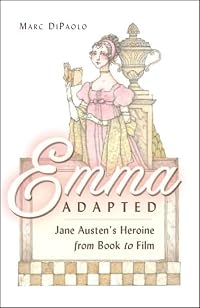
Emma Adapted: Jane Austen's Heroine from Book to Film
by Marc Dipaolo
On This Page
Description
This work of literary and film criticism examines all eight filmed adaptations of Jane Austen's Emma produced between 1948 and 1996 as vastly different interpretations of the source novel. Instead of condemning the movies and television specials as being «not as good as the book,» Marc DiPaolo considers how each adaptation might be understood as a valid «reading» of Austen's text. For example, he demonstrates how the Gwyneth Paltrow film Emma is both a romance and a female coming-of-age show more story, the 1972 BBC miniseries dramatizes Emma's world as claustrophobic and Emma herself as suffering from depression, and the modern-day teen comedy Clueless comes closest of all to bringing a feminist reading of the novel to the screen. Each version illuminates a different, legitimate way of reading the novel that is rewarding for Austen fans, scholars, and students alike. show lessTags
Member Reviews
This pseudo-academic study of Jane Austen's novel Emma 'as seen on screen' has been tantalising me for ages, because I love everything to do with the novel and pages from DiPaolo's text are sampled on Google. Could I find a cheap copy of the book anywhere, though? Nope, rare as hen's teeth. I must have searched all of the popular online booksellers around, but the cheapest price was still way too high for even my extravagant tastes, so I plumped for the British Library. Paying just under a tenner for three weeks' loan is better than nothing.
Was all that effort and outlay worth the bother? Yes and no. Most of DiPaolo's own insights are - or should be - common sense to the average, balanced viewer of Austen adaptations, but I could have show more done without reading some of the more 'inventive' essays on Emma that he quotes. The three categories of adaptation that DiPaolo borrows from a film theorist are useful to know: transition, the plodding, inoffensive, literal page-to-screen translation favoured by the BBC in the 1970s; commentary, the smug, all-knowing redressing of the source material by Andrew Davies in the ITV 1996 miniseries; and analogy, or a modern update of a classic story, a la Clueless. I may have paraphrased DiPaolo's examples somewhat there.
My main problem with Emma Adapted is that if DiPaolo had waited but two more years to write his comprehensive study of all the available adaptations, he could have included the most recent, and my favourite: Sandy Welch's 2009 BBC miniseries. He even heralds the arrival of a new adaptation by suggesting that 'a dramatic, pre-credits segment' showing Frank Churchill's childhood would 'certainly make the Frank Churchill-Jane Fairfax storyline easier to grasp' (and which is exactly what Welch provided). However, DiPaolo cannot be blamed for lack of foresight, and his treatment of both the novel and the other adaptations is perfectly fair and creditable. He even goes into detail about the earlier Emma screen treatments - in 1948, 1954 and 1960 - which are now either archived or lost altogether. The 1954 NBC Kraft Television Theatre teleplay, with a 'twittery' Emma and 'bi-polar' Knightley, sounds perfectly horrendous, however, so I'm not sure we're missing anything!
I was more interested in reading about the four adaptations I have seen - 1972, 1996 (Paltrow and Beckinsale) and Clueless with Alicia Silverstone - for which DiPaolo gathers together sources from a host of 'experts' to analyse each screenplay. Apparently, the director of the dull but faithful 1972 series, John Glenister, saw the character of Emma Woodhouse as 'disturbed/slightly unstable', which would explain Doran Godwin's performance! And in the section on the 1996 television adaptation by Andrew Davies, focusing more on the portrayal of servants than the actual cast, there is a quote from possibly the most pretentious 'reading' of Emma to date. Frances L. Restuccia, in her bonkers 'psychoanalytic' essay, theorises that Emma must seek out 'a parental replacement as an inappropriate and almost incestuous love-match', with Mr Knightley as a 'substitute mother figure'. What are these 'academics' on? And what does that have to do with Davies' adaptation of the novel (except that he's a bit twisted too)? There's some similar psychobabble in the chapter on Clueless, asserting that the reason Cher is 'a virgin who can't drive' is because she has a fear of STDs/AIDS.
I really have no time for modern interpretations of the novel which suck all the joy and romance out of the story - many of the 'experts' quoted by DiPaolo are surely the reason why most people develop a hatred for novels studied in school - but I can see now that each adaptation of Emma is a valid take on the story in its own right, even the ones I don't like. We all look for different qualities in screen translations of our favourite novels, and as the saying goes, 'you can't please all the people all the time'. DiPaolo leans towards the 1996 film version with Gwyneth Paltrow, which I personally find too saccharine and simplistic, but he's right that the female screenwriters portray a more sympathetic portrayal of the heroine - I wonder what he makes of Sandy Welch's contribution? show less
Was all that effort and outlay worth the bother? Yes and no. Most of DiPaolo's own insights are - or should be - common sense to the average, balanced viewer of Austen adaptations, but I could have show more done without reading some of the more 'inventive' essays on Emma that he quotes. The three categories of adaptation that DiPaolo borrows from a film theorist are useful to know: transition, the plodding, inoffensive, literal page-to-screen translation favoured by the BBC in the 1970s; commentary, the smug, all-knowing redressing of the source material by Andrew Davies in the ITV 1996 miniseries; and analogy, or a modern update of a classic story, a la Clueless. I may have paraphrased DiPaolo's examples somewhat there.
My main problem with Emma Adapted is that if DiPaolo had waited but two more years to write his comprehensive study of all the available adaptations, he could have included the most recent, and my favourite: Sandy Welch's 2009 BBC miniseries. He even heralds the arrival of a new adaptation by suggesting that 'a dramatic, pre-credits segment' showing Frank Churchill's childhood would 'certainly make the Frank Churchill-Jane Fairfax storyline easier to grasp' (and which is exactly what Welch provided). However, DiPaolo cannot be blamed for lack of foresight, and his treatment of both the novel and the other adaptations is perfectly fair and creditable. He even goes into detail about the earlier Emma screen treatments - in 1948, 1954 and 1960 - which are now either archived or lost altogether. The 1954 NBC Kraft Television Theatre teleplay, with a 'twittery' Emma and 'bi-polar' Knightley, sounds perfectly horrendous, however, so I'm not sure we're missing anything!
I was more interested in reading about the four adaptations I have seen - 1972, 1996 (Paltrow and Beckinsale) and Clueless with Alicia Silverstone - for which DiPaolo gathers together sources from a host of 'experts' to analyse each screenplay. Apparently, the director of the dull but faithful 1972 series, John Glenister, saw the character of Emma Woodhouse as 'disturbed/slightly unstable', which would explain Doran Godwin's performance! And in the section on the 1996 television adaptation by Andrew Davies, focusing more on the portrayal of servants than the actual cast, there is a quote from possibly the most pretentious 'reading' of Emma to date. Frances L. Restuccia, in her bonkers 'psychoanalytic' essay, theorises that Emma must seek out 'a parental replacement as an inappropriate and almost incestuous love-match', with Mr Knightley as a 'substitute mother figure'. What are these 'academics' on? And what does that have to do with Davies' adaptation of the novel (except that he's a bit twisted too)? There's some similar psychobabble in the chapter on Clueless, asserting that the reason Cher is 'a virgin who can't drive' is because she has a fear of STDs/AIDS.
I really have no time for modern interpretations of the novel which suck all the joy and romance out of the story - many of the 'experts' quoted by DiPaolo are surely the reason why most people develop a hatred for novels studied in school - but I can see now that each adaptation of Emma is a valid take on the story in its own right, even the ones I don't like. We all look for different qualities in screen translations of our favourite novels, and as the saying goes, 'you can't please all the people all the time'. DiPaolo leans towards the 1996 film version with Gwyneth Paltrow, which I personally find too saccharine and simplistic, but he's right that the female screenwriters portray a more sympathetic portrayal of the heroine - I wonder what he makes of Sandy Welch's contribution? show less
Members
- Recently Added By
Author Information

8 Works 96 Members
Classifications
- Genres
- Nonfiction, Literature Studies and Criticism, History
- DDC/MDS
- 791.436 — Arts & recreation Recreation, sports, and performing arts Public performances Motion pictures, radio, television, podcasting Motion pictures Special aspects of films; film adaptations, film genres {class specific films in 791.437}
- LCC
- PR4034 .E53 .D5 — Language and Literature English English Literature 19th century , 1770/1800-1890/1900
- BISAC
Statistics
- Members
- 3
- Popularity
- 4,757,914
- Reviews
- 1
- Rating
- (4.00)
- Languages
- English
- Media
- Paper
- ISBNs
- 1