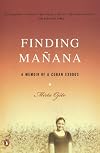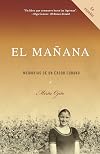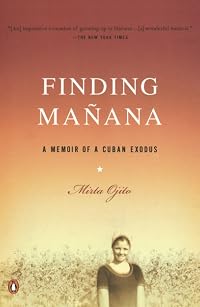
Finding Manana: A Memoir of a Cuban Exodus
by Mirta Ojito
On This Page
Description
A New York Times reporter recounts her childhood in Cuba before the events of the Mariel boatlift rendered her a teenage refugee in Miami, describing the Cuban revolution and her prize-winning journalism career.Tags
Recommendations






Member Reviews
I knew very little about the Mariel boatlift, save snippets of what I heard on the news. My family had come from Cuba right after the revolution -- my brother and I were babies and, of course, unaware of what was happening. When my grandparents came out of Cuba in the mid-60s, I started hearing about how difficult everything was and how many people wanted to get out. This book fills in the gaps in my knowledge about life in Cuba during that time. Mirta Ojita grew up under Castro and was annoyed at her parents for wanting to leave, after all -- her entire life was in Cuba. She and her parents left Cuba on the Mariel boatlift when she was 15, and she later became a journalist. This memoir recounts her trying to find out how it all came show more about. It is well-written and researched, using her own personal oddyssey as a starting point. show less
This is one of those memoirs where the content is interesting but it's not elevated much by the prose. Ojito writes in a very straightforward style, which is to be expected as she's a journalist, but I found myself craving more artistry and colour from her words. The events have to speak for themselves, which they absolutely can—the Mariel Boatlift is dramatic and heartrending—but this couldn't been so much more affecting with a stronger voice behind it.
Cuba is no longer an obsession in my life. Rather, it is the imprint of my life, a dull pain that throbs at the slightest provocation: a word I thought I'd forgotten; a hymn that only former Communist Pioneers, like me, can still sing; a black-and-white picture of my family circa show more 1970 that my mother keeps on her night table; and that chocolate-colored lipstick I brought with me and is now tucked inside my medicine cabinet, just as my parents always kept the nearly empty container of Vicks VapoRub in theirs. show less
Cuba is no longer an obsession in my life. Rather, it is the imprint of my life, a dull pain that throbs at the slightest provocation: a word I thought I'd forgotten; a hymn that only former Communist Pioneers, like me, can still sing; a black-and-white picture of my family circa show more 1970 that my mother keeps on her night table; and that chocolate-colored lipstick I brought with me and is now tucked inside my medicine cabinet, just as my parents always kept the nearly empty container of Vicks VapoRub in theirs. show less
A Cuban woman talks about her experience being part of the Mariel boatlift. She breaks up her experience with interviews of others also involved in the boatlift at the same time. While the first 75% was very well written, the last quarter seemed to lack feeling and seemed to be more reporting. I did find out information that was misrepresented to the public at the time, like the intent was for family to leave Cuba. But Castro then released the prisoners and mental patients and forced the boat owners to also take them. That was not the intention.
Ratings
Members
- Recently Added By
Author Information

7 Works 237 Members
Mirta Ojito taught journalism at New York University, Columbia, and the University of Miami.
Common Knowledge
- Original publication date
- 2005
- People/Characters
- Mirta Ojito
- Important places
- Cuba
- Important events
- Mariel Boatlift (1980)
- Epigraph
- Those who don't have revolutionary genes, revolutionary blood, a mind or heart which can adapt to the effort and heroism of a revolution aren't wanted here, they aren't needed.
--Fidel Castro, during a May 1 speech in Hava... (show all)na, 1980
We will continue to provide an open heart and open arms to refugees seeking freedom from Communist domination and from economic deprivation, brought about primarily by Fidel Castro and his government.
--President Jimmy Car... (show all)ter, May 5, 1980, Washington, D.C. - Dedication
- To Arturo, and to our children: Juan Arturo, Lucas, and Marcelo, my true home
- First words
- The police came on May 7 when I was about to have lunch: a plain yogurt, sweetened with several spoonfuls of sugar, fried yellow plantains, and an egg-and-ketchup sandwich on half a loaf of Cuban bread.
- Last words
- (Click to show. Warning: May contain spoilers.)Exile, like longing, is a way of life, much like a chronic, but not terminal, disease with capricious symptoms: an avowed preference for a certain shade of blue--the color of my old house, I realized once I stood in front of it again--and a formerly inexplicable, almost childish delight at the way the light filters through the fiery blossoms of some South Florida poinciana trees--just as it does in the trees that still shade my old neighborhood, even if I'm no longer there to see them.
- Blurbers
- Hijuelos, Oscar
Classifications
Statistics
- Members
- 151
- Popularity
- 216,372
- Reviews
- 3
- Rating
- (3.77)
- Languages
- English, Spanish
- Media
- Paper, Ebook
- ISBNs
- 5
- ASINs
- 1