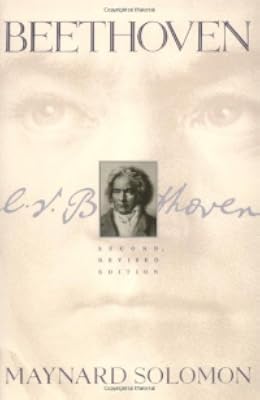
Beethoven
by Maynard Solomon
On This Page
Description
Biography of Ludwig van Beethoven, discussing his life, music, and career.Tags
Recommendations
















Member Reviews
This is a somewhat dated biography, originally written more than forty years ago and last revised in 1998, and that shows in things like the rather heavy-handed Freudian analysis Solomon brings to bear on his subject, on various minor characters, and even on himself as author. That seems to mean that the women in Beethoven's life, in particular, don't really get a fair hearing, and judging by reviews, is enough to put some readers off.
On the other hand, the psychoanalysis is only a rather small part of the whole, and Solomon certainly knows his way around the music and the biographical sources, both of which he'd been studying for many years before he started on this book, and that counts for a lot with a figure like Beethoven where show more there is so much historical misinformation flying around. Solomon takes us through the verifiable facts, reasonable inferences and probable falsehoods swiftly and efficiently, setting out clearly what the evidence is and how he reads it.
Of course, every Beethoven biography requires a theory about the "Immortal Beloved", the unnamed woman to whom Beethoven wrote a letter on Monday, 6th July of an unspecified year (we don't know whether he actually sent it, though...), and who seems to have been the only woman in his life who actually reciprocated his affections. Solomon puts forward a plausible case for Antonie Brentano (the Viennese sister-in-law of the ubiquitous Bettina).
On the music, Solomon seems to have found a good compromise, showing us why and how particular works bend the rules and display Beethoven's creativity (or don't!), and why they matter in music history, without either getting deeply into technical language or straying into the realms of superficial generalisation. There are a few odd moments, like the extended, lyrical epiphany about variation-form he goes into when discussing the Diabelli Variations, but on the whole it's all very sane and informative, telling you the sort of things you would like to know when attending a concert or listening to a record.
A good, brisk introduction to Beethoven. show less
On the other hand, the psychoanalysis is only a rather small part of the whole, and Solomon certainly knows his way around the music and the biographical sources, both of which he'd been studying for many years before he started on this book, and that counts for a lot with a figure like Beethoven where show more there is so much historical misinformation flying around. Solomon takes us through the verifiable facts, reasonable inferences and probable falsehoods swiftly and efficiently, setting out clearly what the evidence is and how he reads it.
Of course, every Beethoven biography requires a theory about the "Immortal Beloved", the unnamed woman to whom Beethoven wrote a letter on Monday, 6th July of an unspecified year (we don't know whether he actually sent it, though...), and who seems to have been the only woman in his life who actually reciprocated his affections. Solomon puts forward a plausible case for Antonie Brentano (the Viennese sister-in-law of the ubiquitous Bettina).
On the music, Solomon seems to have found a good compromise, showing us why and how particular works bend the rules and display Beethoven's creativity (or don't!), and why they matter in music history, without either getting deeply into technical language or straying into the realms of superficial generalisation. There are a few odd moments, like the extended, lyrical epiphany about variation-form he goes into when discussing the Diabelli Variations, but on the whole it's all very sane and informative, telling you the sort of things you would like to know when attending a concert or listening to a record.
A good, brisk introduction to Beethoven. show less
This is a really splendid and extremely readable biography. Beethoven takes on flesh and blood in these pages, moving through a vividly conjured Napoleonic and post-Napoleonic Austria. One star off for the sometimes comically dogmatic Freudianism and for an excessively long and inconsequential chapter devoted to the identity of the so-called "immortal beloved"--who cares about this?
Solomon provides an exhaustively researched look at Beethoven’s life and music that will be eye-opening to anyone who is only familiar with the composer through his works. However, the author’s extreme focus on Beethoven’s (admitted) psychological issues sometimes seems to go a little too far, at the expense of exploring other influences on his musical output. Beethoven’s progressive loss of hearing is addressed at length fairly early in the narrative, but Solomon somehow misses the opportunity to muse about how this affected his composition, which is kind of amazing given how much the author goes on about Beethoven’s psychology.
There is also much here about “The Immortal Beloved”, and Solomon’s identification of the show more correct woman seems faultless. The intense drama of Beethoven’s “adoption” of his nephew and his ongoing conflicts with his deceased brother’s wife are also covered in excruciating detail. Some of these passages are pretty painful to read, and to be honest, Solomon’s prose is not the most scintillating. This is not that fun a book to read. But you will at least feel like you have accomplished something when you are finished!
In the end, the mystery of Beethoven’s greatness is still not completely answered. How did such a conflicted, often unhappy, and frequently mean-spirited individual manage to write some of the most beautiful and moving music of all time? Solomon’s book does seem to show the precedence of art over life, i.e., no matter what type of person Beethoven was, we are willing to forgive him anything because of the irreplaceable legacy he left us. I think I’ll go listen to the first movement of the “Moonlight” Sonata again. It always calms me down…. show less
There is also much here about “The Immortal Beloved”, and Solomon’s identification of the show more correct woman seems faultless. The intense drama of Beethoven’s “adoption” of his nephew and his ongoing conflicts with his deceased brother’s wife are also covered in excruciating detail. Some of these passages are pretty painful to read, and to be honest, Solomon’s prose is not the most scintillating. This is not that fun a book to read. But you will at least feel like you have accomplished something when you are finished!
In the end, the mystery of Beethoven’s greatness is still not completely answered. How did such a conflicted, often unhappy, and frequently mean-spirited individual manage to write some of the most beautiful and moving music of all time? Solomon’s book does seem to show the precedence of art over life, i.e., no matter what type of person Beethoven was, we are willing to forgive him anything because of the irreplaceable legacy he left us. I think I’ll go listen to the first movement of the “Moonlight” Sonata again. It always calms me down…. show less
Among the best Beethoven biographies. In the context of the creative events that shaped the world during his extraordinary life, the humanity of this great composer is placed.
Scholarly presentation, including a careful unwinding of the immortal beloved mystery, but the alternating presentation of "the life" and "the music" disintegrates the biography somewhat.
It took me some time to adapt to the author’s style of writing for this work. My initial feelings were lukewarm at best, however by the end of my journey with this book I found myself surprisingly impressed at the depth of scholarship included in such a compressed volume. Not only is the book well written for a general biography, it doubles as an invaluable reference work for Beethoven scholarship.
Solomon has structured the book into chronological sections of Beethoven’s life and development as a composer. Each chronological era is further subdivided into a series of expositional chapters describing Beethoven’s personal life during the period, followed by a chapter dedicated to his musical compositions of that period.
In general show more the writing tends to vacillate back and forth between very distinct blocks of text that include fact and figure citation, to distinct blocks of text expounding the author’s interpretation of those facts. I believe it was the fact and figure sections of the work that took time to adjust to stylistically. Before seeing the pattern of how the author was weaving back and forth between fact and interpretation, the dry nature of the factual rendition sections made reading pace difficult to sustain. My only other minor complaint was that at times, the interpretation tended to delve too far into clinical psychological analysis for my taste, but this is a minimal portion of the authorship and instances are never mere opinion, but substantiated by appropriately included references.
To end with more positive remarks, which this book deserves, I found the section of the book where Solomon makes his case for the identity of “The Immortal Beloved” quite entertaining. While there may never be an answer to this question regarding the one reciprocating love in Beethoven’s life, Solomon has done the research and makes a very strong argument for his candidate. If you are interested in this historical mystery, this section of the book alone makes it a worthwhile read. show less
Solomon has structured the book into chronological sections of Beethoven’s life and development as a composer. Each chronological era is further subdivided into a series of expositional chapters describing Beethoven’s personal life during the period, followed by a chapter dedicated to his musical compositions of that period.
In general show more the writing tends to vacillate back and forth between very distinct blocks of text that include fact and figure citation, to distinct blocks of text expounding the author’s interpretation of those facts. I believe it was the fact and figure sections of the work that took time to adjust to stylistically. Before seeing the pattern of how the author was weaving back and forth between fact and interpretation, the dry nature of the factual rendition sections made reading pace difficult to sustain. My only other minor complaint was that at times, the interpretation tended to delve too far into clinical psychological analysis for my taste, but this is a minimal portion of the authorship and instances are never mere opinion, but substantiated by appropriately included references.
To end with more positive remarks, which this book deserves, I found the section of the book where Solomon makes his case for the identity of “The Immortal Beloved” quite entertaining. While there may never be an answer to this question regarding the one reciprocating love in Beethoven’s life, Solomon has done the research and makes a very strong argument for his candidate. If you are interested in this historical mystery, this section of the book alone makes it a worthwhile read. show less
Provides a fascinating psychological perspective of the composer. It goes without saying that it is detailed and well-researched.
Members
- Recently Added By
Lists

In Our Time books
4,934 works; 2 members
Author Information

8+ Works 1,569 Members
Maynard Elliott Solomon was a musicologist and record producer. He was born on January 5, 1930 in Manhattan. His family later moved to Brooklyn. When he was young, he worked in his father's art supply store. He played the piano and studied the cello. In 1950, he earned a BA from Brooklyn College, CUNY. He pursued his graduate studies at Columbia show more University, 1950-1952. Also, in 1950, he co-founded Vanguard Records with his brother, Seymour Solomon. It was an influential label for not only classical music but folk and blues music as well. He is best known for his biographies of the classical composers, Beethoven, Mozart, and an article on Schubert. His works include, Beethoven (1973); Marxism and Art (1973); Beethoven Essays (1988); Franz Schubert and the Peacocks of Benvenuto Cellini (1989) (a research article in the book, 19th-Century Music); Mozart: A Life (1993); and Late Beethoven: Music, Thought, Imagination (2004). Maynard Solomon died on September 28. 2020 in Manhattan at the age of 90. (Bowker Author Biography) show less
Awards and Honors
Series
Belongs to Publisher Series
Common Knowledge
- Canonical title
- Beethoven
- Original title
- Beethoven
- Alternate titles
- Beethoven
- Original publication date
- 1998
- People/Characters
- Ludwig van Beethoven
- Original language
- English
Classifications
Statistics
- Members
- 633
- Popularity
- 45,989
- Reviews
- 10
- Rating
- (4.08)
- Languages
- 5 — English, French, German, Italian, Spanish
- Media
- Paper, Ebook
- ISBNs
- 20
- UPCs
- 2
- ASINs
- 5