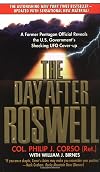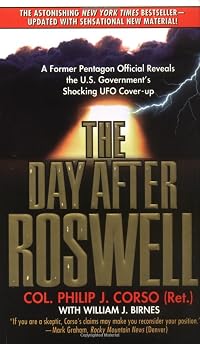
The Day after Roswell
by Philip Corso
On This Page
Description
A breathtaking exposé that reads like a thriller, The Day After Roswell is a stunning depiction of just what happened in Roswell, New Mexico all those years ago and how the effects of this mysterious unidentified aircraft crash are still relevant today.Former member of President Eisenhower's National Security Council and the Foreign Technology Desk in the United States Army, Colonel Philip J. Corso was assigned to work at a strange crash site in Roswell in 1947. He had no idea that his show more work there would change his life and the course of history forever. Only in his fascinating memoir can you discover how he helped removed alien artifacts from the site and used them to help improve much of the technology the Army uses today, such as circuit chips, fiber optics, and more.
Laying bare the United States government's shocking role in the Roswell incident—what was found, the cover-up, and more—The Day After Roswell is an extraordinary memoir that not only forces us to reconsider the past, but also our role in the universe. show less
Tags
Recommendations


















Member Reviews
There have been a lot of books written about Roswell, enough to fill a bookcase if not more. When history ends up sorting them all out in terms of their value, Corso's book will be there up at the top. He has the credibility of a high military rank, provable connections to five-star brass. If he said he saw an alien body in a hangar at Wright-Patterson AFB shortly after Roswell, there's no reason to disbelieve him other than the unshakable "show me" attitude of Missouri. Not everyone gets to be an insider, and not every insider has the courage to disclose what they know. So we now know where the super-technological leaps in the post-war era came from: Corso and his Foreign Technology Desk at the Pentagon seeding recovered artifacts to show more defense industries. This is a good book to reread every few years. show less
I have never read such gibberish in my life!! I find it hard to believe this was written by a Colonel who wrote official military reports. It is badly written, badly researched, over written, and waffles.
I also find it hard to believe that many technologies we now take for granted such as integrated circuitry, lasers and even stealth technology were spoon fed to large companies and reverse engineered from alien materials while tricking the companies into thinking they had invented the materials themselves. I suppose I am a little sceptical.
I particularly enjoyed this paragraph:
"By the time President Nixon returned from China, having agreed to turn over Vietnam to the Communists, he had effectively turned the Soviets' flank in the Cold show more War. For the next decade, the Soviets felt caught between the Chinese, with whom they'd fought border wars in the past, and the United States.When President Ronald Reagan demonstrated to Mikhail Gorbachev that the United States was capable of deploying an effective antimissile missile defense and sought Soviet cooperation in turning it against the extraterrestrials, all pretext of the Cold War ended and the great Soviet monolith in Eastern Europe began to crumble."
Of course!! The whole idea of Vietnam was to eventually hand it to the Communists in order to eventually win the Cold War...and attack aliens, if only those poor people who died knew what they were fighting for, sheesh.
This book is full of crazed ideas such as this. If I was a conspiracy nut I would probably enjoy it, but reading it just made me mad. show less
I also find it hard to believe that many technologies we now take for granted such as integrated circuitry, lasers and even stealth technology were spoon fed to large companies and reverse engineered from alien materials while tricking the companies into thinking they had invented the materials themselves. I suppose I am a little sceptical.
I particularly enjoyed this paragraph:
"By the time President Nixon returned from China, having agreed to turn over Vietnam to the Communists, he had effectively turned the Soviets' flank in the Cold show more War. For the next decade, the Soviets felt caught between the Chinese, with whom they'd fought border wars in the past, and the United States.When President Ronald Reagan demonstrated to Mikhail Gorbachev that the United States was capable of deploying an effective antimissile missile defense and sought Soviet cooperation in turning it against the extraterrestrials, all pretext of the Cold War ended and the great Soviet monolith in Eastern Europe began to crumble."
Of course!! The whole idea of Vietnam was to eventually hand it to the Communists in order to eventually win the Cold War...and attack aliens, if only those poor people who died knew what they were fighting for, sheesh.
This book is full of crazed ideas such as this. If I was a conspiracy nut I would probably enjoy it, but reading it just made me mad. show less
Most reviewers wonder if Corso is telling the truth. Where one stands on that, probably depends upon one's preconceived notions about the subject. Corso really has nothing to gain by lying, therefore it must be. His book is written based on a 2 year assignment in the Pentagon during the early 1960s. That alone would indicate that there were others who held this position before and since...wondering why they have not come forward? That said, this is likely the most credible book on the subject or the Roswell "crash." A fascinating Cold War memoir. The reader must dig through tons of self aggrandizement.
I thought this would be a good alien story, turns out the author re-writes some of the most important events from the second half of the 20th century! Invention of the integrated circuit, laser, kevlar vests, fiber optics are all alien "seeded" inventions. Also the author played a key role leading up to the Cuban Missile Crisis. Wow!
Ridiculous as a ufo conspiracy book; fascinating as a cold war memoir.
Picked up this book when I visited Roswell last summer - I was hoping this would be a better book about what actually happened. This guy says this is an accounting of what actually happened - which maybe it is - but the book was sparse on details of the actual crash and more about all of the technology derived from the wreckage.
The Day After Roswell
Author: Col Philip J Corso with Wiliam J Birnes
Publisher: Pocket Books
Published In: New York
Date: 1997
Pgs: 341
REVIEW MAY CONTAIN SPOILERS
Summary:
As Chief of the Army’s Foreign Technology Division in 1961, Philip J Corso stewarded the Roswell, New Mexico, alien artifcats in a reverse-engineering project that led to: integrated circuits, fiber optics, lasers, super tenacity fibers, and seeded the Roswell alien technology to the giants of American industry. The Roswell tech was a grand leap forward and powered the boom in the 20th century American military-industry complex.
...If...if it’s true and this isn’t just another cover story.
Genre:
Autobiography and memoir
Conspiracy show more theories
Controversy
Espionage
Government
History
Military
Non-fiction
Science and nature
Space
UFOs
Why this book:
Roswell. Truth. Retired Colonel. Senator Strom Thurmond.
______________________________________________________________________________
The Feel:
Feels repetitive chapter to chapter. The format and style and the way the chapter structure is broken up make it seem that a lot of stylistic, textual forms are reused. The same information is re-communicated a number of times.
Pacing:
The style and repetitive nature of some of the text negatively impacts the flow and pace of the story.
Hmm Moments:
Post 1947, the CIA, Navy, and Army did more to trigger the Man in Black scare than anything else. They went into a full court press to ferret out Soviet agents in and around the areas specific to the material recovered from Roswell. The plan came out of the Truman administration, probably originating either with the CIA or the DOD.
Ask too many questions and knocking at your door would be a couple of plainclothes investigators who didn’t need a search warrant to rummage through your things. So maybe the army was a little overzealous in the interrogation procedures…
This gives an excuse for the massive technological explosion that man underwent in the last century, but it doesn’t give man much credit. Yes, it does give him kudos for reverse engineering the tech, but it doesn’t give any credence to the idea that these leaps were purely a product of mankind’s ingenuity. Halfway through the book, I’m begging to get that watching television feel where the guy with the funky hair is about to appear and say, “I’m not saying it’s aliens...but it’s aliens.”
______________________________________________________________________________
Last Page Sound:
Is he part of the cover up and only feeding us “his” version of what happened? By his own admission everything was steeped in hoax and dissembling, so how do you trust his account.
Author Assessment:
The repetitive chapter to chapter bit with Corso’s angst over the reports and what he’s got and his talks with Trudeau begin to grate after you re-read almost the same exchange for the third or fifth time. Whether these were actually repeated conversations or if these were one conversation remembered a dozen times in service to telling each items’ story as it went through the industrialization process from the Army to R&D guys to the defense contractors is unclear, but each chapter seems to have another repeat of the conversation.
Editorial Assessment:
Editorially, someone should have said something about how the repetitive structures of the chapters was impacting the story flow. Almost seems like an editor may have only looked at this as each chapter was completed vs how all the chapters hung together as a whole.
Knee Jerk Reaction:
it’s alright
Disposition of Book:
Half Price Book stack
Would recommend to:
no one
______________________________________________________________________________ show less
Author: Col Philip J Corso with Wiliam J Birnes
Publisher: Pocket Books
Published In: New York
Date: 1997
Pgs: 341
REVIEW MAY CONTAIN SPOILERS
Summary:
As Chief of the Army’s Foreign Technology Division in 1961, Philip J Corso stewarded the Roswell, New Mexico, alien artifcats in a reverse-engineering project that led to: integrated circuits, fiber optics, lasers, super tenacity fibers, and seeded the Roswell alien technology to the giants of American industry. The Roswell tech was a grand leap forward and powered the boom in the 20th century American military-industry complex.
...If...if it’s true and this isn’t just another cover story.
Genre:
Autobiography and memoir
Conspiracy show more theories
Controversy
Espionage
Government
History
Military
Non-fiction
Science and nature
Space
UFOs
Why this book:
Roswell. Truth. Retired Colonel. Senator Strom Thurmond.
______________________________________________________________________________
The Feel:
Feels repetitive chapter to chapter. The format and style and the way the chapter structure is broken up make it seem that a lot of stylistic, textual forms are reused. The same information is re-communicated a number of times.
Pacing:
The style and repetitive nature of some of the text negatively impacts the flow and pace of the story.
Hmm Moments:
Post 1947, the CIA, Navy, and Army did more to trigger the Man in Black scare than anything else. They went into a full court press to ferret out Soviet agents in and around the areas specific to the material recovered from Roswell. The plan came out of the Truman administration, probably originating either with the CIA or the DOD.
Ask too many questions and knocking at your door would be a couple of plainclothes investigators who didn’t need a search warrant to rummage through your things. So maybe the army was a little overzealous in the interrogation procedures…
This gives an excuse for the massive technological explosion that man underwent in the last century, but it doesn’t give man much credit. Yes, it does give him kudos for reverse engineering the tech, but it doesn’t give any credence to the idea that these leaps were purely a product of mankind’s ingenuity. Halfway through the book, I’m begging to get that watching television feel where the guy with the funky hair is about to appear and say, “I’m not saying it’s aliens...but it’s aliens.”
______________________________________________________________________________
Last Page Sound:
Is he part of the cover up and only feeding us “his” version of what happened? By his own admission everything was steeped in hoax and dissembling, so how do you trust his account.
Author Assessment:
The repetitive chapter to chapter bit with Corso’s angst over the reports and what he’s got and his talks with Trudeau begin to grate after you re-read almost the same exchange for the third or fifth time. Whether these were actually repeated conversations or if these were one conversation remembered a dozen times in service to telling each items’ story as it went through the industrialization process from the Army to R&D guys to the defense contractors is unclear, but each chapter seems to have another repeat of the conversation.
Editorial Assessment:
Editorially, someone should have said something about how the repetitive structures of the chapters was impacting the story flow. Almost seems like an editor may have only looked at this as each chapter was completed vs how all the chapters hung together as a whole.
Knee Jerk Reaction:
it’s alright
Disposition of Book:
Half Price Book stack
Would recommend to:
no one
______________________________________________________________________________ show less
Members
- Recently Added By
Lists

Non-fiction that you shouldn't waste your time on
45 works; 15 members

Weirdo Nonfiction
138 works; 3 members
Author Information

3 Works 534 Members
All Editions
Awards and Honors
Distinctions
Common Knowledge
- Canonical title
- The Day after Roswell
- Original publication date
- 1997
- Epigraph
- Be sure you're right, then go ahead. Davy Crockett
- Dedication
- In memory of Lt. Gen. Arthur G. Trudeau. This great man was my superior as chief of U.S. Army Research and Development. He was a man of great courage; he put on a sergeant's helmet and fought with his men at Pork Chop Hill ... (show all)in Korea. He was deeply religious and went on "retreats" at Loyola. He was the most brilliant man I have ever known, who only gave me one standing order: "Watch things for me Phil. The rest do not understand."
His accomplishments changed the world for the better. Any success I had I attribute to him and to his leadership. - First words
- My name is Philip J. Corso, and for two incredible years back in the 1960s while I was a lieutenant colonel in the army, heading up the Foreign Technology desk in Army Research and Development at the Pentagon, I led a double ... (show all)life.
- Blurbers
- Chance, Sharon; Clodfelter, Tim; Tripp, Mary Kate; Martin, Ben; Cummings, James; Kolarik, Robert (show all 8); Tutor, Chris; Raimonto, Bob
- Canonical DDC/MDS
- 001.9420978943
Classifications
- Genres
- Nonfiction, General Nonfiction, History, Teen
- DDC/MDS
- 001.9420978943 — Computer science, information & general works Computer science, knowledge & systems Knowledge and learning in general Aliens/UFOs Mysteries (Atlantis, Bermuda Triangle) Unidentified flying objects (UFOs)
- LCC
- TL789.3 .C67 — Technology Motor vehicles. Aeronautics. Astronautics Motor vehicles. Aeronautics. Astronautics Astronautics. Space travel
- BISAC
Statistics
- Members
- 534
- Popularity
- 55,808
- Reviews
- 12
- Rating
- (3.13)
- Languages
- 5 — English, German, Hungarian, Italian, Portuguese
- Media
- Paper, Audiobook, Ebook
- ISBNs
- 20
- ASINs
- 11