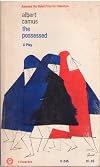
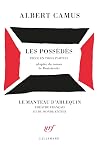
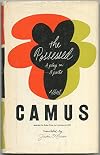
The Possessed
by Albert Camus
On This Page
Description
En 1870 en una ciudad rusa, un grupo de jóvenes revolucionarios anarquistas se proponen derribar el régimen zarista por medio de la violencia. Sus atentados crean un clima de psicosis y de desconfianza mutua entre la población pese a que en realidad tanto revolucionarios como opresores están siendo manipulados por un diabólico individuo que se sirve de la violencia para satisfacer sus venganzas personales.Tags
Recommendations




















Member Reviews
If "Brothers Karamazov" is my true love, then "The Possessed" is my secret mistress. It is exciting, frightening and deeply satisfying. The tension, the hysteria, the inevitable denouement that you know is coming, but is nevertheless shocking when it happens. I've always thought Dostoevsky's novel would make a great movie (or maybe a limited series as even 3 hours would not be enough time to bring together and then unravel all the threads), if done by the right director and screen writer. It was thus with great disappointment that I read Camus' play based on the novel. In trying to get all the main ideas and scenes on the stage, Camus manages to make the story quite dull and fairly incomprehensible. What was so amazing about show more Dostoevsky's slow exposure of the underlying plot, becomes in this play a series of scenes which connect only if one is very familiar with the novel, and even then the scenes come across as singularly inept. Camus was fascinated with Dostoevsky's works and it shows in many of his novels (The Plague, The Fall, for example), but this play does not do justice to Dostoevsky's novel or to Camus. I give it 2 stars for the effort, because he is the first to attempt it for the stage (that I know of, though there is at least one French movie based on the novel.) show less
One of Camus' major plays, although I begin to wonder what the attraction was for me in high school. This is set in pre-Revolutionary Russia, with young Nicholas Stavrogin as the main character in a complicated plot. Stavrogin, who on the surface has every reason to enjoy life and be happy, is a depressed and disillusioned nihilist, wondering why most people, himself included, don't simply end their lives. Most of the characters in his circle are similarly alienated from life, with the exception of those who are actively working to destroy this society, with the intent of establishing a communistic society of all equals, with themselves in charge. Stavrogin, as we eventually learn, has valid reasons for the hidden guilt and depression show more which have become the core of his being. The whole story comes out in the form of a "confessional" with a religious hermit, Bishop Tihon, who seems to be the only moral and sympathetic character in the play, and the only one Stavrogin develops any real respect for - although he rejects his counsel too, in the end. The ending is a depressing and needless nod to the idea that our lives are empty and joyless, despite our best efforts, and death is the only escape. Incidentally, I do appreciate the meaning of the title. It comes from the biblical story about a herd of sheep who were possessed by a plague of demons, and ran over a cliff to their deaths. Here, the sheep seem to be most of the characters of the play, Communism (although it is never mentioned by name) the demons, and the shepherds Mother Russia. The title alone indicates a glimmer of hope here, in that once the sheep and the demons that drive them are destroyed, humanity will again have a chance at peace and happiness. show less
A very confusing play at the start, not unlike the novel on which it is based, but the story becomes clearer as the play progresses. In the end it becomes a tragedy of Shakespearian proportions.
Nikolai Stavrogin é alguém que tenta provar sua liberdade não acreditando em nada e zombando de tudo e de todos ao seu redor. Infelizmente, também é um homem bonito, carismático e influente. Assim, "os demônios saíram deste homem russo e entraram em uma manada de porcos..."; seus discursos eloquentes (não significam nada para si mesmo mas) deixam marcas profundas noutros e causam muito sofrimento, e até morte. Embora Stavróguin seja o personagem central do romance de Dostoiévski, nesta adaptação teatral não é assim. Ele desaparece cerca de meia hora antes do final. No lugar dele, a peça concentra-se em Chátov, o único personagem com o qual podemo-nos identificar. Camus possivelmente queria que víssemos a história do show more ponto de vista de Chátov. Muitos personagens importantes passam , pois, despercebidos. Deduzo que um romance tão complexo e longo não poderia mesmo ser dramatizado fielmente. Alguém que não leu o romance (como eu) poderia efetivamente acompanhar o enredo? quem sabe. show less
Jan 25, 2026English (UK)
piece en 3 parties adaptee du roman de dostoïevski.
Oct 17, 2018French
Ratings
Members
- Recently Added By
Author Information

361+ Works 108,311 Members
Born in 1913 in Algeria, Albert Camus was a French novelist, dramatist, and essayist. He was deeply affected by the plight of the French during the Nazi occupation of World War II, who were subject to the military's arbitrary whims. He explored the existential human condition in such works as L'Etranger (The Outsider, 1942) and Le Mythe de Sisyphe show more (The Myth of Sisyphus, 1942), which propagated the philosophical notion of the "absurd" that was being given dramatic expression by other Theatre of the Absurd dramatists of the 1950s and 1960s. Camus also wrote a number of plays, including Caligula (1944). Much of his work was translated into English. He was awarded the Nobel Prize for Literature in 1957. Camus died in an automobile accident in 1960. (Bowker Author Biography) show less
Some Editions
Series
Belongs to Publisher Series
Work Relationships
Is contained in
Was inspired by
Common Knowledge
- Canonical title*
- Les possédés
- Original title
- Les Possédés
- Original publication date
- 1959
- Important places
- Russia
- First words
- Ladies and Gentlemen, The strange events you are about to witness took place in our provincial city under the influence of my esteemed friend Professor Stepan Trofimovich Verkhoensky.
- Last words
- (Click to show. Warning: May contain spoilers.)Ladies and Gentlemen, one word more. After Stavrogin's death the doctors conferred and pronounced that he showed not the slightest sign of insanity.
- Blurbers
- Ramsey, Warren
- Original language*
- frances
*Some information comes from Common Knowledge in other languages. Click "Edit" for more information.
Classifications
Statistics
- Members
- 343
- Popularity
- 92,152
- Reviews
- 5
- Rating
- (3.50)
- Languages
- 7 — Dutch, English, Finnish, French, Italian, Spanish, Turkish
- Media
- Paper, Ebook
- ISBNs
- 14
- ASINs
- 15