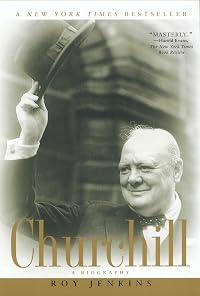
Churchill: A Biography
by Roy Jenkins
On This Page
Description
Provides a glimpse into the extraordinary life of Britain's greatest prime minister, recreating his many accomplishments, trials, and tribulations throughout his life that contributed to his success.Tags
Recommendations




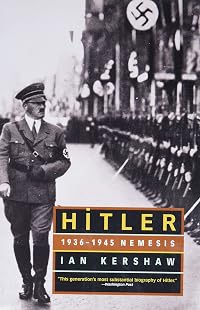

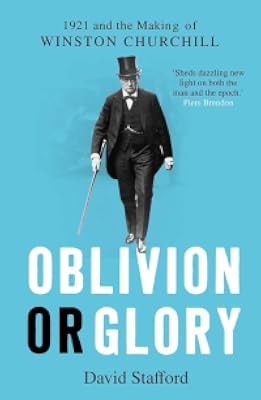
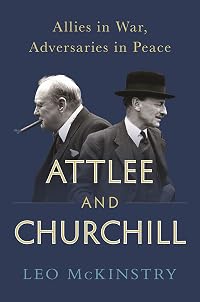

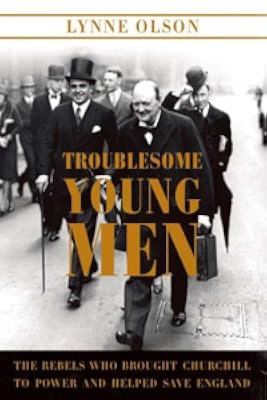









Member Reviews
A good biography of Winston Churchill. As might be expected in a book by someone of the calibre of Roy Jenkins, it concentrates on politics and gives fascinating insights into the British parliamentary system. It's an excellent book as far as content is concerned, but I find some of the writing rather dense. Jenkins has a tendency to hide the main clause at the end of a long and convoluted sentence after so many qualifying clauses that you've forgotten what it was all about by the time you get there. He also uses some rather obscure words.
This is an epic book about an almost unbelieveable life, a classic case of fact being stranger than fiction - you couldn't make it up. His early life is the stuff of a boy's own adventure story, dashing across the british empire fighting natives, being captured by the Boer and escaping.
The politics could be rather dull and confusing to someone not really interested in the mire of modern politics, but Jenkins manages to make this somehow slightly noble! The parties and Churchill's floor crossings are explained as are the big issues of the day.
The second world war period - for which, I suppose he is most associated - does not dominate the book. Of the 46 chapters, 12 are devoted to this period of years. It also goes a long way to show more describing how his life to date had uniquly prepared him for exactly that time in history. It is un-nerving to think what would have happened had he not been in the right place at the right time.
My only critisism is that the book ends, almost abruptly, at Churchill's death. I know a biography usually ends with the death of the subject, but I can't help feeling it might have been nice to have a summary chapter, maybe discussing his legacy.
Jenkins' text is a delight to read, extremely erudite and with a wonderfully wide vocabulary. At approaching 1000 pages, paperback maybe isn't the best format for this book. After 1 read, the spine of my new copy is intact, but the front cover is looking distinctly dog-eared. show less
The politics could be rather dull and confusing to someone not really interested in the mire of modern politics, but Jenkins manages to make this somehow slightly noble! The parties and Churchill's floor crossings are explained as are the big issues of the day.
The second world war period - for which, I suppose he is most associated - does not dominate the book. Of the 46 chapters, 12 are devoted to this period of years. It also goes a long way to show more describing how his life to date had uniquly prepared him for exactly that time in history. It is un-nerving to think what would have happened had he not been in the right place at the right time.
My only critisism is that the book ends, almost abruptly, at Churchill's death. I know a biography usually ends with the death of the subject, but I can't help feeling it might have been nice to have a summary chapter, maybe discussing his legacy.
Jenkins' text is a delight to read, extremely erudite and with a wonderfully wide vocabulary. At approaching 1000 pages, paperback maybe isn't the best format for this book. After 1 read, the spine of my new copy is intact, but the front cover is looking distinctly dog-eared. show less
The subject of the book is, of course, without peer. Churchill's was a life of such enormous variety and import it would be hard for anyone to do it justice.
Roy Jenkins has a unique perspective and a very engaging writing style. Ultimately, rather too many parenthetical comparisons to events of his period at the top of active political life became a little wearing. His assumption, that the chronology of the events of Churchill's life are well enough known to the reader that oblique references are all that is required, credited me with more knowledge than I could legitimately claim.
The narrator is excellent throughout bringing the prose to life without resorting to caricature.
This is a very engaging description of the wit, wisdom and show more bravery of "the greatest human being ever to occupy Downing Street." show less
Roy Jenkins has a unique perspective and a very engaging writing style. Ultimately, rather too many parenthetical comparisons to events of his period at the top of active political life became a little wearing. His assumption, that the chronology of the events of Churchill's life are well enough known to the reader that oblique references are all that is required, credited me with more knowledge than I could legitimately claim.
The narrator is excellent throughout bringing the prose to life without resorting to caricature.
This is a very engaging description of the wit, wisdom and show more bravery of "the greatest human being ever to occupy Downing Street." show less
This magnificent big biography of the great Prime Minister and war leader, written by the former Labour Cabinet member and Social Democratic Party founder Roy Jenkins, was the British Book Awards Best Biography of the Year in 2003. It is political and personal biography as its very best, beautifully written and covering all aspects of the colourful life of Churchill, which packed in more incident, especially on the political and literary fronts, then any other figure during the twentieth century. His magnificent leadership during the Second World War is of course rightly lauded, but there was so much more to him than this: his early military and journalistic experiences in the Boer War; his Cabinet career as quite a radical Liberal show more President of the Board of the Trade in the reforming 1906-10 Liberal Government; his dramatic changes of party from Conservative to Liberal in 1904 and back to Conservative in 1924, holding very high offices in Liberal and Conservative Cabinets, e.g. as a Liberal Home Secretary and a Conservative Chancellor of the Exchequer; and as a Liberal First Lord of the Admiralty in the First World War and a Conservative First Lord of the Admiralty at the beginning of the Second World War, before the crisis of confidence caused by Chamberlain's wretched appeasement policy led to Churchill's assuming the pinnacle of his power and influence on the world stage. His loss of office in the Labour landslide of the 1945 General Election was for him shockingly unexpected and, in hindsight it would no doubt have been better for him had he retired from front line politics at that point (he was already 70). But he was motivated to continue as Leader of the Opposition due to his fears of the encroaching influence of the Soviet Union in central and Eastern Europe and his belief that only a strong Anglo-American alliance could combat this; in fact this was also the policy of Attlee's Government. He was also very involved in founding and supporting some of the earliest European institutions that later became the embryonic EC (though most modern Conservatives would be reluctant to admit this!). Churchill's return to power in 1951 made him a Prime Minister at 77, something which is pretty much unthinkable now, but after a couple of reasonable years, when his main driving force was horror of the H Bomb and a desire to reach some kind of understanding with the Soviet Union, his health deteriorated when he had a major stroke in the summer on 1953. After this, the author's recounting of his clinging to power for another year and a half makes for unedifying reading and one feels sorry both for Churchill as a human being and for his Cabinet colleagues having to work with him in this state; only his enormous prestige made his continuation in office even plausible. After his retirement in April 1955, the remaining near decade of his life was dominated by lengthy stays in southern France and Italy and in Mediterranean cruises on Aristotle Onassis's yacht; yet despite these absences and detachment from life in Britain, he remained an MP, even after a fall in 1962 which incapacitated him, almost until his death, standing down at the dissolution of Parliament in summer 1964 before the General Election that saw Labour returned with a small majority, and dying in January 1965. The biography also extensively covers Churchill's prodigious and mostly high quality literary output over a period of some 60 years, and his love of and talent for painting, demonstrating what a genuine polymath he was. A remarkable biography of a remarkable statesman. show less
As an American reader I may be rather trapped in my own perspective. What does any English PM mean to me? Well, WW II makes Churchill prominent in my mind and much else I don't understand.
This is a while life story, however, and it includes how the Boer War helped Churchill become a of the empire but his time there also made him seem to me conniving, manipulative, and disingenuous. In a way he comes across as seeing himself as better than others and in an elite role where normal rules need not apply to him. Maybe he was all that. Certainly the author, for a time in Parliament with Churchill, is certainly impressed. He got no respect from Teddy Roosevelt. Or, was that an early meting with FDR as governor? Well, I was having a hard time show more following along waiting for WW II to come about. During these early days I detected a distinct imperialist leaning: against Home Rule for Ireland and deriding the Boers' native language as inferior to English, etc.
Of course there is a lot on other British politicians, leaders, generals, etc. that rolled on by. One that kept emerging was his friend Violet Bonham Carter who I have learned is grandmother to the Bonham Carter I see in the movies.
I used to think it odd that the UK electorate so soon cast Churchill aside after his WW II success, but now I see that as more obvious due to his overt decline in health and ability due to a series of strokes (we have our own sagas of senile government heads) and apparent irrelevance due to failure to lead in a world nuclear politics, a federalist Europe, and more. show less
This is a while life story, however, and it includes how the Boer War helped Churchill become a of the empire but his time there also made him seem to me conniving, manipulative, and disingenuous. In a way he comes across as seeing himself as better than others and in an elite role where normal rules need not apply to him. Maybe he was all that. Certainly the author, for a time in Parliament with Churchill, is certainly impressed. He got no respect from Teddy Roosevelt. Or, was that an early meting with FDR as governor? Well, I was having a hard time show more following along waiting for WW II to come about. During these early days I detected a distinct imperialist leaning: against Home Rule for Ireland and deriding the Boers' native language as inferior to English, etc.
Of course there is a lot on other British politicians, leaders, generals, etc. that rolled on by. One that kept emerging was his friend Violet Bonham Carter who I have learned is grandmother to the Bonham Carter I see in the movies.
I used to think it odd that the UK electorate so soon cast Churchill aside after his WW II success, but now I see that as more obvious due to his overt decline in health and ability due to a series of strokes (we have our own sagas of senile government heads) and apparent irrelevance due to failure to lead in a world nuclear politics, a federalist Europe, and more. show less
A very dense, detailed biography of Churchill which is probably the best one volume life of the man that exists. Jenkins' work has been nominated for a number of awards, and deservedly so: this is a very impressive piece of history, made all the more so when you consider that he was in his 80s at the time of writing. Jenkins was a parliamentarian himself, and even met Churchill briefly, so he has that extra little bit of insight into the world in which the man lived. Perhaps not a book to sit down and read in one go (my copy is well over 900 pages), but it's certainly worth dipping into every now and then and absorbing.
This book took me a long ass time to read, maybe 2 years. Its mostly a description of all the parliamentary work he did, in order, in detail. Somehow this was stupendously interesting to read. I don't really understand how, but it was. Would recommend.
Members
- Recently Added By
Lists

Top Five Books of 2014
1,064 works; 398 members

Books in the Bibliography of The Cold War by John Lewis Gaddis
192 works; 1 member
Author Information

29+ Works 3,532 Members
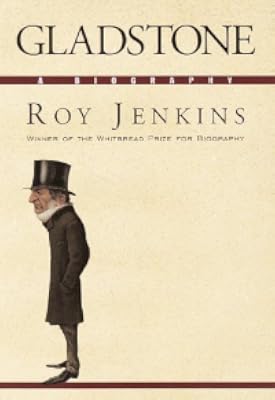
Roy Jenkins is the author of eighteen books, including Gladstone (1997), which won the Whitbread Prize for Biography. Active in British politics for half a century, he entered the House of Commons as a Labour member in 1948 and subsequently served as Minister of Aviation, Home Secretary, and Chancellor of the Exchequer. In 1977-81 he was President show more of the European Commission. In 1987 he became Chancellor of Oxford University and took his seat in the House of Lords as Lord Jenkins of Hillhead. He is currently President of the Royal Society of Literature. He lives with his wife in London and Oxfordshire show less
Awards and Honors
Awards
Distinctions
Series
Belongs to Publisher Series
Inimene ja ajalugu (14. raamat)
Common Knowledge
- Original publication date
- 2001
- People/Characters
- Arthur Balfour; Clementine Hozier (Churchill); Lord Randolph Churchill; Winston Churchill (Churchill, Winston Leonard Spencer); Georges Clemenceau; Admiral of the Fleet Sir John Fisher (show all 10); Eleanor Roosevelt; Franklin Delano Roosevelt; H. H. Asquith; David Lloyd George
- Important places
- House of Commons, Palace of Westminster, London, England, UK; Harrow School, Harrow, London, England, UK; South Africa; United Kingdom
- Important events
- Second Boer War; World War I; World War II
- Blurbers
- Roberts, Andrew; McCrum, Robert
Classifications
- Genres
- Biography & Memoir, History, Nonfiction, General Nonfiction
- DDC/MDS
- 941.084092 — History & geography History of Europe British Isles Historical periods of British Isles 1837- Period of Victoria and House of Windsor 1936-1945
- LCC
- DA566.9 .C5 .J46 — History of Europe, Asia, Africa and Oceania Great Britain History of Great Britain England History By period Modern, 1485- 20th century
- BISAC
Statistics
- Members
- 2,232
- Popularity
- 9,094
- Reviews
- 19
- Rating
- (3.97)
- Languages
- 8 — Danish, English, Estonian, French, Hungarian, Norwegian (Bokmål), Portuguese, Spanish
- Media
- Paper, Audiobook, Ebook
- ISBNs
- 32
- ASINs
- 18