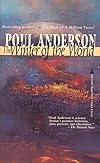
The Winter of the World
by Poul Anderson
On This Page
Description
The term ?±person? has been important in the development of the doctrine of the Trinity. Modern uses of the word, however, have changed drastically its meaning and have raised serious questions about the lasting significance of the definition of the Trinity produced by the controversies of the patristic era. For this reason, some modern theologians have argued in favor of rephrasing traditional formulas, particularly the Trinitarian formula of one God in three persons. Others have show more contended that the term ?±person? should be retained in Trinitarian theology, because the modern notion of an individual center of consciousness and action helps to express the relationships among the Father, Son, and Holy Spirit. This book analyzes and evaluates the Trinitarian theology of Wolfhart Pannenberg (1928-) and the importance that he attributes to the term ?±person.? In addition, this study provides an overview of key themes in the systematic expression of his theology in general and summarizes his treatment of the term's use throughout the history of Trinitarian theology. The crucial discussion in the present work takes the form of an analysis of Pannenberg's Trinitarian theology and his use of the term ?±person? with particular emphasis on the way this material is developed in his systematic theology. The final chapter evaluates the contribution, importance, and influence as well as strengths and weaknesses of Pannenberg's thoughts on the debate over the use of the term ?±person? in Trinitarian theology. show lessTags
Recommendations











Member Reviews
I seem to have liked this 1976 Poul Anderson novel more than most. I’ve read several of his novels in the past six months or so, and he tends to be a bit of a hit or miss author for me. This one, which is built around solidly science fiction premises, but in many ways reads more like a fantasy, was a hit.
At his best Anderson brings a sad poetic sensibility to his storytelling, and I certainly felt that here. While I can’t really argue that the characters and the societies they inhabit are particularly plausible, I found them complicated and interesting.
Somehow he makes a story about a matriarchal society led by strangely attractive, pheromaniacal (I know that’s not really a word, but if it were it would be the right one to use show more here), and fiercely independent women (who are every bit as interested in a romp in the sack with a random stranger as your average adolescent male science fiction reader) not feel gratuitous. show less
At his best Anderson brings a sad poetic sensibility to his storytelling, and I certainly felt that here. While I can’t really argue that the characters and the societies they inhabit are particularly plausible, I found them complicated and interesting.
Somehow he makes a story about a matriarchal society led by strangely attractive, pheromaniacal (I know that’s not really a word, but if it were it would be the right one to use show more here), and fiercely independent women (who are every bit as interested in a romp in the sack with a random stranger as your average adolescent male science fiction reader) not feel gratuitous. show less
This is pretty much a standard post-apocalypse story, except that Anderson presents the idea that idealized native americas have developed. They have very close ties to the land, almost no sense of ownership, and are extremely protective of the animals that live there. When threatened by a 'civilized' Empire with overwhelming force, they have to react, but that would require cooperation and strategy, two things they do not do well. A very interesting take on this theme.
In an era in which humanity has been pushed back to a semi-medieval tech level (though the most advanced culture has radio, among other items), a empire based in what used to be Mexico which recently conquered an ancient city state on the site of New Orleans is pushing up the the Jugular (Mississippi) River to try to conquer a semi-nomadic and notoriously fiercely independent culture in the plains. Despite the North American setting, one of the cultures seem at all North American (unlike, say, "No Truce with Kings"). The empire (Rahid) was itself conquered by a nomadic cavalry culture (Baromm) a few generations earlier, and the feel of the story is more like Manchu China invading Dzungaria than, say, the wars of US Cavalry against the show more Plains Indians. The POV shifts among Lady Donya of the quasi-libertarian Rogaviki, Josserek of the technlogically sophisticated Seafolk based in Australia, (rather like the Pacific confederation Anderson used in some early stories) and Sidir, the commander of the Barommian army. Anderson's sympathies are obviously with Donya and Josserek, but as often with his "villains" Sidir also has an understandable point of view. Rogaviki women have a reputation for being sexually irresistible to non-Rogaviki men, and both Josserek and SIrdir become Donya's lovers at different points in the story. Eventually Josserek develops a theory of why there is this attraction --and why Rogaviki literally cannot bear living in large groups for long. However, this is only revealed in a postscript after Sidir and his army have perished in a battle on the frozen river sightly reminiscent of the Russian defeat of the Teutonic Knights at Lake Piepus. show less
Set after a devastating Ice Age, where remnants of humanity struggle to survive, focusing on the freedom-loving Seafolk trying to reclaim lost technology and resist the expansionist Rahidain-Barammian Empire. Agent Josserek Derrain navigates this harsh world of salvaged tech, nascent warfare, and political intrigue, highlighting conflicts between advanced empires and primitive cultures like the defiant Rogaviki, led by the strong Donya of Hervar.
not my favorite Anderson story, but a good ending; it started off like a standard attempt to show us a 'best form of society", but with a more "realistic" ending.
Ratings
Members
- Recently Added By
Lists

Winter Books
127 works; 17 members
Author Information

692+ Works 53,369 Members
Poul Anderson, November 25, 1926 - July 31, 2001 Poul Anderson was born on November 25, 1926 in Bristol, Pennsylvania to parents Anton and Astrid. After his father's death, Poul's mother took them first to Denmark and then to Maryland and Minnesota. He earned his degree in Physics from the University of Minnesota, but chose instead to write show more stories for science fiction magazines, such as "Astounding." Anderson is considered a "hard science fiction" writer, meaning that his books have a basis in scientific fact. To attain this high level of scientific realism, Anderson spent many hours researching his topics with scientists and professors. He liked to write about individual liberty and free will, which was a well known theme in many of his books. He also liked to incorporate his love of Norse mythology into his stories, sometimes causing his modern day characters to find themselves in fantastical worlds, such as in "Three Hearts and Three Lions," published in 1961. Anderson has written over a hundred books, his last novel, "Genesis" won the John W. Campbell Award, one of the three major science fiction awards. He is a former president of the Science Fiction and Fantasy Writers of America and won three Nebula awards and nine Hugo Awards. In 1997, Anderson was named a Grandmaster by the Science Fiction and Fantasy Writers of America and was also inducted into the Science Fiction Fantasy Hall of Fame. Poul Anderson died on July 31, 2001 at the age of 74. (Bowker Author Biography) show less
Some Editions
Awards and Honors
Awards
Series
Belongs to Publisher Series
Science Fiction Book Club (1659)
Work Relationships
Is contained in
Common Knowledge
- Original publication date
- 1976-05
Classifications
Statistics
- Members
- 362
- Popularity
- 86,325
- Reviews
- 5
- Rating
- (3.30)
- Languages
- English
- Media
- Paper
- ISBNs
- 6
- ASINs
- 12