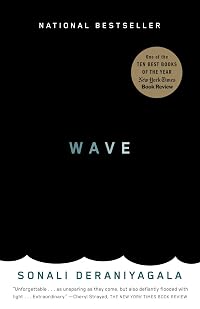
Wave
by Sonali Deraniyagala
On This Page
Description
On the morning of December 26, 2004, on the southern coast of Sri Lanka, Sonali Deraniyagala lost her parents, her husband, and her two young sons in the tsunami she miraculously survived. In this brave and searingly frank memoir, she describes those first horrifying moments and her long journey since. She has written an engrossing, unsentimental, beautifully poised account: as she struggles through the first months following the tragedy, furiously clenched against a reality that she cannot show more face and cannot deny; and then, over the ensuing years, as she emerges reluctantly, slowly allowing her memory to take her back through the rich and joyous life she's mourning, from her family's home in London, to the birth of her children, to the year she met her English husband at Cambridge, to her childhood in Colombo; all the while learning the difficult balance between the almost unbearable reminders of her loss and the need to keep her family, somehow, still alive within her.--Publisher description. show lessTags
Recommendations


















Member Reviews
I chose this book for my book club this summer, mainly because I wanted to read it myself and decided that I was going to drag others along on what was guaranteed to be a difficult read. The first response I got, long before the meeting, was "Why on earth would you choose this book for us. It's terrible!" And by terrible, the reader/commenter meant not that it wasn't well written but that it was horrific to be reading about the sudden, unexpected, and gut wrenching deaths of almost an entire family and the subsequent grief and despair of the lone survivor, daughter, wife, mother. Luckily this reader kept pushing through and ultimately appreciated the book and we all went on to have a deep, if somber, discussion.
In 2004, economist Sonali show more Deraniyagala was on holiday in Sri Lanka with her husband and their two school aged sons, spending Christmas with her parents at a seaside resort she'd been visiting since she was a child growing up in the country, when in an instant everything changed. As Deraniyagala stood and watched, a tumbling white wave came rushing toward their room. She and her husband grabbed both of their boys and ran, finding a Jeep to climb into to try and escape the onslaught of the ocean. But the Jeep couldn't outrun the wave and it was upended, with Deraniyagala losing sight of her family while fighting for her own life. Miraculously surviving the tsunami and in shock, she then faced the darkest time of her entire life, fearing and then knowing for sure that Steve, their boys Vik and Malli, and both of her parents were missing and had lost their lives while she had not.
This memoir is not just the account of the terrible wave that swept into her life and devastated it, but also of the aftermath, of her desperate madness, the overwhelming desire for her own death, the stark grief she suffered, and her own soul stripped bare. She shied away from looking too closely at such an all-encompassing loss until she could no longer avoid it, protecting her mind from the personal remembrances that could derail her, and yet she had to go on living, go on in a world without her most beloved people in it. She writes beautifully and movingly of the natural world, shares the intense and harrowing feelings that grief engendered in her, and gives glimpses of who her husband, her sons, and her parents were and how she continues to navigate a world without them so many years on from her loss. The book is raw and unfiltered, emotional and crushing. It is also a powerful testament to love. show less
In 2004, economist Sonali show more Deraniyagala was on holiday in Sri Lanka with her husband and their two school aged sons, spending Christmas with her parents at a seaside resort she'd been visiting since she was a child growing up in the country, when in an instant everything changed. As Deraniyagala stood and watched, a tumbling white wave came rushing toward their room. She and her husband grabbed both of their boys and ran, finding a Jeep to climb into to try and escape the onslaught of the ocean. But the Jeep couldn't outrun the wave and it was upended, with Deraniyagala losing sight of her family while fighting for her own life. Miraculously surviving the tsunami and in shock, she then faced the darkest time of her entire life, fearing and then knowing for sure that Steve, their boys Vik and Malli, and both of her parents were missing and had lost their lives while she had not.
This memoir is not just the account of the terrible wave that swept into her life and devastated it, but also of the aftermath, of her desperate madness, the overwhelming desire for her own death, the stark grief she suffered, and her own soul stripped bare. She shied away from looking too closely at such an all-encompassing loss until she could no longer avoid it, protecting her mind from the personal remembrances that could derail her, and yet she had to go on living, go on in a world without her most beloved people in it. She writes beautifully and movingly of the natural world, shares the intense and harrowing feelings that grief engendered in her, and gives glimpses of who her husband, her sons, and her parents were and how she continues to navigate a world without them so many years on from her loss. The book is raw and unfiltered, emotional and crushing. It is also a powerful testament to love. show less
This book is beautifully written and poignant. It helped me understand a little better what friends of mine who have been through the sudden loss of loved ones go through and how, though someone may appear to be okay on the outside, they are still living with the terrible grief. I wish, though, that the author had told us a bit about what she was doing in her public life while she processed this grief in her inner life.
"Why do I have to be the f**king ghost?"
Sri Lankan economist Sonali Deraniyagala lost her parents, her husband and two young sons in an instant, as they were all swept away in the 2004 Indian Ocean Tsunami. In her memoir Wave she comes to terms with all the memories and emotions that go along with these devastating losses. She doesn't spare herself as she describes her "ghost"-like post-disaster existence, which included bouts of heavy drinking, harassment of the family who rented her parents' house after their deaths, and survivor's guilt. Although nothing can replace the happy life she had with her family in London, she does have the advantages of good friends, a successful career, and the means to afford therapy and vacations to show more exotic destinations. These things have allowed her to continue living despite her grief, even though no real resolution of it is possible.
This is a sad, but moving book about finding the strength to go on after almost all has been lost. show less
Sri Lankan economist Sonali Deraniyagala lost her parents, her husband and two young sons in an instant, as they were all swept away in the 2004 Indian Ocean Tsunami. In her memoir Wave she comes to terms with all the memories and emotions that go along with these devastating losses. She doesn't spare herself as she describes her "ghost"-like post-disaster existence, which included bouts of heavy drinking, harassment of the family who rented her parents' house after their deaths, and survivor's guilt. Although nothing can replace the happy life she had with her family in London, she does have the advantages of good friends, a successful career, and the means to afford therapy and vacations to show more exotic destinations. These things have allowed her to continue living despite her grief, even though no real resolution of it is possible.
This is a sad, but moving book about finding the strength to go on after almost all has been lost. show less
(22) Oh my. I have no words. As a privileged professional first-world mother of two boys - I have no words. The author was vacationing on the beach in Sri Lanka with her family for Christmas when the tsunami hit - in an instant, she lost everything. She was the only survivor in her immediate family. Horrifying. Her stark narration is absolutely haunting and soul-destroying. My heart breaks for her.
I could relate to the beginning stages of shock - where you want to wallow in misery and don't want to be distracted because then you will have to remember all over again. The break you get from sleeping is more than offset by the few moments of confusion when you awake and have to accept the unacceptable all over again. When I suffered a show more trauma, I could not seem to get across that concept to people - anything that takes you away from misery - movies, music, sleep - is bad because you must re-enter again.
As she left the initial days, months and tried to find a way to think about her boys, her husband, and her parents in turn without dying inside (the hierarchy of grief) her reminiscences became much more personal and specific to her family members. Occasionally I lost the thread here and there because she and her husband's food and travel fetish was so bougie and a tad pretentious which accounts for the half star off - but my God - how brave to write this book. How courageous to write it without a happy ending. She did an amazing job depicting unfathomable pain without melodrama.
Speaking of God - how does this not make you doubt? Why several thousand innocents destroyed by 'an act of God,' right? There can be no just higher plan for this. I am so sorry. I hope that writing this book helped the author realize that despite the loss, those precious years cannot be stolen from her. Her family lived lives of meaning and are alive in her and in her book for eternity. show less
I could relate to the beginning stages of shock - where you want to wallow in misery and don't want to be distracted because then you will have to remember all over again. The break you get from sleeping is more than offset by the few moments of confusion when you awake and have to accept the unacceptable all over again. When I suffered a show more trauma, I could not seem to get across that concept to people - anything that takes you away from misery - movies, music, sleep - is bad because you must re-enter again.
As she left the initial days, months and tried to find a way to think about her boys, her husband, and her parents in turn without dying inside (the hierarchy of grief) her reminiscences became much more personal and specific to her family members. Occasionally I lost the thread here and there because she and her husband's food and travel fetish was so bougie and a tad pretentious which accounts for the half star off - but my God - how brave to write this book. How courageous to write it without a happy ending. She did an amazing job depicting unfathomable pain without melodrama.
Speaking of God - how does this not make you doubt? Why several thousand innocents destroyed by 'an act of God,' right? There can be no just higher plan for this. I am so sorry. I hope that writing this book helped the author realize that despite the loss, those precious years cannot be stolen from her. Her family lived lives of meaning and are alive in her and in her book for eternity. show less
Wave by Sonali Deraniyagala is a devastating portrait of grief but also it is a picture of love and living on after tragedy. Her family (husband, two sons, her parents) were lost to the tidal wave which hit Sri Lanka in 2004. Each is portrayed vividly and engenders a start and a smile as these recollections become more bearable. There are poetic descriptions of nature such as her trip to Sweden where she is “on the deserted shores of a lake of ice, surrounded by naked birches sheathed in frozen fog, each branch glowing like a stag’s antlers in velvet in that mellow light” and .on her return to Yala where the wave hit, she sees “the sea eagles that had thrilled” her son, “bold in this desolation, they sailed low, sudden show more shadows striking the bare ground,” or a boat trip to see the blue whales: “a foamy mass heralds the head that rises to the surface, its shape an ancient arch.” She parses out fond recollections of growing up in Sri Lanka, her family, their culture including the food they ate (curries, shrimp pastes, fruit, fish), her father’s library in their house, her mother’s sari collection, their vacations, friends and servants. She writes evocatively and I was compelled to keep reading despite the sadness and pain. The end of the book, seven years after her loss, grants a whiff of hope as she is able finally to recall joyful moments with her missing loved ones in her new home in New York City which has given her “the distance for which I can reach for my family…travel[ing] back and forth to London and Columbo, rediscovering us.” The book was on several “best of 2013” lists and now goes on mine. show less
Wave is not for the faint-hearted.
Sonali Deraniyagala was holidaying in Sri Lanka with her family on Boxing Day 2004, when the tsunami hit. While trying to flee they were swept away in the raging torrent. Sonali managed to survive, but the rest of her family were all victims of the disaster. Her entire family - mother, father, husband and two little sons - were ripped away from her in a flash.
Wave is about Sonali's attempts to deal with this crushing loss. It is an extremely harrowing and direct account. The author doesn't spare us or herself; she is brutally frank about her own some times appalling behaviour in her grief-stricken aftermath. She recounts how every small thing, every familiar place, rekindles her great distress at the show more loss of the people she shared those experiences with, for years after.
This is the best book on grief I have ever read. Deraniyagala shares the pain of losing her entire family in an unstinting fashion that allows the reader to feel a small part of an unimaginable loss. A terrific read. show less
Sonali Deraniyagala was holidaying in Sri Lanka with her family on Boxing Day 2004, when the tsunami hit. While trying to flee they were swept away in the raging torrent. Sonali managed to survive, but the rest of her family were all victims of the disaster. Her entire family - mother, father, husband and two little sons - were ripped away from her in a flash.
Wave is about Sonali's attempts to deal with this crushing loss. It is an extremely harrowing and direct account. The author doesn't spare us or herself; she is brutally frank about her own some times appalling behaviour in her grief-stricken aftermath. She recounts how every small thing, every familiar place, rekindles her great distress at the show more loss of the people she shared those experiences with, for years after.
This is the best book on grief I have ever read. Deraniyagala shares the pain of losing her entire family in an unstinting fashion that allows the reader to feel a small part of an unimaginable loss. A terrific read. show less
Wave by Sonali Deraniyagala is a devastating portrait of grief but also it is a picture of love and living on after tragedy. Her family (husband, two sons, her parents) were lost to the tidal wave which hit Sri Lanka in 2004. Each is portrayed vividly and engenders a start and a smile as these recollections become more bearable. There are poetic descriptions of nature such as her trip to Sweden where she is “on the deserted shores of a lake of ice, surrounded by naked birches sheathed in frozen fog, each branch glowing like a stag’s antlers in velvet in that mellow light” and .on her return to Yala where the wave hit, she sees “the sea eagles that had thrilled” her son, “bold in this desolation, they sailed low, sudden show more shadows striking the bare ground,” or a boat trip to see the blue whales: “a foamy mass heralds the head that rises to the surface, its shape an ancient arch.” She parses out fond recollections of growing up in Sri Lanka, her family, their culture including the food they ate (curries, shrimp pastes, fruit, fish), her father’s library in their house, her mother’s sari collection, their vacations, friends and servants. She writes evocatively and I was compelled to keep reading despite the sadness and pain. The end of the book, seven years after her loss, grants a whiff of hope as she is able finally to recall joyful moments with her missing loved ones in her new home in New York City which has given her “the distance for which I can reach for my family…travel[ing] back and forth to London and Columbo, rediscovering us.” The book was on several “best of 2013” lists and now goes on mine. show less
Members
- Recently Added By
Published Reviews
ThingScore 92
This is possibly the most moving book I have ever read about grief, but it is also a very, very fine book about love. For grief is the black hole that is left in our lives when we lose someone irreplaceable – a child, a parent, a lover. It is the negative image that, in its blackness, sometimes reveals love with a greater clarity than its positive counterpart. And while in Wave love reveals show more itself by the bleak intensity of the pain of absolute, irreplaceable loss, it is in the end a love story, and a book about the importance of love. show less
added by Nickelini
It is a nightmarish tale of what happened that desperate day and the desolation and rage that followed. At times, Deraniyagala’s honesty shocks.
added by Nickelini
The word “brave” is used a lot to describe those who write about their deepest traumas — too often, I think — but it’s an apt description of Deraniyagala. She has fearlessly delivered on memoir’s greatest promise: to tell it like it is, no matter the cost. The result is an unforgettable book that isn’t only as unsparing as they come, but also defiantly flooded with light.
added by Nickelini
Lists

Top Five Books of 2013
1,562 works; 721 members

Favorite Memoirs
64 works; 13 members

BingoDOG - Books With Natural Disasters: Nonfiction
18 works; 5 members

.
184 works; 1 member

Biographies: Women
112 works; 1 member
Author Information

4 Works 1,013 Members
Some Editions
Awards and Honors
Awards
Distinctions
Common Knowledge
- Original publication date
- 2013
- Important places
- Yala, Sri Lanka
- Important events
- Tsunami; December 26, 2004 Tsunami
- Dedication
- To Alexandra and Kristiana
- First words
- I thought nothing of it at first.
- Quotations
- Starved of their loveliness, I feel shrunken. Diminished and faded, without their sustenance, their beauty, their smiles.
Occasionally an insensitive relative might walk away if I mention my anguish, and I reel from the humiliation of my pain being outlandish, not palatable to others. - Last words
- (Click to show. Warning: May contain spoilers.)Now I sit in this garden in New York, and I hear them, jubilant, gleeful, on our lawn.
Classifications
Statistics
- Members
- 1,009
- Popularity
- 25,892
- Reviews
- 77
- Rating
- (3.75)
- Languages
- Dutch, English
- Media
- Paper, Audiobook, Ebook
- ISBNs
- 18
- ASINs
- 6