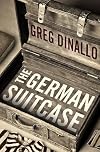
The German Suitcase
by Greg Dinallo
On This Page
Description
This novel from "a suspense pro" is part World War II thriller and part modern-day mystery (Chicago Tribune). A vintage suitcase is pulled from the trash by a young New York advertising executive brainstorming a campaign on her way to work. The account is Steinbach Luggage, the German answer to Louis Vuitton and Hermes. There is only one problem with the vintage bag—like Steinbach's CEO, it is a Holocaust survivor, as evidenced by the name and other personal data painted on it. The show more suitcase is hallowed memorabilia, and no one dares open it until it is determined if the owner is still alive. The Holocaust survivor turns out to be an eighty-nine-year-old member of New York's Jewish aristocracy, a prominent philanthropist and surgeon. When he gives his consent, the documents inside the suitcase pique the interest of a New York Times reporter—whose investigation begins to unravel a devastating secret that has been locked away since the day Dachau was liberated. From an author whose work has been praised by the New York Times for "sharp insight into character," The German Suitcase is a unique thriller focusing on the Nazi doctors who were conscripted by the Secret Service and given the task of carrying out Hitler's Final Solution, delving deeply into questions that have been asked ever since the war ended. What is a war crime? What is guilt? How is justice best served? It is a novel that questions the very nature of identity, and ultimately asks if a lifetime of good deeds can make up for past acts of evil. Thriller. Fiction. show lessTags
Recommendations











































Member Recommendations

Limelite Jewish woman scholar in Renaissance Italy suspended between two cultures.
Member Reviews
A vintage suitcase is pulled from the trash by a young New York advertising executive brainstorming a campaign on her way to work. The account is Steinbach Luggage, the German answer to Louis Vuitton and Hermes. There is only one problem with the vintage bag—like Steinbach’s CEO, it is a Holocaust survivor, as evidenced by the name and other personal data painted on it.
The suitcase is hallowed memorabilia, and no one dares open it until it is determined if the owner is still alive. The Holocaust survivor turns out to be an eighty-nine-year-old member of New York’s Jewish aristocracy, a prominent philanthropist and surgeon. When he gives his consent, the documents inside the suitcase pique the interest of a New York Times show more reporter—whose investigation begins to unravel a devastating secret that has been locked away since the day Dachau was liberated show less
The suitcase is hallowed memorabilia, and no one dares open it until it is determined if the owner is still alive. The Holocaust survivor turns out to be an eighty-nine-year-old member of New York’s Jewish aristocracy, a prominent philanthropist and surgeon. When he gives his consent, the documents inside the suitcase pique the interest of a New York Times show more reporter—whose investigation begins to unravel a devastating secret that has been locked away since the day Dachau was liberated show less
Concurrent Stories Run for a Dramatic Conclusion
When a young New York advertising executive pulls a vintage suitcase from a trash pile to use in a new advertising series, she pulls a string that links the Holocaust to a prominent New York doctor. Then her boyfriend, a journalist who agrees to write a story for the times, spots some idiosyncrasies in the artifacts pulled from the suitcase and the Doctor’s story. Attempting to discover the facts without alerting the Doctor or smearing his reputation becomes a suspenseful walk through history. As a young man, the doctor fell in love with a Jewish doctor in Germany, so when an SS officer came, demanding that two Jews must go to a camp, the doctor tries to help them escape, endangering his show more family in the process.
Anything that has a connection to Germany and World War II, has the potential to be exciting, but when I realized that two of the characters where Jewish and likely headed to a concentration camp, I tried to slow down my fascination. I knew it would be emotional. I have a fascination with stories of this era because it was such an incredibly difficult time to live through. Once I read a few chapters, I could not put it down. What seemed to be the likely conclusion from the beginning kept twisting and kept me guessing.
One of the themes gave me much thought for contemplation, when a good Christian man had to make life and death choices for the people arriving at Dachau, or have his family killed. Somehow, I believed that the people in those positions chose those positions of their own free will, something very naive on my part. After I finished the book, this kept my mind busy for hours, with thought of, “What would I do?” Life is never as simple as we believe. The story reinforces my opinion that evil exists.
This is the first Greg Dinallo novel I have read, but it will not be the last. It took me a couple of days to surface from this deeply suspenseful and emotional novel. This is a well-researched novel, with many compelling facts, including people and dates, both contemporary and historical. If you enjoy the era, suspense, and romance, you should pick this one up today.
Received from NetGalley. show less
When a young New York advertising executive pulls a vintage suitcase from a trash pile to use in a new advertising series, she pulls a string that links the Holocaust to a prominent New York doctor. Then her boyfriend, a journalist who agrees to write a story for the times, spots some idiosyncrasies in the artifacts pulled from the suitcase and the Doctor’s story. Attempting to discover the facts without alerting the Doctor or smearing his reputation becomes a suspenseful walk through history. As a young man, the doctor fell in love with a Jewish doctor in Germany, so when an SS officer came, demanding that two Jews must go to a camp, the doctor tries to help them escape, endangering his show more family in the process.
Anything that has a connection to Germany and World War II, has the potential to be exciting, but when I realized that two of the characters where Jewish and likely headed to a concentration camp, I tried to slow down my fascination. I knew it would be emotional. I have a fascination with stories of this era because it was such an incredibly difficult time to live through. Once I read a few chapters, I could not put it down. What seemed to be the likely conclusion from the beginning kept twisting and kept me guessing.
One of the themes gave me much thought for contemplation, when a good Christian man had to make life and death choices for the people arriving at Dachau, or have his family killed. Somehow, I believed that the people in those positions chose those positions of their own free will, something very naive on my part. After I finished the book, this kept my mind busy for hours, with thought of, “What would I do?” Life is never as simple as we believe. The story reinforces my opinion that evil exists.
This is the first Greg Dinallo novel I have read, but it will not be the last. It took me a couple of days to surface from this deeply suspenseful and emotional novel. This is a well-researched novel, with many compelling facts, including people and dates, both contemporary and historical. If you enjoy the era, suspense, and romance, you should pick this one up today.
Received from NetGalley. show less
Warning, Spoilers!!! When a New York advertising executive finds a vintage suitcase in the trash, she immediately comes up with an advertising campaign for Steinbach Luggage. Her boss immediately recognizes the information painted on the bag and identifies it as he suitcase of a holocaust survivor. They immediately try to track down the survivor, Jacob. The book alternates between the present day and the story of Jacob, Kleist, Eva and Hannah.
I don't really understand why Eva decided to change her identity to Hannah. I thought that this took away from Jacob's sacrifice and Kleist's life. I think the book would have been more powerful without this detail. I also thought the book was a bit predictable. As soon as they took the passport show more photos, it became clear to me that present day Jacob was really Kleist. Overall, it wasn't a bad book, I just wished it had been more of a mystery. show less
I don't really understand why Eva decided to change her identity to Hannah. I thought that this took away from Jacob's sacrifice and Kleist's life. I think the book would have been more powerful without this detail. I also thought the book was a bit predictable. As soon as they took the passport show more photos, it became clear to me that present day Jacob was really Kleist. Overall, it wasn't a bad book, I just wished it had been more of a mystery. show less
Stacey Dutton works for a major New York ad agency. She is to come up with a new campaign for Steinbach luggage. She finds an old Steinbach suitcase in the trash on the curb across from her apartment. She quickly determines that it must have belonged to a survivor of a Nazi concentration. That person is Jacob Epstein.
The chapters of the book alternate between today and Germany near the end of World War II. We follow Jacob and his friends and family while at the same time as we are following Stacey and her group. The story is written pretty well.
There are twists and turns, some of which can be easily foreseen and others that are not so obvious.
The best part of the book is that it was readable. The characters are believable. I actually show more cared what might happen to them.
There are some issues with strong language as the book ends nears the end, so be aware of that. show less
The chapters of the book alternate between today and Germany near the end of World War II. We follow Jacob and his friends and family while at the same time as we are following Stacey and her group. The story is written pretty well.
There are twists and turns, some of which can be easily foreseen and others that are not so obvious.
The best part of the book is that it was readable. The characters are believable. I actually show more cared what might happen to them.
There are some issues with strong language as the book ends nears the end, so be aware of that. show less
The chapters in The German Suitcase alternate between present day New York and World War Two Germany. There is an old suitcase found in the garbage in NY, which turns out to have come from Germany with a Holocaust survivor many years before. It's an interesting premise for a novel, but both time periods in the story are filled with highly unlikely (well, all right...downright silly) situations and unnatural dialogue. I found the book a real chore to read and gave up after forcing myself through the first hundred pages or so.
3.5 stars
Stacey Dutton, a young go-getter at a New York ad agency, spots an old, high-end leather suitcase among the discarded storeroom belongings from a grand Manhattan apartment building being converted to condos. Her agency represents Steinbach & Co., the maker of the suitcase, and Stacey is inspired to grab the suitcase for use in an ad campaign. When it's found that the suitcase belongs to a prominent doctor and pillar of New York philanthropy, who is also a Holocaust survivor, the suitcase becomes much more than a prop in an ad campaign. But when Stacey's boyfriend, a New York Times reporter, finds discrepancies between the doctor's story and the artifacts found in the suitcase, a mystery tale begins.
In alternating chapters, we show more travel between contemporary New York, and Munich during the last year of World War II, where three friends are surgeons in a hospital, treating military and civilian victims of war wounds. This is an unlikely friendship, considering that one, Max Kleist, is an officer in the Waffen-SS, while Eva Rosenberg and Jacob Epstein are Jews working under an extremely rare exemption from the Nazi state's laws that forbade Jewish doctors to treat Aryan patients. This exemption is abruptly yanked, and Jake and Eva must go on the run to avoid falling into the Nazis' genocidal machine. Max, whose close relationship with his Jewish colleagues is known, and whose prominent family is suspected of working underground to help victims of Nazi persecution, is sent to serve as a medical officer at the Dachau extermination camp.
For Germany during World War II, Nazism and the cult of Hitler supplanted all other loyalties and beliefs. Soldiers swore fealty not to the Fatherland, but to Adolf Hitler personally. Formerly devout Catholics and Protestants converted to a faith in Nazism's confused melding of Nordic mythology and racial destiny. Even scientific truths were corrupted by Germany's new dogma of racialism, with its virulent anti-Semitism and belief in the superiority of Aryans. At Dachau, Max finds himself in an environment where he is expected to pervert his Hippocratic oath in the service of these twisted beliefs and aims. His family and his own destiny are held hostage to his choices.
There are some weaknesses in the book. The present-day characters lack the dimensionality of the World War II characters. The conclusion doesn't live up to the promise of the rest of the book. A plot twist is obvious (to die-hard mystery readers anyway) almost from the get-go. The writing in the early part of the book is overburdened with adjectives and adverbs, which bogs down the pace and makes it feel like the author is trying too hard. Fortunately, he snaps out of this and the writing becomes clean and assured. Despite its flaws, I recommend the book to readers of World War II-era novels. Author Dinallo poses difficult questions about moral choices in impossible circumstances, and challenges our black-and-white views of World War II survivors. The topic of doctors in Nazi Germany is particularly interesting, and one that is not often a focus of World War II fiction. Above all, the stories of Max, Jake and Eva are gripping.
Greg Dinallo is a former filmmaker and television and movie writer. He turned to novel writing 20 years ago and, before The German Suitcase, published five thrillers, including RED INK, which was named a New York Times Notable Book. The German Suitcase is Dinallo's first digital-only title, published on November 14, 2012 by Premier Digital Publishing.
Note: I received a publisher's review copy of The German Suitcase. show less
Stacey Dutton, a young go-getter at a New York ad agency, spots an old, high-end leather suitcase among the discarded storeroom belongings from a grand Manhattan apartment building being converted to condos. Her agency represents Steinbach & Co., the maker of the suitcase, and Stacey is inspired to grab the suitcase for use in an ad campaign. When it's found that the suitcase belongs to a prominent doctor and pillar of New York philanthropy, who is also a Holocaust survivor, the suitcase becomes much more than a prop in an ad campaign. But when Stacey's boyfriend, a New York Times reporter, finds discrepancies between the doctor's story and the artifacts found in the suitcase, a mystery tale begins.
In alternating chapters, we show more travel between contemporary New York, and Munich during the last year of World War II, where three friends are surgeons in a hospital, treating military and civilian victims of war wounds. This is an unlikely friendship, considering that one, Max Kleist, is an officer in the Waffen-SS, while Eva Rosenberg and Jacob Epstein are Jews working under an extremely rare exemption from the Nazi state's laws that forbade Jewish doctors to treat Aryan patients. This exemption is abruptly yanked, and Jake and Eva must go on the run to avoid falling into the Nazis' genocidal machine. Max, whose close relationship with his Jewish colleagues is known, and whose prominent family is suspected of working underground to help victims of Nazi persecution, is sent to serve as a medical officer at the Dachau extermination camp.
For Germany during World War II, Nazism and the cult of Hitler supplanted all other loyalties and beliefs. Soldiers swore fealty not to the Fatherland, but to Adolf Hitler personally. Formerly devout Catholics and Protestants converted to a faith in Nazism's confused melding of Nordic mythology and racial destiny. Even scientific truths were corrupted by Germany's new dogma of racialism, with its virulent anti-Semitism and belief in the superiority of Aryans. At Dachau, Max finds himself in an environment where he is expected to pervert his Hippocratic oath in the service of these twisted beliefs and aims. His family and his own destiny are held hostage to his choices.
There are some weaknesses in the book. The present-day characters lack the dimensionality of the World War II characters. The conclusion doesn't live up to the promise of the rest of the book. A plot twist is obvious (to die-hard mystery readers anyway) almost from the get-go. The writing in the early part of the book is overburdened with adjectives and adverbs, which bogs down the pace and makes it feel like the author is trying too hard. Fortunately, he snaps out of this and the writing becomes clean and assured. Despite its flaws, I recommend the book to readers of World War II-era novels. Author Dinallo poses difficult questions about moral choices in impossible circumstances, and challenges our black-and-white views of World War II survivors. The topic of doctors in Nazi Germany is particularly interesting, and one that is not often a focus of World War II fiction. Above all, the stories of Max, Jake and Eva are gripping.
Greg Dinallo is a former filmmaker and television and movie writer. He turned to novel writing 20 years ago and, before The German Suitcase, published five thrillers, including RED INK, which was named a New York Times Notable Book. The German Suitcase is Dinallo's first digital-only title, published on November 14, 2012 by Premier Digital Publishing.
Note: I received a publisher's review copy of The German Suitcase. show less
Ratings
Members
- Recently Added By
Author Information

15+ Works 2,097 Members
Common Knowledge
- Canonical title
- The German Suitcase
- Original publication date
- 2012-11-14
Classifications
Statistics
- Members
- 63
- Popularity
- 490,964
- Reviews
- 6
- Rating
- (3.89)
- Languages
- English
- Media
- Paper, Ebook
- ISBNs
- 5
- ASINs
- 2