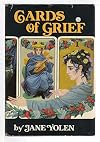
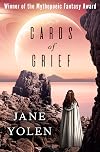
Cards of Grief
by Jane Yolen
On This Page
Description
An alien civilization is forever changed by the incursion of human social scientists--and an ancient prophecy--in this award-winning novel. The year is 2132 when members of the Anthropologist's Guild set down on the planet Henderson's IV, or L'Lal'lor as it is known to the native population. Charged with the nonintrusive study of alien cultures, the crew discovers a society containing no love or laughter. It is, instead, centered around death--a world of aristocratic and common folk in show more which grieving is an art and the cornerstone of life. But the alien civilization stands on the brink of astonishing change, heralded by the discovery of Linni, the Gray Wanderer, a young woman from the countryside whose arrival has been foretold for centuries. And for Anthropologist First Class Aaron Spenser, L'Lal'lor is a place of destructive temptations, seducing him with its mysterious, sad beauty, and leading him into an unthinkable criminal act. Told from the shifting viewpoints of characters both alien and human, and through records of local lore and transcripts of court martial proceedings, Cards of Grief is a thoughtful, lyrical, and spellbinding tale of first contact. It is a true masterwork of world building from Jane Yolen, a premier crafter of speculative fiction and fantasy. This ebook features a personal history by Jane Yolen including rare images from the author's personal collection, as well as a note from the author about the making of the book. show lessTags
Recommendations























Member Recommendations

Member Reviews
Overall, I enjoyed this one, a thoughtful fantasy with SF elements. Published in 1984, it seems quite early for a novel to be so matter-of-fact about the bisexuality of its characters, though the social structure of a matriarchy is nicely imagined. The main downside was the concluding section: after an entire book built around a culture in which grief is institutionalized and presented mainly in the genre of poetry with music, the "cards" of the title are suddenly introduced without any preparation on the part of the author, and sit uneasily in the established context. MB 27-viii-2023
sffbc buddy read march 2020
Reading as ebook from okc library.
Almost halfway. The exploration of ritualized grief is interesting. The examination of racism/ classism and what-we-would-call pedophilia bother me. But these humanoids have developed a culture that works for them well enough, it seems. At least the book (at least so far) qualifies as "post-scarcity" and "SF w/no bad guys!" (For all our attempts to have enlightened social structures, we still starve, torture, and kill one another....)
...............................
Done. Imo it got better and better. It's much richer than all that. So much to unpack. The beliefs of the characters, and their prejudices, are their own, not Yolen's. There are complex reasons for each facet of the show more world-building; it's all crafted with care.
Hard to read until the end, I absolutely agree. But then I read of the last two cardsAaron's Laughing Man and Linnet's Child of Earth and Sky and I have even more to think about. This could be worth a reread.
End note in e-book is brief. Mentions, for one thing, that Dr. Z is a real person, a friend. Includes a timeline which gives ages of characters... a big help in keeping track.
Ok, I highlighted a few things:
"Imagine not being able to distinguish art from artifice" muses our favorite (?) prince.
Not until halfway through do we learn that not only do the 'natives' not laugh, but neither do theylove (though there were clues earlier).
An older person, given a fresh reason to live, is "like a gourd with a new candle inside. For a while all you see is the light; you do not notice, until it is too late, that the gourd has rotted from the inside out." show less
Reading as ebook from okc library.
Almost halfway. The exploration of ritualized grief is interesting. The examination of racism/ classism and what-we-would-call pedophilia bother me. But these humanoids have developed a culture that works for them well enough, it seems. At least the book (at least so far) qualifies as "post-scarcity" and "SF w/no bad guys!" (For all our attempts to have enlightened social structures, we still starve, torture, and kill one another....)
...............................
Done. Imo it got better and better. It's much richer than all that. So much to unpack. The beliefs of the characters, and their prejudices, are their own, not Yolen's. There are complex reasons for each facet of the show more world-building; it's all crafted with care.
Hard to read until the end, I absolutely agree. But then I read of the last two cards
End note in e-book is brief. Mentions, for one thing, that Dr. Z is a real person, a friend. Includes a timeline which gives ages of characters... a big help in keeping track.
Ok, I highlighted a few things:
"Imagine not being able to distinguish art from artifice" muses our favorite (?) prince.
Not until halfway through do we learn that not only do the 'natives' not laugh, but neither do they
An older person, given a fresh reason to live, is "like a gourd with a new candle inside. For a while all you see is the light; you do not notice, until it is too late, that the gourd has rotted from the inside out." show less
Firstly, the 'Cards' of the title do not appear until the very end of the story which is set on a planet where the whole culture is centred around the idea of "grief" but really mourning, as in commemorating the dead. The culture is matriarchial due to the peculiar biology of the race, or rather the two races who can interbreed, wherein the men are only fertile for about five years maximum in early adulthood. They are ruled by a Queen from the Royal race who turn out to have some odd biological properties, but the Queen is aging and has produced only sons.
A young woman who is taller than those around her and is therefore probably a child who is half Royal - the young men are sent out for a year when first mature to 'sow' their seed as show more widely as possible to try to produce more Royals - has a gift for creating poems-songs (the arts are very closely associated) for the dead or 'grieven' as they are called and is recognised as such by Prince B'oremos who is nearing the end of his wandering year.
The girl, called Linna-Lania, from the line of Lania, but hereafter called the Grey Wanderer because of the character in her early poem - or just Grey by the Royals - is brought to court and becomes the Queen's Own Griever after accelerated training. One sinister, to our viewpoint, development of the grieving cult is that people routinely take 'the Cup' - a painless poison - when either they are terminally ill and suffering, or else just because they have disappointed others in some way. For example there is a throw away remark at one point about a servant who is responsible for a curtain not hanging right who will probably have to choose between dismissal (which might lead to a life of penury in this culture) or suicide via the Cup. Similarly, Grey's own innocence leads her to make a remark which has fatal repercussions for a family member.
Into this rather static and possibly stagnating society comes a human mission who at first study the population via hidden recording machines but who eventually intervene directly to initiate first contact. This we're told leads to the trivialising of the grief cult by the end of the story - yet there were already signs that the whole thing was a rote observance in the sections where Grey is discovered. There is a more immediate and personal impact on Grey herself however.
The story is told in a disjointed fashion via transcripts of the recordings made by the humans and therefore darts about in the history further complicated by the fact that for some reason, unexplained unless I missed it, shipboard time passes far more slowly than on the planet so that five years goes by there while 50 planetary years go by. I found this a bit distancing, and it was difficult to really engage with the characters. I also found the set up of the two races, so fundamentally different physically yet able to interbreed - and also to do so with humans - a bit difficult to accept and couldn't imagine any evolutionary pressure which would have resulted in males being fertile for only five years, given the far less onerous burden of fertility on men than women. So although superficially the book is science fiction, it comes across as being rather more of a fantasy - though in my opinion even fantasy should have internal consistency and believability. Therefore for me the story rates a 2-star rating but because of the quality of the writing, I have raised this to 3 stars overall.
This is a strange book. It is filled with interesting ideas but it always feels distant and disconnected, not because of the "recordings" format, but because of something else missing. I never felt drawn to any of the characters. show less
A young woman who is taller than those around her and is therefore probably a child who is half Royal - the young men are sent out for a year when first mature to 'sow' their seed as show more widely as possible to try to produce more Royals - has a gift for creating poems-songs (the arts are very closely associated) for the dead or 'grieven' as they are called and is recognised as such by Prince B'oremos who is nearing the end of his wandering year.
The girl, called Linna-Lania, from the line of Lania, but hereafter called the Grey Wanderer because of the character in her early poem - or just Grey by the Royals - is brought to court and becomes the Queen's Own Griever after accelerated training. One sinister, to our viewpoint, development of the grieving cult is that people routinely take 'the Cup' - a painless poison - when either they are terminally ill and suffering, or else just because they have disappointed others in some way. For example there is a throw away remark at one point about a servant who is responsible for a curtain not hanging right who will probably have to choose between dismissal (which might lead to a life of penury in this culture) or suicide via the Cup. Similarly, Grey's own innocence leads her to make a remark which has fatal repercussions for a family member.
Into this rather static and possibly stagnating society comes a human mission who at first study the population via hidden recording machines but who eventually intervene directly to initiate first contact. This we're told leads to the trivialising of the grief cult by the end of the story - yet there were already signs that the whole thing was a rote observance in the sections where Grey is discovered. There is a more immediate and personal impact on Grey herself however.
The story is told in a disjointed fashion via transcripts of the recordings made by the humans and therefore darts about in the history further complicated by the fact that for some reason, unexplained unless I missed it, shipboard time passes far more slowly than on the planet so that five years goes by there while 50 planetary years go by. I found this a bit distancing, and it was difficult to really engage with the characters. I also found the set up of the two races, so fundamentally different physically yet able to interbreed - and also to do so with humans - a bit difficult to accept and couldn't imagine any evolutionary pressure which would have resulted in males being fertile for only five years, given the far less onerous burden of fertility on men than women. So although superficially the book is science fiction, it comes across as being rather more of a fantasy - though in my opinion even fantasy should have internal consistency and believability. Therefore for me the story rates a 2-star rating but because of the quality of the writing, I have raised this to 3 stars overall.
This is a strange book. It is filled with interesting ideas but it always feels distant and disconnected, not because of the "recordings" format, but because of something else missing. I never felt drawn to any of the characters. show less
The anthropological aspect was really interesting, as was the exploration of a society so focused on making grief an art. The descriptions of what songs/music/poetry meant to the planet's inhabitants and the culture's mythology were lovely. I liked the characters and interview-style chapters, but at the beginning especially they were arranged in an untimely order that made it difficult to piece together the puzzle of the overall timeline. I actually went back at one point to re-read a chapter because otherwise the full meaning would not have come through. The flatness of the worldbuilding also made it difficult to connect and get immersed in the culture. But the book definitely has ideas that are worth a read.
This was a very good book to me. The story is of a matriarchal society where grief is institutionalized. It's a generally peaceful society without joy. Things happen in the story and the reader begins to see that things will change. The writing is lyrical and very easy to read. The culture is well developed but it isn't boring. The people in the story matter. In some ways it reminded me of Lois Lowry and GATHERING BLUE more than Le Guin. However, CARDS OF GRIEF is definitely an adult book.
A sort of anthropological science fiction - exploring our culture by looking at a different fictional world's culture. Similar to some of Ursula K. Le Guin's work.
Yolen in Le Guin mode. Fascinating.
Members
- Recently Added By
Author Information

661+ Works 104,425 Members
Jane Yolen was born February 11, 1939 in New York City. She received a bachelor's degree from Smith College in 1960 and a master's degree in education from the University of Massachusetts in 1976. After college, she became an editor in New York City and wrote during her lunch break. She sold her first children's book, Pirates in Petticoats, at the show more age of 22. Since then, she has written over 300 books for children, young adults, and adults. Her other works include the Emperor and the Kite, Owl Moon, How Do Dinosaurs Say Goodnight? and The Devil's Arithmetic. She has won numerous awards including the Kerlan Award, the Regina Medal, the Keene State Children's Literature Award, the Caldecott Medal, two Nebula Awards, two Christopher Medals, the World Fantasy Award, three Mythopoeic Fantasy Awards, the Golden Kite Award, the Jewish Book Award, the World Fantasy Association's Lifetime Achievement Award, and the Association of Jewish Libraries Award. (Bowker Author Biography) show less
Some Editions
Awards and Honors
Awards
Work Relationships
Common Knowledge
- Original publication date
- 1984 (collection) (collection); 1983; 1984 (Betrayals) (Betrayals); 1983 (Cards of Grief) (Cards of Grief); 1982 (In the Hall of Grief) (In the Hall of Grief); 1984 (The Man Without Tears) (The Man Without Tears) (show all 11); 1984 (Prince of Traitors) (Prince of Traitors); 1984 (Queen of Shadows) (Queen of Shadows); 1984 (The Seven Grievers) (The Seven Grievers); 1984 (The Singer of Dirges) (The Singer of Dirges); 1984 (Transmission to Command) (Transmission to Command)
- People/Characters
- Aaron Spenser; Lina-Lania; B'oremos; Mar-keshan; Dr Z; D'oremos (show all 10); T'arremos; Grenna; The Gray Wanderer; Linnet
- Important places
- Henderson's IV
- Dedication
- For Georgia and Milton and all the cloud-filled skies
- First words
- ARCHIVIST'S REPORT
Here are the preliminary tapes and reports on our one-hundred-year study of Henderson's IV, known in the common tongue as L'Lal'lor, the Planet of the Grievers. - Quotations
- It is a fearful thing to love what death can touch.
- Last words
- (Click to show. Warning: May contain spoilers.)I hope that my lines of my mourning will be very long, fo r I would stay with my beloved Gray Wanderer and the Laughing Man in the Cave that is beyond all of your stars.
- Blurbers
- Bradley, Marion Zimmer ; McKillip, Patricia ; Tepper, Sherri S.
Classifications
Statistics
- Members
- 452
- Popularity
- 67,789
- Reviews
- 8
- Rating
- (3.79)
- Languages
- English, German
- Media
- Paper, Ebook
- ISBNs
- 6
- ASINs
- 7