On This Page
Description
"Privileged Syd and and his proxy, Knox, are thrown together to overthrow the system"--Tags
Recommendations











Member Reviews
This entertaining story takes place in a future after “the ice melted and the waters rose, after the wars and the fires and the plagues that collapsed the old civilizations.”
The main protagonist is sixteen-year-old orphan Sydney Carton. [The names are a riot; orphans are given monikers taken from a database of "ancient" literature.] Syd is a poor kid who is allowed to abide in the slums, albeit at subsistence level, by taking on the role of “proxy” for one of the rich “patron” kids who live in the luxurious city. Whenever patron kids misbehave, proxy kids pay the price, whether through serving hard labor for a stint, or getting zapped by a taser, or other punishments. This service pays off the “debts” to society of the show more have-nots for funding their existence.
Orphan kids never had any say in these contracts; nevertheless, they were bound to a patron in theory until the age of 18. [Just the rescue from being an orphan costs ten years of service. Other charges are incurred for foster care, a data tracking system in your bloodstream that is required, schooling, and so on.] The patron kids watch the punishments on video. Therefore Knox, also 16 and Syd’s patron, is very familiar with Syd, even though Syd has no idea who Knox is; he only knows that Knox is spoiled and irresponsible.
[Back to the character names, it is possible they are also meta-proxy-aptronyms. That is, an aptronym is a name that suits the owner's traits or personality, such as a parsimonious man named Mr. Tightwad or a puritanical girl named Purity or an orthopedist with the moniker of Dr. Bones. The name of Sydney Carton references the character of that name from the Dickens classic A Tale of Two Cities. But it is Knox who is most like that book's protagonist, not Syd. I can’t imagine that choice wasn't made without a deliberate sly wink by the author.]
Syd lives in the backroom of an illegal repair shop run by Mr. Baram, who is like a father and mentor to Syd. Syd spends time with his BFF Egan and is generally looking forward to the day he can be free of his contract, when everything changes for the worse. Suddenly, Knox has been declared guilty of theft, trespassing, destruction of property, and homicide, and Syd has to pay the debt, the payment for which he may not survive. Syd has got to get away, and the only person who can help him is, ironically enough, Knox.
What I liked about this book:
I not only liked, but loved the way gender preference was portrayed. The hero, Syd, is gay, but he is also mechanically talented, loyal, softhearted, has brown skin “the color of dark beer” and so on; his sexual orientation is just one of the many aspects of his persona, which confers a normalcy on it that is refreshingly welcome.
There are a lot of references to the Judaism of the Old Testament in this book that are also in the background but add some interesting depth. First of all, there is the primary story arc, the designation of a proxy, or scapegoat, to pay for the sins of others. Although modern stories, such as The Whipping Boy by Sid Fleischman, have picked up this theme, it is first reported in long, gory passages in Leviticus, in which the laws of “sin offerings” are laid out in great detail. Second, this whole dystopian society is based on a contractual agreement, just as the Jewish faith is based on the contract that Abraham made with God. In Genesis 17, we learn that God is making a covenant not just between Himself and Abraham, but between Himself and all of Abraham’s descendants.
They are bound to this contract from birth, even though they had no say in this deal whatsoever. Essentially, this is the basis by which Jews became the “chosen” people. Similarly, Syd finds himself bound to an agreement made for him that, by “choosing” him, took away any choice of his own.
Moreover, like another one of Abraham’s descendants, Syd is called upon to take on the role of a savior, a role he is not ready to accept. And in yet another referential plot line, the rebel force in this dystopia uses as their rallying cry another concept from Leviticus, that of Yovel, or Jubilee. This refers to the commandment that, as the character Mr. Baram explains, “every fifty years, all debts were to be forgiven, all slaves were to be freed and all property returned.” No wonder this was a compelling rallying cry for the proxies. It is also notable that the rebels are called “bandits.” “Bandit” was the term used for revolutionaries in Judea at the time of Jesus.
There are some very astute political observations in this book, such as:
(1) the way in which the “haves” encourage internecine conflict (via the mechanisms of greed, job scarcity, racism, etc.) among the “have-nots” to keep them from “looking too far up in the direction of the skyscrapers and the private communities.” This age-old tactic which has always been used to great effect in the United States is also used with great success in this future dystopia;
(2) the idea that “truth” is a commodity that can be bought; [even now, the U.S. Supreme Court is the focus of a battle over whether money can be counted as speech, because it has so much effect on what gets broadcast and what doesn’t. (See, for example, this article by U. of Chicaco Law Professor Geoffrey R. Stone on the subject.)]
(3) the insistence that perception can create reality; if you are brutal but wear an expensive suit, you are viewed as an executive at the top of society rather than a street thug at the bottom.
There is some very deft writing, such as this lyrical phrase: “the impossible metaphysics of dreaming.” And this terrific description of friendship:
"They stuck together. They looked after each other and fought with each other and fought for each other. They told each other their plans and their dreams and their secrets. Some of them were even true. They were, in short, best friends.”
There are clever tropes: biological Easter eggs; the unexpected usefulness of a useless antique “ancient plastic pen”; the Woody Allen-esque very funny idea that in the future, all of what we thought was true would be turned upside down. In Allen’s 1973 parody Sleeper, the owner of a health food store is cryogenically frozen in 1973 and defrosted 200 years later in a police state. In one of my favorite scenes, doctors are discussing how weird this man from the past is:
"Dr. Melik: This morning for breakfast he requested something called "wheat germ, organic honey and tiger's milk.
Dr. Aragon: [chuckling] Oh, yes. Those are the charmed substances that some years ago were thought to contain life-preserving properties.
Dr. Melik: You mean there was no deep fat? No steak or cream pies or... hot fudge?
Dr. Aragon: Those were thought to be unhealthy... precisely the opposite of what we now know to be true.
Dr. Melik: Incredible."
Similarly, in Proxy, Mr. Baram serves an organic berry drink to rich patrons Knox and Marie, and Knox shuddered at the idea of eating anything “organic”:
"The word conjured up disease and poverty, the riot of jungles and the desolation of deserts. City life was designed, organized, clean, and controlled. Knox loved that about it. It was completely human.”
Evaluation: I loved this book. Can't wait for the sequel! show less
The main protagonist is sixteen-year-old orphan Sydney Carton. [The names are a riot; orphans are given monikers taken from a database of "ancient" literature.] Syd is a poor kid who is allowed to abide in the slums, albeit at subsistence level, by taking on the role of “proxy” for one of the rich “patron” kids who live in the luxurious city. Whenever patron kids misbehave, proxy kids pay the price, whether through serving hard labor for a stint, or getting zapped by a taser, or other punishments. This service pays off the “debts” to society of the show more have-nots for funding their existence.
Orphan kids never had any say in these contracts; nevertheless, they were bound to a patron in theory until the age of 18. [Just the rescue from being an orphan costs ten years of service. Other charges are incurred for foster care, a data tracking system in your bloodstream that is required, schooling, and so on.] The patron kids watch the punishments on video. Therefore Knox, also 16 and Syd’s patron, is very familiar with Syd, even though Syd has no idea who Knox is; he only knows that Knox is spoiled and irresponsible.
[Back to the character names, it is possible they are also meta-proxy-aptronyms. That is, an aptronym is a name that suits the owner's traits or personality, such as a parsimonious man named Mr. Tightwad or a puritanical girl named Purity or an orthopedist with the moniker of Dr. Bones. The name of Sydney Carton references the character of that name from the Dickens classic A Tale of Two Cities. But it is Knox who is most like that book's protagonist, not Syd. I can’t imagine that choice wasn't made without a deliberate sly wink by the author.]
Syd lives in the backroom of an illegal repair shop run by Mr. Baram, who is like a father and mentor to Syd. Syd spends time with his BFF Egan and is generally looking forward to the day he can be free of his contract, when everything changes for the worse. Suddenly, Knox has been declared guilty of theft, trespassing, destruction of property, and homicide, and Syd has to pay the debt, the payment for which he may not survive. Syd has got to get away, and the only person who can help him is, ironically enough, Knox.
What I liked about this book:
I not only liked, but loved the way gender preference was portrayed. The hero, Syd, is gay, but he is also mechanically talented, loyal, softhearted, has brown skin “the color of dark beer” and so on; his sexual orientation is just one of the many aspects of his persona, which confers a normalcy on it that is refreshingly welcome.
There are a lot of references to the Judaism of the Old Testament in this book that are also in the background but add some interesting depth. First of all, there is the primary story arc, the designation of a proxy, or scapegoat, to pay for the sins of others. Although modern stories, such as The Whipping Boy by Sid Fleischman, have picked up this theme, it is first reported in long, gory passages in Leviticus, in which the laws of “sin offerings” are laid out in great detail. Second, this whole dystopian society is based on a contractual agreement, just as the Jewish faith is based on the contract that Abraham made with God. In Genesis 17, we learn that God is making a covenant not just between Himself and Abraham, but between Himself and all of Abraham’s descendants.
They are bound to this contract from birth, even though they had no say in this deal whatsoever. Essentially, this is the basis by which Jews became the “chosen” people. Similarly, Syd finds himself bound to an agreement made for him that, by “choosing” him, took away any choice of his own.
Moreover, like another one of Abraham’s descendants, Syd is called upon to take on the role of a savior, a role he is not ready to accept. And in yet another referential plot line, the rebel force in this dystopia uses as their rallying cry another concept from Leviticus, that of Yovel, or Jubilee. This refers to the commandment that, as the character Mr. Baram explains, “every fifty years, all debts were to be forgiven, all slaves were to be freed and all property returned.” No wonder this was a compelling rallying cry for the proxies. It is also notable that the rebels are called “bandits.” “Bandit” was the term used for revolutionaries in Judea at the time of Jesus.
There are some very astute political observations in this book, such as:
(1) the way in which the “haves” encourage internecine conflict (via the mechanisms of greed, job scarcity, racism, etc.) among the “have-nots” to keep them from “looking too far up in the direction of the skyscrapers and the private communities.” This age-old tactic which has always been used to great effect in the United States is also used with great success in this future dystopia;
(2) the idea that “truth” is a commodity that can be bought; [even now, the U.S. Supreme Court is the focus of a battle over whether money can be counted as speech, because it has so much effect on what gets broadcast and what doesn’t. (See, for example, this article by U. of Chicaco Law Professor Geoffrey R. Stone on the subject.)]
(3) the insistence that perception can create reality; if you are brutal but wear an expensive suit, you are viewed as an executive at the top of society rather than a street thug at the bottom.
There is some very deft writing, such as this lyrical phrase: “the impossible metaphysics of dreaming.” And this terrific description of friendship:
"They stuck together. They looked after each other and fought with each other and fought for each other. They told each other their plans and their dreams and their secrets. Some of them were even true. They were, in short, best friends.”
There are clever tropes: biological Easter eggs; the unexpected usefulness of a useless antique “ancient plastic pen”; the Woody Allen-esque very funny idea that in the future, all of what we thought was true would be turned upside down. In Allen’s 1973 parody Sleeper, the owner of a health food store is cryogenically frozen in 1973 and defrosted 200 years later in a police state. In one of my favorite scenes, doctors are discussing how weird this man from the past is:
"Dr. Melik: This morning for breakfast he requested something called "wheat germ, organic honey and tiger's milk.
Dr. Aragon: [chuckling] Oh, yes. Those are the charmed substances that some years ago were thought to contain life-preserving properties.
Dr. Melik: You mean there was no deep fat? No steak or cream pies or... hot fudge?
Dr. Aragon: Those were thought to be unhealthy... precisely the opposite of what we now know to be true.
Dr. Melik: Incredible."
Similarly, in Proxy, Mr. Baram serves an organic berry drink to rich patrons Knox and Marie, and Knox shuddered at the idea of eating anything “organic”:
"The word conjured up disease and poverty, the riot of jungles and the desolation of deserts. City life was designed, organized, clean, and controlled. Knox loved that about it. It was completely human.”
Evaluation: I loved this book. Can't wait for the sequel! show less
Really loved this one. Think M.T. Anderson's FEED meets Lloyd Alexander's THE BLACK CAULDRON, with some queer content thrown in. I like a dystopia where tonally it seems exactly like the world we live in. Good pacing, realistic characters, killer ending that gives a satisfying conclusion to the story but made me eager to read the next book.
What didn't I like? Minor, minor things. There were some typos early in the book, and the publisher's description on the copyright page reverses the names of the main characters (doesn't anyone read that stuff?) I had a hard time believing that kids who've never seen horses could mount and ride horses that easily. That's all, everything else about this novel pleases me.
Considering that this novel is show more about a world destroyed by our corporate overlords, why not buy it from an independent bookstore? Check indiebound dot org. http://www.indiebound.org/book/9780399257766 show less
What didn't I like? Minor, minor things. There were some typos early in the book, and the publisher's description on the copyright page reverses the names of the main characters (doesn't anyone read that stuff?) I had a hard time believing that kids who've never seen horses could mount and ride horses that easily. That's all, everything else about this novel pleases me.
Considering that this novel is show more about a world destroyed by our corporate overlords, why not buy it from an independent bookstore? Check indiebound dot org. http://www.indiebound.org/book/9780399257766 show less
i just finished this and oh my god it was so great. i was at first under the impression that it was a sci-fi novel, which put me off a little bit, but no. it’s dystopia. it’s definitely dystopia, and i love dystopia. also, there’s a trend in dystopia, with something wrong in the world and then a heterosexual white female (or of ambiguous race, which everyone assumes is white) does something to defy government structure and does everything for defying government structure while spending a lot of her time choosing between two boys.
like. this wasn’t it. this was different and refreshing and i really liked it. first off, the society. the society is shit. basically, a corporation runs the whole thing and patrons can pay for proxies, show more which means that the proxy gets a small benefit for taking the punishments of the patrons. it’s rich vs poor, and the rich are ignorant and the poor have no way to get out of it. this is where paying debts come in and it is a major theme of the novel - the phrase “paying debts” or “owing debts” and just debts in general are mentioned a lot. blood debts, life debts, money debts. (and i had to burst out with “a lannister always pays their debts,” at least in the beginning … later on, i got too involved in the story.) so i liked that. (i need to read divergent … wow.) it was a lot more technological and computerized than a lot of other dystopias i’ve read, which could put it under the sci-fi umbrella.
remember how i said that most other young adult dystopians involve a cishet white female? now i’m all for girls kicking ass and we get that in the form of marie, who is presumably heterosexual, but she’s also a poc. also, knox is a cisgender white guy. the heterosexual … that’s debatable. and syd, the main main character is a gay person of color whose identity is not consumed by the fact, which is PRETTY DAMN COOL. (the only other one i can think of is malinda lo’s books anD I NEED TO READ THEM TOO.)
so yeah. that made me really happy, and while homophobia is discussed and present, the characters don’t really give a shit because they are running for their fucking lives. and the romance isn’t really a big deal either, which, again, is refreshing. knox is a giant flirt. he flirts with tons and tons of girls (or at least he’s said to) and he even flirts with syd a bit, though it’s kind of on the fence to whether he’s joking or serious. marie pretty much likes both syd and knox, syd doesn’t really give a shit and knox just kind of likes both of them. but they’re running for their lives so it’s not a big concern - like it’s there, but it doesn’t completely take over and it’s not overbearing. wow. this is the book i was hoping for. and the stakes just kept getting raised higher and higher; there’s no going back. the plot escalated. and then it escalated more and more and moreandmoreandmore until the fricking ending which made me cry and laugh at the same time.
please don’t talk to me about the ending because i will cry on you and let me say that it was very similar to the last book i reviewed. like i said, i will cry on you.
i liked syd right from the beginning, and i liked marie from the time we met her. marie is definitely the most kickass of the trio, i think. syd is a close second. knox … eh. he’s all right. speaking of knox, i disliked him with a passion for a good half of the novel. i was rooting for syd to punch him in the face, or push him off the horse, or something. and then, later, i realized i liked him. i’m not entirely sure when i started liking knox, i just realized that i did like him after all, and that he was a good character. in my eyes, he had almost redeemed himself for putting syd through sixteen years of hell.
i’m definitely ready for the next book, and will be waiting anxiously.
i give this a 9.5/10, and i recommend this to anyone who likes dystopian or sci-fi, and definitely to anyone who is tired of seeing books about poc or queer people be about the fact that they are poc or queer because this book does not care the antagonists just want to kill the protags and even the protags want to kill the protags sometimes show less
like. this wasn’t it. this was different and refreshing and i really liked it. first off, the society. the society is shit. basically, a corporation runs the whole thing and patrons can pay for proxies, show more which means that the proxy gets a small benefit for taking the punishments of the patrons. it’s rich vs poor, and the rich are ignorant and the poor have no way to get out of it. this is where paying debts come in and it is a major theme of the novel - the phrase “paying debts” or “owing debts” and just debts in general are mentioned a lot. blood debts, life debts, money debts. (and i had to burst out with “a lannister always pays their debts,” at least in the beginning … later on, i got too involved in the story.) so i liked that. (i need to read divergent … wow.) it was a lot more technological and computerized than a lot of other dystopias i’ve read, which could put it under the sci-fi umbrella.
remember how i said that most other young adult dystopians involve a cishet white female? now i’m all for girls kicking ass and we get that in the form of marie, who is presumably heterosexual, but she’s also a poc. also, knox is a cisgender white guy. the heterosexual … that’s debatable. and syd, the main main character is a gay person of color whose identity is not consumed by the fact, which is PRETTY DAMN COOL. (the only other one i can think of is malinda lo’s books anD I NEED TO READ THEM TOO.)
so yeah. that made me really happy, and while homophobia is discussed and present, the characters don’t really give a shit because they are running for their fucking lives. and the romance isn’t really a big deal either, which, again, is refreshing. knox is a giant flirt. he flirts with tons and tons of girls (or at least he’s said to) and he even flirts with syd a bit, though it’s kind of on the fence to whether he’s joking or serious. marie pretty much likes both syd and knox, syd doesn’t really give a shit and knox just kind of likes both of them. but they’re running for their lives so it’s not a big concern - like it’s there, but it doesn’t completely take over and it’s not overbearing. wow. this is the book i was hoping for. and the stakes just kept getting raised higher and higher; there’s no going back. the plot escalated. and then it escalated more and more and moreandmoreandmore until the fricking ending which made me cry and laugh at the same time.
please don’t talk to me about the ending because i will cry on you and let me say that it was very similar to the last book i reviewed. like i said, i will cry on you.
i liked syd right from the beginning, and i liked marie from the time we met her. marie is definitely the most kickass of the trio, i think. syd is a close second. knox … eh. he’s all right. speaking of knox, i disliked him with a passion for a good half of the novel. i was rooting for syd to punch him in the face, or push him off the horse, or something. and then, later, i realized i liked him. i’m not entirely sure when i started liking knox, i just realized that i did like him after all, and that he was a good character. in my eyes, he had almost redeemed himself for putting syd through sixteen years of hell.
i’m definitely ready for the next book, and will be waiting anxiously.
i give this a 9.5/10, and i recommend this to anyone who likes dystopian or sci-fi, and definitely to anyone who is tired of seeing books about poc or queer people be about the fact that they are poc or queer because this book does not care the antagonists just want to kill the protags and even the protags want to kill the protags sometimes show less
In this dystopia, debt is encoded into our very systems. You are either a Patron or a Proxy. If you are a Patron, you live a lux life with the best food and medical benefits, the best schooling. However, if you do mess up, it's not you that gets punished. It is your proxy. In return for taking your punishment for you, a Proxy gets some schooling and other benefits. Knox and Syd are connected by the Patron/Proxy relationship. Knox screws up a lot, Syd just wants to get by. But when Knox makes a huge mistake, it may end up changing both their lives drastically.
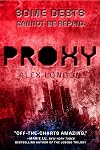
I think my favorite part about this story is that one of the main characters is gay, and it's not "the issue." The cover also may perhaps be a bit of white-washing, as Syd is black. show more I really enjoyed this book a lot, and am interested in reading its sequel (part one of a duet.) show less
I think my favorite part about this story is that one of the main characters is gay, and it's not "the issue." The cover also may perhaps be a bit of white-washing, as Syd is black. show more I really enjoyed this book a lot, and am interested in reading its sequel (part one of a duet.) show less
Proxy, by Alex London, is set in a futuristic dystopian Denver hundreds of years in the future. The society is the only civilization on the continent and runs on the “proxy” system where the rich own the poor’s debt and the poor take the rich’s punishments. Syd is a poor citizen living a boring and terrible life because his “patron”, Knox (a rich person), is basically a criminal. One day Knox accidentally goes too far when he kills a girl and can’t face the consequences. This event threatens to ruin both of their lives and forces Syd and Knox to see the truth behind their society.
I loved how London isn’t afraid to include a homosexual main character. It helps make the story more interesting and also gives insight on how show more someone’s sexuality doesn’t change who they are. The best part of the book by far was how the author presents and describes the city throughout the story. The description is so intricate and seamless that I could basically see London’s futuristic world before me. Proxy gave me a whole new view on how society works and showed me that everything really does come with a price.
For fans of Legend, and other dystopian thrillers, Proxy is the book to get!
Ryan W., SC Teen Book Crew show less
I loved how London isn’t afraid to include a homosexual main character. It helps make the story more interesting and also gives insight on how show more someone’s sexuality doesn’t change who they are. The best part of the book by far was how the author presents and describes the city throughout the story. The description is so intricate and seamless that I could basically see London’s futuristic world before me. Proxy gave me a whole new view on how society works and showed me that everything really does come with a price.
For fans of Legend, and other dystopian thrillers, Proxy is the book to get!
Ryan W., SC Teen Book Crew show less
Sydney Carton has spent his entire life in debt; his literary name an indicator of his status as an orphan. In order to pay for his education and the mandatory technology that pervades everyday life, Sydney’s life has been sold as a “proxy” to take the punishments of his wealthy patron. Knoz Brindle, on the other hand, lives a life of privilege and wealth as the son of the city’s largest security company. However, when Knox causes a car accident that kills his passenger, it is his proxy, Syd, who is to be sent to a work camp. Only two years from freedom and facing a 16-year sentence, Syd flees-and finds his patron may be his only ticket to freedom.
Proxy is a refreshing read amidst current glut of YA dystopias. The story raises show more some genuine questions about both societal and personal debt without being too heavy handed. There’s some obvious take-thats at libertarianism, including some not-so subtle criticism of Ayn Randian objectivism too. In some ways the market-driven society is reminiscent of that in Atwood’s MaddAddam novels, but the focus here is much more on the relationship between the two boy.
The story moves like a thriller, packed with action scenes that keep the story moving without getting too ridiculous. There’s some “chosen-one” stuff with Syd and his origins, but luckily it’s also not too obnoxious. It’s also nice that Syd is non-white and identifies as gay; they’re part of his character without being his only traits.
Like pretty much all YA, this is made to be a series, so the ending is a bit abrupt, but there is some closure to the story. There are some awkward perspective shifts as between Syd and Knox, but this was a solid read with a lot to make it stand out.
A review copy was provided through the goodreads.com first reads program. show less
Proxy is a refreshing read amidst current glut of YA dystopias. The story raises show more some genuine questions about both societal and personal debt without being too heavy handed. There’s some obvious take-thats at libertarianism, including some not-so subtle criticism of Ayn Randian objectivism too. In some ways the market-driven society is reminiscent of that in Atwood’s MaddAddam novels, but the focus here is much more on the relationship between the two boy.
The story moves like a thriller, packed with action scenes that keep the story moving without getting too ridiculous. There’s some “chosen-one” stuff with Syd and his origins, but luckily it’s also not too obnoxious. It’s also nice that Syd is non-white and identifies as gay; they’re part of his character without being his only traits.
Like pretty much all YA, this is made to be a series, so the ending is a bit abrupt, but there is some closure to the story. There are some awkward perspective shifts as between Syd and Knox, but this was a solid read with a lot to make it stand out.
A review copy was provided through the goodreads.com first reads program. show less
Syd is the punishment proxy for a rich boy, Knox. When Knox breaks a family heirloom, Syd gets tased. When Knox skips class, Syd gets beaten. And when Knox kills a classmate in a car accident, Syd has to serve his life sentence.
But this is one step too far for Syd, who has always played by the rules in hopes of ending his debt slavery early. He breaks out of prison, takes Knox as a hostage, and forces him on the run with him. The boys are hunted by Knox's father, bounty hunters, the Guardians, and the crazy rebel group that thinks Syd's blood has the power to destroy all DNA-linked debt.
Deals with tough issues but is a little light weight...but that's probably appropriate for a younger audience than me.
But this is one step too far for Syd, who has always played by the rules in hopes of ending his debt slavery early. He breaks out of prison, takes Knox as a hostage, and forces him on the run with him. The boys are hunted by Knox's father, bounty hunters, the Guardians, and the crazy rebel group that thinks Syd's blood has the power to destroy all DNA-linked debt.
Deals with tough issues but is a little light weight...but that's probably appropriate for a younger audience than me.
Members
- Recently Added By
Lists

Best Young Adult
399 works; 101 members

LGBTQ+ Speculative Fiction
821 works; 51 members

School library books removed after TX state legislator inquiry
429 works; 6 members

QLAP
14 works; 1 member

el
1,139 works; 1 member
Author Information
18+ Works 1,948 Members
Awards and Honors
Awards
Distinctions
Series

Common Knowledge
- Original publication date
- 2013-06-18
- Dedication
- For Tim, who inspired, Robert, who believed, and Jill, who elevated
- First words
- Even a perfect machine wasn't built to go this fast.
- Canonical DDC/MDS
- 813.6
- Canonical LCC
- PZ7.L84188
Classifications
- Genres
- Fiction and Literature, Teen, Science Fiction, Young Adult
- DDC/MDS
- 813.6 — Literature & rhetoric American literature in English American fiction in English 2000-
- LCC
- PZ7 .L84188 — Language and Literature Fiction and juvenile belles lettres Fiction and juvenile belles lettres Juvenile belles lettres
- BISAC
Statistics
- Members
- 740
- Popularity
- 37,969
- Reviews
- 38
- Rating
- (3.74)
- Languages
- English
- Media
- Paper, Audiobook, Ebook
- ISBNs
- 8
- ASINs
- 4