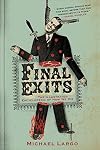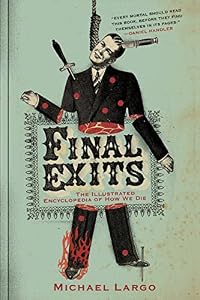
Final Exits: The Illustrated Encyclopedia of How We Die
by Michael Largo
On This Page
Description
We all die, but how will it happen? Although we all live longer today, people are killed by some strange things, including bingo, bad words, flying cows, eating hair, frozen toilets, laughing and toupees. According to death certificates, there are over 3000 ways to die. In this eye-opening and addictive book, the ways we die are arranged in alphabetical order. Thoroughly researched, with uncanny historical detail, Final Exits is much more than just a trivia book: it is a portrait in words show more and numbers of human fate. show lessTags
Recommendations












Member Recommendations
Member Reviews
As the aftermath of the catastrophic earthquake in Haiti continues unfolding and the horrific, gut-wrenching reality of Death grimly stares everybody down, collectively, body after ruined body, from the detached safety of my/our computer monitors and TV sets, how can I not imagine (especially considering I live too close to The San Andreas Fault that's long overdue to destroy us Southern Californians in "The Big One"), that those poor Haitians, buried and crushed by the rubble of not just an earthquake, but by chronic poverty and an archaically constructed infrastructure both physical and political, could just as easily have been me? Or my loved ones? Someday that may be us bloodied or obliterated on the TV screen should an 8.0 strike show more anywhere on The San Andreas Fault between Wrightwood and Palm Springs, California, thus making the movie 2012 a veritable reality.
I'd just finished reading most of Final Exits: The Illustrated Encyclopedia of How We Die, when the Haiti earthquake struck. I'd planned on writing what I'd hoped would amount to a really funny review, good for some good lowbrow giggles, poking fun at and mocking those chronicled in the morbid book who've died in some of the most unbelievably ridiculous and absurd scenarios ever. Like death by Vending Machine. Or death by Video Game. Death by Vegetarians and Vigilantes too. No joke. I'm flipping through the "V" section of the book, right now, obviously, as this encyclopedia is arranged alphabetically after all, as most encyclopedias are, beginning with, Death-by-Words-that-Start-with-"A," and ending, you guessed it, with, Death-by-Words-that-Start-with-"Z". Death by A-B-C-D-E-F-G.... The lone "Z" entry is "Zoofatalism". Zoofatalism is "a psychological disorder in which the afflicted get dangerously close to zoo animals or keep wild animals as pets against better judgment." Normally, at this point in the "review," I would mercilessly mock such Zoofatalists, but out of respect for my brothers and sisters in humanity mercilessly suffering and dying by the day in Haiti, I will refrain.
Final Exits also comes illustrated with drawings and photos of either outright-death, or of seemingly non-fatal activities that can nevertheless lead to death. Like Cheerleading. It's "Rah-rah," one second apparently; and the next second...ooops...you're dead, and no pom-pom can save you now! Damn, I indeed was trying really hard not to mock or poke fun at anybody, even cheerleaders. But I was a geek in high school, and cheerleaders ignored, if not outright rejected me. Stuck up pom-pom wenches. So, I guess they deserve to be mocked, cheerleaders, now that I consider it, no matter what natural disasters and untold deaths have just occurred in the world.
Most of the drawings and photographs in Final Exits are benign and tastefully crafted, like the doesn't-really-show-anything drawing (darn!) of the man being "Autocastrated" with a sword in the "A" section of the book. Equally as tasteful is the cute photograph of the huge-toothed hippopotamus Yawning in the "Y" section of the book. Death by hippopotamus Yawning? Read it to believe it:
"According to a story reported in the Melbourne Herald Sun in July 1999, one man died when a hippo yawned. A circus clown, a dwarf named Od...jumped off a trampoline just as a hippo, waiting to perform in the next act, yawned. The man landed square in the animal's mouth, which opened to a span of four feet. The hippo's involuntary gag reflex caused Od to be instantaneously swallowed whole. The one thousand-plus spectators who witnessed it continued to applaud wildly until common sense dictated that there had been a tragic mistake. Attempts to force the hippo to regurgitate the body were not successful."
Funny, right? Wrong!
Any other week it might've been funny and I'd of had a blast writing this "review," sharing such wacky, weird, and even erotic ways in which people die. Sometimes people die in wacky, weird, and erotic ways simultaneously, come to find out. But I just can't, right now, in good conscience, crack jokes about women who've died during cunnilingus, or died from "drowning in molasses;" I just can't, because, even though I know I stated at the outset I wouldn't try to be funny in this "review," and I've obviously failed in a very limited (arguably) perhaps unfunny-funny extent in that non-humor endeavor, because now is not an appropriate time for humor, right?, with so much inconceivable quantities of death - literally truckloads of death bound for mass graves - confronting us day after tragic day! I feel awkward "reviewing" a book like this at a time like this when so many are suffering beyond what the word "suffering" can even come close to adequately describe. How does one adequately describe complete decimation and despair without sounding glib or trivializing it in the process?
Know that whatever humor has been present here in this "review" isn't meant to make light of real pain and real grief and sorrow and all the other adjectives I could summon to my rescue (in case I have in fact, stepped in it); but that the humor is just a mask, a ruse, a psychological coping device, a weakness, a defense against the indiscriminate pain and horror hurled at this World from God-knows-where, that I can't understand or control or make go away; a distraction, if you will, the humor, to prevent me from really pondering how godawfully unhumorous it is, the Hell that is happening in Haiti, and the Hells abundant elsewhere on this sorrowful globe, that are conveniently, in rectilinear, sanitized and safe fashion, transmitted to us everyday on a screen for our ocular consumption. show less
I'd just finished reading most of Final Exits: The Illustrated Encyclopedia of How We Die, when the Haiti earthquake struck. I'd planned on writing what I'd hoped would amount to a really funny review, good for some good lowbrow giggles, poking fun at and mocking those chronicled in the morbid book who've died in some of the most unbelievably ridiculous and absurd scenarios ever. Like death by Vending Machine. Or death by Video Game. Death by Vegetarians and Vigilantes too. No joke. I'm flipping through the "V" section of the book, right now, obviously, as this encyclopedia is arranged alphabetically after all, as most encyclopedias are, beginning with, Death-by-Words-that-Start-with-"A," and ending, you guessed it, with, Death-by-Words-that-Start-with-"Z". Death by A-B-C-D-E-F-G.... The lone "Z" entry is "Zoofatalism". Zoofatalism is "a psychological disorder in which the afflicted get dangerously close to zoo animals or keep wild animals as pets against better judgment." Normally, at this point in the "review," I would mercilessly mock such Zoofatalists, but out of respect for my brothers and sisters in humanity mercilessly suffering and dying by the day in Haiti, I will refrain.
Final Exits also comes illustrated with drawings and photos of either outright-death, or of seemingly non-fatal activities that can nevertheless lead to death. Like Cheerleading. It's "Rah-rah," one second apparently; and the next second...ooops...you're dead, and no pom-pom can save you now! Damn, I indeed was trying really hard not to mock or poke fun at anybody, even cheerleaders. But I was a geek in high school, and cheerleaders ignored, if not outright rejected me. Stuck up pom-pom wenches. So, I guess they deserve to be mocked, cheerleaders, now that I consider it, no matter what natural disasters and untold deaths have just occurred in the world.
Most of the drawings and photographs in Final Exits are benign and tastefully crafted, like the doesn't-really-show-anything drawing (darn!) of the man being "Autocastrated" with a sword in the "A" section of the book. Equally as tasteful is the cute photograph of the huge-toothed hippopotamus Yawning in the "Y" section of the book. Death by hippopotamus Yawning? Read it to believe it:
"According to a story reported in the Melbourne Herald Sun in July 1999, one man died when a hippo yawned. A circus clown, a dwarf named Od...jumped off a trampoline just as a hippo, waiting to perform in the next act, yawned. The man landed square in the animal's mouth, which opened to a span of four feet. The hippo's involuntary gag reflex caused Od to be instantaneously swallowed whole. The one thousand-plus spectators who witnessed it continued to applaud wildly until common sense dictated that there had been a tragic mistake. Attempts to force the hippo to regurgitate the body were not successful."
Funny, right? Wrong!
Any other week it might've been funny and I'd of had a blast writing this "review," sharing such wacky, weird, and even erotic ways in which people die. Sometimes people die in wacky, weird, and erotic ways simultaneously, come to find out. But I just can't, right now, in good conscience, crack jokes about women who've died during cunnilingus, or died from "drowning in molasses;" I just can't, because, even though I know I stated at the outset I wouldn't try to be funny in this "review," and I've obviously failed in a very limited (arguably) perhaps unfunny-funny extent in that non-humor endeavor, because now is not an appropriate time for humor, right?, with so much inconceivable quantities of death - literally truckloads of death bound for mass graves - confronting us day after tragic day! I feel awkward "reviewing" a book like this at a time like this when so many are suffering beyond what the word "suffering" can even come close to adequately describe. How does one adequately describe complete decimation and despair without sounding glib or trivializing it in the process?
Know that whatever humor has been present here in this "review" isn't meant to make light of real pain and real grief and sorrow and all the other adjectives I could summon to my rescue (in case I have in fact, stepped in it); but that the humor is just a mask, a ruse, a psychological coping device, a weakness, a defense against the indiscriminate pain and horror hurled at this World from God-knows-where, that I can't understand or control or make go away; a distraction, if you will, the humor, to prevent me from really pondering how godawfully unhumorous it is, the Hell that is happening in Haiti, and the Hells abundant elsewhere on this sorrowful globe, that are conveniently, in rectilinear, sanitized and safe fashion, transmitted to us everyday on a screen for our ocular consumption. show less
I love the type of books that list all sorts of weird shit, so "Final Exits" is almost the perfect book for me. Turning to a random page, we see death by custard pie to the face, death by street sweeper and death by cockroach. and of course the infamous Enumclaw horse case gets a run.
Some of the stories you may wish to take with a grain of salt (although I'm sure you'll find a gruesome salt-related story in here) but overall an enjoyable if unsettling read.
Some of the stories you may wish to take with a grain of salt (although I'm sure you'll find a gruesome salt-related story in here) but overall an enjoyable if unsettling read.
I really thought that I would like this book more than I did. I'm a morbid sort of person, and having a huge book (it's over 400 pages) full of different ways to die seemed, well, intriguing. And it really is.
But.
The research going into this book had to be immense, and therefore I tried to be kind about the numerous inaccuracies and spelling errors. Eventually, however, they just annoyed me to no end. Here are just a few:
(p. 405) "[Albert Einstein] died in 1955...when an aorta in his stomach exploded."
What. Yes, Albert Einstein died of an aortic aneurysm, but this is just so wrongly worded. By saying "an aorta," the author is implying that there is more than one. There is not. There is one aorta, which has different sections (thoracic show more and abdominal), but there is just ONE aorta. And it's not in your stomach, although it does give branches that feed the stomach - it's in the abdomen. Yes, I know a lot of non-medical people call their entire abdomen their stomach, but come on, I'm expecting more here. And it did not "explode," which is just ridiculous hyperbole. It ruptured.
(p. 338) "William Henry Harrison was reelected president in 1840."
No sir, he was not. William Henry Harrison was elected president for the first (and only, as he was about to die) time in 1840. The author also states that William Henry Harrison was sixty-nine when "reelected" [sic]. He was actually sixty-eight. Granted, only a year off, but still...how many errors exactly were in this book?
(p. 301) "Alfred Packer killed five prospectors with a pick ax...[and] was released on a technicality [and] died in 1899 from ulcers."
There is so much wrong with this statement! First off, Alfred Packer died in 1907, not 1899 (he was still in prison in 1899). And he didn't die from ulcers - his official cause of death was listed as "senility - trouble and worry," although most believe that he either died of a stroke or an epileptic seizure (he was a life-long epileptic). And he was not released on a technicality; he was paroled by the outgoing Colorado governor in 1901. He did escape the death penalty under a technicality, but he still served a prison sentence. And he didn't kill with a pick ax, but a skinning knife (and possibly a bullet).
If there is so much wrong with just THREE items (there were more that I caught), I can't imagine how many inaccuracies are in this book, and therefore I looked at it with a very critical eye. show less
But.
The research going into this book had to be immense, and therefore I tried to be kind about the numerous inaccuracies and spelling errors. Eventually, however, they just annoyed me to no end. Here are just a few:
(p. 405) "[Albert Einstein] died in 1955...when an aorta in his stomach exploded."
What. Yes, Albert Einstein died of an aortic aneurysm, but this is just so wrongly worded. By saying "an aorta," the author is implying that there is more than one. There is not. There is one aorta, which has different sections (thoracic show more and abdominal), but there is just ONE aorta. And it's not in your stomach, although it does give branches that feed the stomach - it's in the abdomen. Yes, I know a lot of non-medical people call their entire abdomen their stomach, but come on, I'm expecting more here. And it did not "explode," which is just ridiculous hyperbole. It ruptured.
(p. 338) "William Henry Harrison was reelected president in 1840."
No sir, he was not. William Henry Harrison was elected president for the first (and only, as he was about to die) time in 1840. The author also states that William Henry Harrison was sixty-nine when "reelected" [sic]. He was actually sixty-eight. Granted, only a year off, but still...how many errors exactly were in this book?
(p. 301) "Alfred Packer killed five prospectors with a pick ax...[and] was released on a technicality [and] died in 1899 from ulcers."
There is so much wrong with this statement! First off, Alfred Packer died in 1907, not 1899 (he was still in prison in 1899). And he didn't die from ulcers - his official cause of death was listed as "senility - trouble and worry," although most believe that he either died of a stroke or an epileptic seizure (he was a life-long epileptic). And he was not released on a technicality; he was paroled by the outgoing Colorado governor in 1901. He did escape the death penalty under a technicality, but he still served a prison sentence. And he didn't kill with a pick ax, but a skinning knife (and possibly a bullet).
If there is so much wrong with just THREE items (there were more that I caught), I can't imagine how many inaccuracies are in this book, and therefore I looked at it with a very critical eye. show less
I apparently have some fairly morbid interests. Thinking about all the fascinating material that I've read (both fiction and nonfiction) about death, dying, human survival, suicide, near-death experience, afterlife traditions, etc., one might think I'm a bit obsessed. I blame my mother. (Not really, but she does share the interest and has since she was a young girl.)
That being said, Final Exits finds a welcome place in my collection as a well researched and documented work complete with illustrations. Although I didn't find the book as humorous as the author purported it to be, the fun and irreverence doesn't stop at the fantastic cover design. Michael Largo has done a tremendous amount of research into what exactly is found on death show more certificate and presents his findings in a very accessible way.
Well, mostly. Perusing and browsing the book works much better than trying to find specific information within it. National park deaths? Look under "Deep Fried." Spiders? Under "P" for "Poisonous Spiders." But poisonous snakes? Make sure to turn to the entry for "Snake Handlers." Unfortunately, there is no index; serendipity often plays a major role in finding particular facts. But what information is found is fascinating, if at times understandably frightening. And every entry is documented and cited.
According to Largo, "in 1700 there were less than one hundred causes of death described on death certificates, while today there are over three thousand." He certainly doesn't cover all three thousand causes of death, choosing instead to focus on some of the more unusual ways, people, and accompanying stories. In addition to the "encyclopedic" A-Z entries, he has included his sources, bibliography, and a "Postmortem" section exploring some of the interesting differences between death in the 1700s and death today.
I'm not sure that I've gained "two extra years of life" promised by reading this book, but I have learned quite a few fun facts to spout at opportune, and inopportune times. Actually, I might just lose a few years because of it; I had one friend make me promise not to relate anything from the book in his presence or potentially forfeit my physical well-being. My mom, however, loved it.
Experiments in Reading show less
That being said, Final Exits finds a welcome place in my collection as a well researched and documented work complete with illustrations. Although I didn't find the book as humorous as the author purported it to be, the fun and irreverence doesn't stop at the fantastic cover design. Michael Largo has done a tremendous amount of research into what exactly is found on death show more certificate and presents his findings in a very accessible way.
Well, mostly. Perusing and browsing the book works much better than trying to find specific information within it. National park deaths? Look under "Deep Fried." Spiders? Under "P" for "Poisonous Spiders." But poisonous snakes? Make sure to turn to the entry for "Snake Handlers." Unfortunately, there is no index; serendipity often plays a major role in finding particular facts. But what information is found is fascinating, if at times understandably frightening. And every entry is documented and cited.
According to Largo, "in 1700 there were less than one hundred causes of death described on death certificates, while today there are over three thousand." He certainly doesn't cover all three thousand causes of death, choosing instead to focus on some of the more unusual ways, people, and accompanying stories. In addition to the "encyclopedic" A-Z entries, he has included his sources, bibliography, and a "Postmortem" section exploring some of the interesting differences between death in the 1700s and death today.
I'm not sure that I've gained "two extra years of life" promised by reading this book, but I have learned quite a few fun facts to spout at opportune, and inopportune times. Actually, I might just lose a few years because of it; I had one friend make me promise not to relate anything from the book in his presence or potentially forfeit my physical well-being. My mom, however, loved it.
Experiments in Reading show less
An intriguing book full of interesting statistics and factoids that will make you really, really disturbing at dinner parties, should you choose to share. Its "entry" format lends itself to reading in small bits and pieces, which may be a good thing so as not to over do it. Here's a word to the wise: your mother will really get upset if you play the "pick a page at random - that's how you'll die" game. For the record, somewhere out there is a serial killer's knife with my name on it.
This book is very well written and organized, with interesting facts and pictures. Can be read strait through or just used as a bathroom reader. I'd recommend it to anyone interested in the macabre!
This was a compulsively readable book of death trivia, well-illustrated, with numerous interesting tales of people who died in unusual ways. I noticed several inaccuracies, however, and some sentences that were so grammatically flawed they made me wince.
Members
- Recently Added By
Lists

Bram Stoker Award
238 works; 5 members
Author Information

10+ Works 1,125 Members
Some Editions
Awards and Honors
Awards
Common Knowledge
- Original publication date
- 2006
- People/Characters
- Albert Einstein; Glynn Wolfe; David Koresh; Richard Cornish
- Important places
- San Francisco, California, USA
- Important events
- San Francisco Earthquake and Fire (1906)
- Dedication
- Inspirational in life and death, in loving memory Dominick, Victoria, and Tom Largo
- First words
- To die, kick the bucket, cross over to the other side, to meet the Maker, to be dead as a doornail, to get wasted, whacked, smoked, to sleep with the fishes, bite the dust, put on the wooden overcoat, or sleep with Jesus; wha... (show all)tever death is called, it's going to happen.
- Last words
- (Click to show. Warning: May contain spoilers.)Here lies Ned.
There is nothing more to be said -
Classifications
- Genres
- Nonfiction, Reference, General Nonfiction, History
- DDC/MDS
- 306.903 — Society, Government, and Culture Social sciences, sociology & anthropology Social Behavior - Dating, Marriage, Divorce Institutions pertaining to death
- LCC
- HQ1073 .L37 — Social sciences The family. Marriage, Women and Sexuality The Family. Marriage. Women Thanatology. Death. Dying
Statistics
- Members
- 479
- Popularity
- 63,130
- Reviews
- 11
- Rating
- (4.02)
- Languages
- Chinese, English, Italian
- Media
- Paper
- ISBNs
- 4
- ASINs
- 1