On This Page
Description
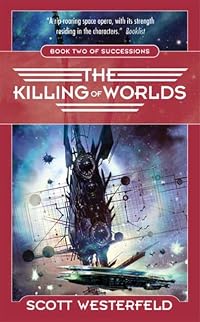
Scott Westerfeld, the acclaimed author of "Fine Prey, Polymorph, "and "Evolution's Darling," reached new heights of excitement in last spring's T"he Risen Empire," and left readers begging for more. Now he comes through with the dazzling payoff in book two of S"uccession, The Killing of Worlds." Captain Laurent Zai of the Imperial frigate Lynx is a walking dead man. Unjustly held responsible for the death of the Child Empress, sister of the immortal Emperor, Zai has been sent to fight an show more unwinnable battle. The Lynx must stop a vastly superior Rix ship from reaching the planet Legis, a suicide mission that will almost certainly end in oblivion for Captain Zai and his crew. On the planet Legis below, a Rix compound mind--a massive emergent AI formed from every computer on the planet--as been isolated by their Imperial blockade. But the mind has guided a lone Rix commando, Herd, to the planet's frozen north, and will soon order a desperate attempt to seize a polar communications array and break the blockade. Herd is a single warrior against an Imperial army, but moving silently behind her is the intelligence of an entire planet. Ten light-years away, Captain Zai's true love, the psychic (some say mad) Senator Nara Oxham is engaged in a deadly game of political intrigue. From her position on the Emperor's War Council, Senator Oxham must find a way to forestall the Emperor's final solution if the blockade is broken: a nuclear strike to destroy the compound mind, which will also kill millions of Imperial citizens. She suspects that the Emperor has a hidden weakness discovered, by the mind, a secret so dangerous to his immortal dynasty that to prevent its discovery the Emperor is willing to countenance the ultimate crime. . . . The killing of worlds. With this powerful conclusion to the first story arc of "Succession," Scott Westerfeld confirms his stature as one of the leading writers of high space opera. show lessTags
Recommendations


Member Reviews
I loved this page-turner of a sci-fi novel, which balanced military sci-fi with space opera. The fulcrum of the book, a romance between two people with very different characters, also really worked for me. I would have given it an even higher rating -- the highest -- if it had handled more adroitly the balancing of the two halves. So it's not a literary masterpiece. But there's no doubt about it, if you have tastes like mine, you'll think this one is a banger.
After reading the first book in this series, I wasn't sure about reading the second one, but I trusted Westerfeld and I have to say - I'm so glad that I read it!
I had gotten used to the style of writing in the first one, as this book follows the same model as the first one. I sank into the rapid perspective and times changes immediately. The action of the battle in deep space was rapid and I was constantly surprised by the twists and turns that the plot took. I would say that The Killing of Worlds was actually BETTER than the first one! I also love how Nara's character was so deeply involved in the politics back Home and that we finally got to see how her position in Senate worked AND hear the Emperor's secret! I think this book just show more simply embellished and deepened the world that I had been so intrigued by in the first novel, that I couldn't help but enjoy the ride!
My one disappointment was the ending - While Nara and Laurent's stories have certainly accomplished a great deal (and drastically surprised me) I wanted to see more of what would happen to the Empire after the truth had been revealed. That being said, I totally understand why Westerfeld didn't go into this - Nara says herself that the Empire is going to have drastic changes in the future. I only wish there was another book to read.
Although I was unsure on the first in this series, I am sold on this sequel! I would really recommend this book to any sci fi or fantasy lover! show less
I had gotten used to the style of writing in the first one, as this book follows the same model as the first one. I sank into the rapid perspective and times changes immediately. The action of the battle in deep space was rapid and I was constantly surprised by the twists and turns that the plot took. I would say that The Killing of Worlds was actually BETTER than the first one! I also love how Nara's character was so deeply involved in the politics back Home and that we finally got to see how her position in Senate worked AND hear the Emperor's secret! I think this book just show more simply embellished and deepened the world that I had been so intrigued by in the first novel, that I couldn't help but enjoy the ride!
My one disappointment was the ending - While Nara and Laurent's stories have certainly accomplished a great deal (and drastically surprised me) I wanted to see more of what would happen to the Empire after the truth had been revealed. That being said, I totally understand why Westerfeld didn't go into this - Nara says herself that the Empire is going to have drastic changes in the future. I only wish there was another book to read.
Although I was unsure on the first in this series, I am sold on this sequel! I would really recommend this book to any sci fi or fantasy lover! show less
Read my review of book 1, The Risen Empire
Summary: Following the Rix attack on on the homeworld of the Emperor's sister, a new threat has emerged. Alexander, the planet-sized compound mind seeded by the Rix, is in possession of the Emperor's greatest secret, and a Rix battleship with a communications array is moving to receive a message from the planet. Laurent Zai and the crew of the Imperial frigate Lynx must stop that transmission at any cost. For if they should fail, the Emperor is prepared to nuke the entire planet... because what are hundreds of millions of lives to protect the secret that holds the Empire together...
Review: I was about ready to give this series up after 50 pages of the first book, but I'm glad I stuck it out. I show more don't know whether Westerfeld front-loaded the technobabble world-building into The Risen Empire, and left most of it out of this one, or if I just got better at skimming over the tech-heavy parts (or probably some of both), but I enjoyed this book quite a bit more than the previous one. The entire first half of the book is consumed by the battle between the Lynx and the Rix battleship, and it kept me entirely involved - not only understanding the maneuverings and their outcomes, but caring how each step of the process turned out. The rest of the book was similarly interesting, ultimately building to an satisfying conclusion. Part of me wished that Westerfeld had taken some more time to explore the ramifications of the conclusion, to untangle more of the philosophical implications, and to show us what happened afterwards... but part of me also recognizes the power inherent in the subtle and understated way he chose to end things. 4 out of 5 stars.
Recommendation: I wasn't mistaken when I could sense a good, interesting story underneath the techno jargon of The Risen Empire; Westerfeld really allowed it to come to the fore in the second volume, which meant I enjoyed it more. Still, I think the series is probably best for those who like extremely tech-y "hard" sci-fi, and may be worth a gamble for "softer" sci-fi fans who are willing to branch out of their comfort zone... or at least willing to skim in parts. show less
Summary: Following the Rix attack on on the homeworld of the Emperor's sister, a new threat has emerged. Alexander, the planet-sized compound mind seeded by the Rix, is in possession of the Emperor's greatest secret, and a Rix battleship with a communications array is moving to receive a message from the planet. Laurent Zai and the crew of the Imperial frigate Lynx must stop that transmission at any cost. For if they should fail, the Emperor is prepared to nuke the entire planet... because what are hundreds of millions of lives to protect the secret that holds the Empire together...
Review: I was about ready to give this series up after 50 pages of the first book, but I'm glad I stuck it out. I show more don't know whether Westerfeld front-loaded the technobabble world-building into The Risen Empire, and left most of it out of this one, or if I just got better at skimming over the tech-heavy parts (or probably some of both), but I enjoyed this book quite a bit more than the previous one. The entire first half of the book is consumed by the battle between the Lynx and the Rix battleship, and it kept me entirely involved - not only understanding the maneuverings and their outcomes, but caring how each step of the process turned out. The rest of the book was similarly interesting, ultimately building to an satisfying conclusion. Part of me wished that Westerfeld had taken some more time to explore the ramifications of the conclusion, to untangle more of the philosophical implications, and to show us what happened afterwards... but part of me also recognizes the power inherent in the subtle and understated way he chose to end things. 4 out of 5 stars.
Recommendation: I wasn't mistaken when I could sense a good, interesting story underneath the techno jargon of The Risen Empire; Westerfeld really allowed it to come to the fore in the second volume, which meant I enjoyed it more. Still, I think the series is probably best for those who like extremely tech-y "hard" sci-fi, and may be worth a gamble for "softer" sci-fi fans who are willing to branch out of their comfort zone... or at least willing to skim in parts. show less
As the sequel to [b:The Risen Empire|267022|The Risen Empire (Succession, Book 1)|Scott Westerfeld|http://ecx.images-amazon.com/images/I/51Z6WN21H4L._SL75_.jpg|1641114], this book deals with the aftermath of the battles in the first, although there is one skirmish in space that stands out. In The Killing of Worlds, the emphasis is a little more on the political and personal side, which I loved. The last few scenes are particularly wonderful. Westerfeld reads a bit like Nancy Kress; he's really good at combining innovative yet realistic science with multi-faceted, interesting characters and believable societies. I was particularly impressed with the multitude of perspectives he brought to the story without ever losing his focus.
They did this book a disservice by splitting it into two volumes. Dry, often in love with its own ambition, of disjointed, but it weaves an amazing tale all the same. Could have used a stronger editor, though.
It took me a while to become engaged with the story. It is essentially a continuation of the first book in the series and, therefore, lacks the world creation that I enjoy so much. It jumps right into the action and pretty much stays there until the final third of the book. Death is real and a kiss could change the world. Fine, romantic space opera.
This book was a lot more engaging than the first (The Risen Empire). Normally I'm not a huge fan of battle scenes, but the one that opens Killing of World's is very engaging. Westerfeld uses just the right combination of action, suspense, tactics, and science. The emperor's secret (which is revealed in this book) was a little anticlimactic, but very clever.
Members
- Recently Added By
Lists

Best Science Fiction Novels
816 works; 430 members
Author Information

64+ Works 76,289 Members
Scott Westerfeld was born in Dallas, Texas on May 5, 1963. He received a degree in philosophy from Vassar College in 1985. Before becoming a full time writer, he held several jobs including factory worker, software designer, editor, and substitute teacher. His works for young adults include the Uglies series, the Midnighters series, and The Last show more Days. He is the co-author of the Zeroes series written with Margo Lanagan and Deborah Biancotti. He also writes science fiction novels for adults. He has won numerous awards including a Special Citation for the 2000 Philip K. Dick Award for Evolution's Darling, a Victorian Premier's Award for So Yesterday, and an Aurealis Award for The Secret Hour. (Bowker Author Biography) show less
Awards and Honors
Notable Lists
Series

Work Relationships
Is contained in
Common Knowledge
- Canonical title
- The Killing of Worlds
- Original publication date
- 2003-10
- Dedication
- To Justine, with whom I have a genuine and continuing relationship
- First words
- The contrail of a supersonic aircraft blossomed weakly in the thin, dry air, barely marking the sky.
- Last words
- (Click to show. Warning: May contain spoilers.)A kiss could change the world.
Classifications
Statistics
- Members
- 498
- Popularity
- 60,255
- Reviews
- 16
- Rating
- (3.90)
- Languages
- English, French, Spanish
- Media
- Paper, Ebook
- ISBNs
- 7
- ASINs
- 2