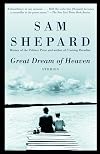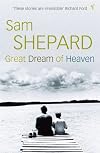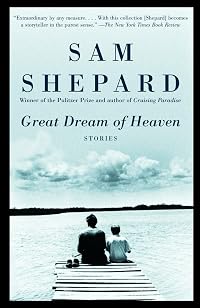
Great Dream of Heaven: Stories
by Sam Shepard
On This Page
Description
Fiction. Literature. Short Stories. HTML:In eighteen stories unlike any in our contemporary literature, Sam Shepard explores the vast and rugged American West with the same parched intensity that has made him â??the great playwright of his generationâ? (The New York Times).A boy watches a â??remedy manâ? tame a wild stallion, a contest that mirrors his own struggle with his father. A woman driving her motherâ??s ashes across the country has a strangely transcendent run-in with an show more injured hawk. Two aging widowers, in Stetsons and bolo ties, together make a daily pilgrimage to the local Dennyâ??s, only to be divided by the attentions of their favorite waitress. Peering unblinkingly into the chasms that separate fathers and sons, husbands and wives, friends and strangers, these powerful tales bear the unmistakable signature of a show less
Tags
Recommendations





Member Reviews
The best of these stories painted a picture of the SW through the eyes of Sam Shepherd. The stories were spare and tight and at their best left me with thinking that these were slices of his life. Sometimes almost an essay.
Smooth writing for sure.
Smooth writing for sure.
"In eighteen stories unlike any in our contemporary literature, Sam Shepard explores the vast and rugged American West with the same parched intensity that has made him “the great playwright of his generation”
I have been a fan of the actor Sam Shepard for decades. He died in 2017, at the age of 73. I loved his work in Days of Heaven and The Right Stuff, among many other films. I knew he was also a playwright but I had never seen any of his plays. So, I was very excited to learn that he had also written short fiction and really wanted to give one of his story collections a try. It did not disappoint and really grew on me, as I read along. I LOVE literary surprises and this one ranks right up there.
I have been a fan of the actor Sam Shepard for decades. He died in 2017, at the age of 73. I loved his work in Days of Heaven and The Right Stuff, among many other films. I knew he was also a playwright but I had never seen any of his plays. So, I was very excited to learn that he had also written short fiction and really wanted to give one of his story collections a try. It did not disappoint and really grew on me, as I read along. I LOVE literary surprises and this one ranks right up there.
Some of these are little more than character or mood sketches rather than real short stories but when he hits the sweet spot ... geez, he could be teaching in Iowa and appearing in the Best American Short Stories every year instead of being known as the best playwright of his generation, actor, screenwriter and no doubt rodeo rider, great white hunter and cabinetmaker.
Take "An Unfair Question," the only previously published one. I suppose it ran in the New Yorker because, taking place in Minnesota and featuring a family that moved from Virginia, it bears a resemblance to the Shepard-Jessica Lange household, but it reminds me of Carver. It starts off so innocuously homey, with our narrator (always male narrators and protagonists, hmmm) show more off to the supermarket on a basil mission, and very quickly ends up in his basement with him showing a shotgun to a guest claiming to have originated in Montana and scaring the bejesus out of her. Now, I never thought for an instance that our Sam Shepard stand-in was blasting starlings in his bedroom but note how smoothly he swerved into the escalation of annoyance.
"Great Dream of Heaven": two old guys, friends from childhood, living in a cinderblock house in the desert but savoring things: "The two of them would stand side by side with their hats held in their hands, covering their knees, waiting sometimes 45 minutes for a booth, just to watch Faye swing her amazing hips, balancing trays of steaming turkey and BLTs and always with her heartbreaking smile sweeping across the multitudes: the fat, the ugly, the rude, the drunken, the insane--she made no distinction, they all received the same radiant beam of kindness from her eyes."
Other favorites: "It Wasn't Proust," even if it seems to be an aborted play, being mostly dialogue; "The Door to Women," "Living the Sign," "The Stout of Heart." show less
Take "An Unfair Question," the only previously published one. I suppose it ran in the New Yorker because, taking place in Minnesota and featuring a family that moved from Virginia, it bears a resemblance to the Shepard-Jessica Lange household, but it reminds me of Carver. It starts off so innocuously homey, with our narrator (always male narrators and protagonists, hmmm) show more off to the supermarket on a basil mission, and very quickly ends up in his basement with him showing a shotgun to a guest claiming to have originated in Montana and scaring the bejesus out of her. Now, I never thought for an instance that our Sam Shepard stand-in was blasting starlings in his bedroom but note how smoothly he swerved into the escalation of annoyance.
"Great Dream of Heaven": two old guys, friends from childhood, living in a cinderblock house in the desert but savoring things: "The two of them would stand side by side with their hats held in their hands, covering their knees, waiting sometimes 45 minutes for a booth, just to watch Faye swing her amazing hips, balancing trays of steaming turkey and BLTs and always with her heartbreaking smile sweeping across the multitudes: the fat, the ugly, the rude, the drunken, the insane--she made no distinction, they all received the same radiant beam of kindness from her eyes."
Other favorites: "It Wasn't Proust," even if it seems to be an aborted play, being mostly dialogue; "The Door to Women," "Living the Sign," "The Stout of Heart." show less
http://www.mytwostotinki.com/?p=1100
E.V. is the Remedy Man in the short story with this title that opens the collection Great Dream of Heaven. He is a kind of horse whisperer who is called by Mason, a farmer somewhere in the West of the U.S. when one of his particular wild horses cannot be tamed. E.V., a rather unassuming man, knows his trade and we readers witness how he is resolving the problem while chatting casually with Mason and inviting Mason’s son, who is also the narrator of the story to assist him. In the end we have learned a few things about horses and about life on an isolated farm in the West. So, what - you will maybe feel inclined to say.
But there is more to this story than just this. While usually the father, a show more well-meaning, but dominating figure is the one who sets the rules for the son (women are absent in this story), it is this one time E.V. who tells the son in a friendly, casual way what to do next in order to help him – while the father is a quite passive bystander, strangely skeptic about E.V.’s remedy man’s work that proves to be successful. For the son, this is a new experience: to see his father passive and another person being in charge. In the end, the narrator watches from a tree the evening and night sky:
“The whole ranch turned below me. I arched my head back and my mouth went open to the black sky. The giant splash of the Milky Way must have caused the high shrill squealing to burst out of me, just like someone had pulled a cord straight down my spine. My skin was laughing. I heard my dad come out on the screen porch and yell my name but I didn’t answer. I just hung there spinning in silence. I knew right then where I’d come from and how far I’d be going away.”
The heroes of these stories are frequently on the move, like the man who left his wife to live with his new love (in Coalinga ½ Way). He stops in some godforsaken place called Coalinga, halfway between the place he lived and the place he intends to live. It’s revealing that it is the perfect equidistance between the two important women in his life. When he calls his wife from there, she tries to convince him to come back, or at least meet somewhere to discuss what is wrong with their relationship in person. But even the fact that he is not only leaving his wife for good, but also his son who is still a little child, cannot make him change his mind.
“What about Spence? Are you going to tell him you’re not coming back?” – “Not right now.” – “When?” she says. – “I don’t know.” – “What am I supposed to tell him then?” – “Tell him I’ll call him.” – “When?” – “I’m not sure.” - Silence again. A high piercing shriek of a circling hawk. A Jeep roars past. A Jeep with no windows or doors, just the wind ripping across the wide-eyed face of the driver. – “Are you still there?”, he says to the phone. – “Where am I supposed to go?” she says. – “I don’t know.”
After he hangs up, he is calling his lover with whom he intends to live in the future. But this woman tells him not to come. It turns out she is moving to Indiana with her husband and considered the relationship with the narrator as a fling without much importance. The end mirrors the conversation he had just before with his wife, but with reversed roles:
“You’re flying out to Indiana to meet David?” – “Yes. I was just going out the door when the phone rang.” He hears the loud splash of the fat man hitting the pool outside. Then nothing. A distant siren. “Hello,” she says. “Are you still there?” – “Where am I supposed to go?” he says.
These two stories contain a lot of elements that are typical for this book. A man between two women, or a woman between two men. The physical distance, but also the rift between people in general, and the gulf that separates people from their true selves. The setting is usually in a small town, or somewhere on the road (like in Blinking Eye, where a young woman drives thousands of kilometers with the urn that contains the ashes of her mother). Men have problems with women and with themselves, frequently because they cannot find the right words to express their feelings or leave the important things unsaid. Paranoia is frequently just around the corner (The Company’s Interest), and when firearms come into the picture, things threaten to get out of control very fast (An Unfair Question).
There is also a dry humor in many stories (like in It Wasn’t Proust, or in The Door to Women). The dialogues (Betty’s Cats consists exclusively of dialogues) conceal the experienced playwright and film scenarist and seem to be written with an effortless ease. These are real people talking, and their loneliness is always present, just like in the paintings of Edward Hopper, of which they reminded me sometimes. Or as in the movie Paris, Texas by Wim Wenders. And that’s no coincidence, because Shepard wrote the script of that film. (He is also a remarkable actor – The Right Stuff, Fool for Love, Homo Faber, Don’t Come Knocking come to mind.)
I enjoyed these wonderful stories very much. My favorite piece is the title story Great Dream of Heaven. But they are all very good, without exception. show less
E.V. is the Remedy Man in the short story with this title that opens the collection Great Dream of Heaven. He is a kind of horse whisperer who is called by Mason, a farmer somewhere in the West of the U.S. when one of his particular wild horses cannot be tamed. E.V., a rather unassuming man, knows his trade and we readers witness how he is resolving the problem while chatting casually with Mason and inviting Mason’s son, who is also the narrator of the story to assist him. In the end we have learned a few things about horses and about life on an isolated farm in the West. So, what - you will maybe feel inclined to say.
But there is more to this story than just this. While usually the father, a show more well-meaning, but dominating figure is the one who sets the rules for the son (women are absent in this story), it is this one time E.V. who tells the son in a friendly, casual way what to do next in order to help him – while the father is a quite passive bystander, strangely skeptic about E.V.’s remedy man’s work that proves to be successful. For the son, this is a new experience: to see his father passive and another person being in charge. In the end, the narrator watches from a tree the evening and night sky:
“The whole ranch turned below me. I arched my head back and my mouth went open to the black sky. The giant splash of the Milky Way must have caused the high shrill squealing to burst out of me, just like someone had pulled a cord straight down my spine. My skin was laughing. I heard my dad come out on the screen porch and yell my name but I didn’t answer. I just hung there spinning in silence. I knew right then where I’d come from and how far I’d be going away.”
The heroes of these stories are frequently on the move, like the man who left his wife to live with his new love (in Coalinga ½ Way). He stops in some godforsaken place called Coalinga, halfway between the place he lived and the place he intends to live. It’s revealing that it is the perfect equidistance between the two important women in his life. When he calls his wife from there, she tries to convince him to come back, or at least meet somewhere to discuss what is wrong with their relationship in person. But even the fact that he is not only leaving his wife for good, but also his son who is still a little child, cannot make him change his mind.
“What about Spence? Are you going to tell him you’re not coming back?” – “Not right now.” – “When?” she says. – “I don’t know.” – “What am I supposed to tell him then?” – “Tell him I’ll call him.” – “When?” – “I’m not sure.” - Silence again. A high piercing shriek of a circling hawk. A Jeep roars past. A Jeep with no windows or doors, just the wind ripping across the wide-eyed face of the driver. – “Are you still there?”, he says to the phone. – “Where am I supposed to go?” she says. – “I don’t know.”
After he hangs up, he is calling his lover with whom he intends to live in the future. But this woman tells him not to come. It turns out she is moving to Indiana with her husband and considered the relationship with the narrator as a fling without much importance. The end mirrors the conversation he had just before with his wife, but with reversed roles:
“You’re flying out to Indiana to meet David?” – “Yes. I was just going out the door when the phone rang.” He hears the loud splash of the fat man hitting the pool outside. Then nothing. A distant siren. “Hello,” she says. “Are you still there?” – “Where am I supposed to go?” he says.
These two stories contain a lot of elements that are typical for this book. A man between two women, or a woman between two men. The physical distance, but also the rift between people in general, and the gulf that separates people from their true selves. The setting is usually in a small town, or somewhere on the road (like in Blinking Eye, where a young woman drives thousands of kilometers with the urn that contains the ashes of her mother). Men have problems with women and with themselves, frequently because they cannot find the right words to express their feelings or leave the important things unsaid. Paranoia is frequently just around the corner (The Company’s Interest), and when firearms come into the picture, things threaten to get out of control very fast (An Unfair Question).
There is also a dry humor in many stories (like in It Wasn’t Proust, or in The Door to Women). The dialogues (Betty’s Cats consists exclusively of dialogues) conceal the experienced playwright and film scenarist and seem to be written with an effortless ease. These are real people talking, and their loneliness is always present, just like in the paintings of Edward Hopper, of which they reminded me sometimes. Or as in the movie Paris, Texas by Wim Wenders. And that’s no coincidence, because Shepard wrote the script of that film. (He is also a remarkable actor – The Right Stuff, Fool for Love, Homo Faber, Don’t Come Knocking come to mind.)
I enjoyed these wonderful stories very much. My favorite piece is the title story Great Dream of Heaven. But they are all very good, without exception. show less
http://msarki.tumblr.com/post/103088095778/great-dream-of-heaven-by-sam-shepard
Sam Shepard is a natural storyteller. And I do have my doubts over where he might have learned his craft. In other words, I think he may be self-taught. Comparisons have been made to Raymond Carver, but Shepard hasn’t had the sharp blade of editor Lish cutting on his page as Carver did. Shepard simply tells his short story. He sidesteps all the fancy adjectives, and he even tends to avoid unnecessary adverbs. He is succinct and never wordy. Rarely do his stories ever run above ten pages. He writes over a wide range of rugged individualist and portrays stereotypes in order to carefully make fun of them. There are always plenty of lonely people in a Sam show more Shepard story. And characters are generally in the business of looking for something they cannot find, or have. In these tales it is always better to be a self sufficient independent than a person who might be in need of something. It is also advised to keep in constant motion so as to keep the sea legs from collapsing.
I came to this book directly from his first, but that being the result of reading Shepard’s letters back and forth to his ex father-in-law Johnny Dark. I had already seen some of his plays including [b:True West|206893|True West|Sam Shepard|https://d.gr-assets.com/books/1388256474s/206893.jpg|200243] and [b:The Late Henry Moss|974387|The Late Henry Moss|Sam Shepard|https://d.gr-assets.com/books/1179931923s/974387.jpg|959284] back in 2000-2001. I had also seen him act in several films. So I was familiar with his work in the arts. I had no doubt the man could write. And where I have read some criticism that Shepard fails at prose I had rejected these stupid comments as most likely made by some idiot who hadn’t a clue about truth and what a bit of honesty reveals in your fiction. Shepard is certainly unpretentious in his writing, but I would assume he is rather particular about who he keeps company with. Not surprisingly, the more writing I read by Shepard the more I wanted. That is a good problem to have as it appears he never tires of having something he will someday have get entered onto the page.
Shepard is an American treasure. A homegrown and homespun hero to me. A person more at ease with horses, dogs, and cattle in bucolic settings. Unspoiled. Unchained. show less
Sam Shepard is a natural storyteller. And I do have my doubts over where he might have learned his craft. In other words, I think he may be self-taught. Comparisons have been made to Raymond Carver, but Shepard hasn’t had the sharp blade of editor Lish cutting on his page as Carver did. Shepard simply tells his short story. He sidesteps all the fancy adjectives, and he even tends to avoid unnecessary adverbs. He is succinct and never wordy. Rarely do his stories ever run above ten pages. He writes over a wide range of rugged individualist and portrays stereotypes in order to carefully make fun of them. There are always plenty of lonely people in a Sam show more Shepard story. And characters are generally in the business of looking for something they cannot find, or have. In these tales it is always better to be a self sufficient independent than a person who might be in need of something. It is also advised to keep in constant motion so as to keep the sea legs from collapsing.
I came to this book directly from his first, but that being the result of reading Shepard’s letters back and forth to his ex father-in-law Johnny Dark. I had already seen some of his plays including [b:True West|206893|True West|Sam Shepard|https://d.gr-assets.com/books/1388256474s/206893.jpg|200243] and [b:The Late Henry Moss|974387|The Late Henry Moss|Sam Shepard|https://d.gr-assets.com/books/1179931923s/974387.jpg|959284] back in 2000-2001. I had also seen him act in several films. So I was familiar with his work in the arts. I had no doubt the man could write. And where I have read some criticism that Shepard fails at prose I had rejected these stupid comments as most likely made by some idiot who hadn’t a clue about truth and what a bit of honesty reveals in your fiction. Shepard is certainly unpretentious in his writing, but I would assume he is rather particular about who he keeps company with. Not surprisingly, the more writing I read by Shepard the more I wanted. That is a good problem to have as it appears he never tires of having something he will someday have get entered onto the page.
Shepard is an American treasure. A homegrown and homespun hero to me. A person more at ease with horses, dogs, and cattle in bucolic settings. Unspoiled. Unchained. show less
http://www.mytwostotinki.com/?p=1100
E.V. is the Remedy Man in the short story with this title that opens the collection Great Dream of Heaven. He is a kind of horse whisperer who is called by Mason, a farmer somewhere in the West of the U.S. when one of his particular wild horses cannot be tamed. E.V., a rather unassuming man, knows his trade and we readers witness how he is resolving the problem while chatting casually with Mason and inviting Mason’s son, who is also the narrator of the story to assist him. In the end we have learned a few things about horses and about life on an isolated farm in the West. So, what - you will maybe feel inclined to say.
But there is more to this story than just this. While usually the father, a show more well-meaning, but dominating figure is the one who sets the rules for the son (women are absent in this story), it is this one time E.V. who tells the son in a friendly, casual way what to do next in order to help him – while the father is a quite passive bystander, strangely skeptic about E.V.’s remedy man’s work that proves to be successful. For the son, this is a new experience: to see his father passive and another person being in charge. In the end, the narrator watches from a tree the evening and night sky:
“The whole ranch turned below me. I arched my head back and my mouth went open to the black sky. The giant splash of the Milky Way must have caused the high shrill squealing to burst out of me, just like someone had pulled a cord straight down my spine. My skin was laughing. I heard my dad come out on the screen porch and yell my name but I didn’t answer. I just hung there spinning in silence. I knew right then where I’d come from and how far I’d be going away.”
The heroes of these stories are frequently on the move, like the man who left his wife to live with his new love (in Coalinga ½ Way). He stops in some godforsaken place called Coalinga, halfway between the place he lived and the place he intends to live. It’s revealing that it is the perfect equidistance between the two important women in his life. When he calls his wife from there, she tries to convince him to come back, or at least meet somewhere to discuss what is wrong with their relationship in person. But even the fact that he is not only leaving his wife for good, but also his son who is still a little child, cannot make him change his mind.
“What about Spence? Are you going to tell him you’re not coming back?” – “Not right now.” – “When?” she says. – “I don’t know.” – “What am I supposed to tell him then?” – “Tell him I’ll call him.” – “When?” – “I’m not sure.” - Silence again. A high piercing shriek of a circling hawk. A Jeep roars past. A Jeep with no windows or doors, just the wind ripping across the wide-eyed face of the driver. – “Are you still there?”, he says to the phone. – “Where am I supposed to go?” she says. – “I don’t know.”
After he hangs up, he is calling his lover with whom he intends to live in the future. But this woman tells him not to come. It turns out she is moving to Indiana with her husband and considered the relationship with the narrator as a fling without much importance. The end mirrors the conversation he had just before with his wife, but with reversed roles:
“You’re flying out to Indiana to meet David?” – “Yes. I was just going out the door when the phone rang.” He hears the loud splash of the fat man hitting the pool outside. Then nothing. A distant siren. “Hello,” she says. “Are you still there?” – “Where am I supposed to go?” he says.
These two stories contain a lot of elements that are typical for this book. A man between two women, or a woman between two men. The physical distance, but also the rift between people in general, and the gulf that separates people from their true selves. The setting is usually in a small town, or somewhere on the road (like in Blinking Eye, where a young woman drives thousands of kilometers with the urn that contains the ashes of her mother). Men have problems with women and with themselves, frequently because they cannot find the right words to express their feelings or leave the important things unsaid. Paranoia is frequently just around the corner (The Company’s Interest), and when firearms come into the picture, things threaten to get out of control very fast (An Unfair Question).
There is also a dry humor in many stories (like in It Wasn’t Proust, or in The Door to Women). The dialogues (Betty’s Cats consists exclusively of dialogues) conceal the experienced playwright and film scenarist and seem to be written with an effortless ease. These are real people talking, and their loneliness is always present, just like in the paintings of Edward Hopper, of which they reminded me sometimes. Or as in the movie Paris, Texas by Wim Wenders. And that’s no coincidence, because Shepard wrote the script of that film. (He is also a remarkable actor – The Right Stuff, Fool for Love, Homo Faber, Don’t Come Knocking come to mind.)
I enjoyed these wonderful stories very much. My favorite piece is the title story Great Dream of Heaven. But they are all very good, without exception. show less
E.V. is the Remedy Man in the short story with this title that opens the collection Great Dream of Heaven. He is a kind of horse whisperer who is called by Mason, a farmer somewhere in the West of the U.S. when one of his particular wild horses cannot be tamed. E.V., a rather unassuming man, knows his trade and we readers witness how he is resolving the problem while chatting casually with Mason and inviting Mason’s son, who is also the narrator of the story to assist him. In the end we have learned a few things about horses and about life on an isolated farm in the West. So, what - you will maybe feel inclined to say.
But there is more to this story than just this. While usually the father, a show more well-meaning, but dominating figure is the one who sets the rules for the son (women are absent in this story), it is this one time E.V. who tells the son in a friendly, casual way what to do next in order to help him – while the father is a quite passive bystander, strangely skeptic about E.V.’s remedy man’s work that proves to be successful. For the son, this is a new experience: to see his father passive and another person being in charge. In the end, the narrator watches from a tree the evening and night sky:
“The whole ranch turned below me. I arched my head back and my mouth went open to the black sky. The giant splash of the Milky Way must have caused the high shrill squealing to burst out of me, just like someone had pulled a cord straight down my spine. My skin was laughing. I heard my dad come out on the screen porch and yell my name but I didn’t answer. I just hung there spinning in silence. I knew right then where I’d come from and how far I’d be going away.”
The heroes of these stories are frequently on the move, like the man who left his wife to live with his new love (in Coalinga ½ Way). He stops in some godforsaken place called Coalinga, halfway between the place he lived and the place he intends to live. It’s revealing that it is the perfect equidistance between the two important women in his life. When he calls his wife from there, she tries to convince him to come back, or at least meet somewhere to discuss what is wrong with their relationship in person. But even the fact that he is not only leaving his wife for good, but also his son who is still a little child, cannot make him change his mind.
“What about Spence? Are you going to tell him you’re not coming back?” – “Not right now.” – “When?” she says. – “I don’t know.” – “What am I supposed to tell him then?” – “Tell him I’ll call him.” – “When?” – “I’m not sure.” - Silence again. A high piercing shriek of a circling hawk. A Jeep roars past. A Jeep with no windows or doors, just the wind ripping across the wide-eyed face of the driver. – “Are you still there?”, he says to the phone. – “Where am I supposed to go?” she says. – “I don’t know.”
After he hangs up, he is calling his lover with whom he intends to live in the future. But this woman tells him not to come. It turns out she is moving to Indiana with her husband and considered the relationship with the narrator as a fling without much importance. The end mirrors the conversation he had just before with his wife, but with reversed roles:
“You’re flying out to Indiana to meet David?” – “Yes. I was just going out the door when the phone rang.” He hears the loud splash of the fat man hitting the pool outside. Then nothing. A distant siren. “Hello,” she says. “Are you still there?” – “Where am I supposed to go?” he says.
These two stories contain a lot of elements that are typical for this book. A man between two women, or a woman between two men. The physical distance, but also the rift between people in general, and the gulf that separates people from their true selves. The setting is usually in a small town, or somewhere on the road (like in Blinking Eye, where a young woman drives thousands of kilometers with the urn that contains the ashes of her mother). Men have problems with women and with themselves, frequently because they cannot find the right words to express their feelings or leave the important things unsaid. Paranoia is frequently just around the corner (The Company’s Interest), and when firearms come into the picture, things threaten to get out of control very fast (An Unfair Question).
There is also a dry humor in many stories (like in It Wasn’t Proust, or in The Door to Women). The dialogues (Betty’s Cats consists exclusively of dialogues) conceal the experienced playwright and film scenarist and seem to be written with an effortless ease. These are real people talking, and their loneliness is always present, just like in the paintings of Edward Hopper, of which they reminded me sometimes. Or as in the movie Paris, Texas by Wim Wenders. And that’s no coincidence, because Shepard wrote the script of that film. (He is also a remarkable actor – The Right Stuff, Fool for Love, Homo Faber, Don’t Come Knocking come to mind.)
I enjoyed these wonderful stories very much. My favorite piece is the title story Great Dream of Heaven. But they are all very good, without exception. show less
The story "Coalinga 1/2 Way" alone is worth the price of admission to this collection.
Members
- Recently Added By
Author Information

121+ Works 5,850 Members
Sam Shepard was born Samuel Shepard Rogers III on an army base in Illinois on November 5, 1943. He briefly studied agriculture at Mount San Antonio College, but dropped out to move to New York in 1962. He wrote more than 55 plays during his lifetime. His first play was produced off-off-Broadway when he was 19 years old and he won the first of his show more 8 Obie Awards when he was 23 years old. His plays included Chicago, The Tooth of Crime, True West, Fool for Love, A Lie of the Mind, The Late Henry Moss, Heartless, and A Particle of Dread. He received the Pulitzer Prize for drama for Buried Child in 1978. He was an actor for both film and television. His films included Days of Heaven, The Right Stuff, and Baby Boom. He also appeared in the Netflix series Bloodline. He wrote or co-wrote several screenplays including Far North and Renaldo and Clara with Bob Dylan. He also wrote songs with John Cale and Bob Dylan including Brownsville Girl. He wrote several books including Cruising Paradise and Motel Chronicles. He died from complications of amyotrophic lateral sclerosis on July 27, 2017 at the age of 73. (Bowker Author Biography) show less
Common Knowledge
- Canonical title
- Great Dream of Heaven: Stories
- Original title
- Great Dream of Heaven
- Original publication date
- 2002
- Epigraph
- People used to say the blessed "would see heaven"; my wish would be to see the earth forever. - Peter Handke
- Dedication
- Jessica
- First words
- E.V. made no bones about it; he was not a horse whisperer by any stretch.
- Last words
- (Click to show. Warning: May contain spoilers.)How long ago was it when I first kissed her and who was I pretending to be?
Classifications
Statistics
- Members
- 274
- Popularity
- 117,139
- Reviews
- 9
- Rating
- (3.82)
- Languages
- 8 — Bulgarian, English, French, German, Italian, Portuguese, Croatian, Spanish
- Media
- Paper, Ebook
- ISBNs
- 19
- ASINs
- 2